- Unhashed Newsletter
- Posts
- Australia slams Binance with $6.9M fine
Australia slams Binance with $6.9M fine

Reading time: 5 minutes
Australia hits Binance with $6.9M penalty

Key points:
Australia fined Binance’s derivatives unit $6.9M after misclassifying over 85% of clients, exposing retail users to high-risk products.
The penalty follows $9M in compensation and reinforces stricter scrutiny on crypto onboarding and compliance.
News - Australia’s Federal Court has fined Binance’s local derivatives arm $6.9 million (A$10 million) after widespread client misclassification exposed retail investors to complex crypto products without required protections.
Regulators found that 524 retail users were incorrectly labeled as wholesale clients between July 2022 and April 2023. This allowed them to trade high-risk derivatives typically reserved for experienced investors.
The group recorded roughly $6 million in trading losses and paid about $2.6 million in fees during that period.
The ruling followed a 2024 lawsuit by the Australian Securities and Investments Commission, which flagged serious gaps in Binance’s onboarding and compliance systems.
Where compliance broke down - The court highlighted multiple failures in Binance’s processes. Users were allowed repeated attempts at qualification tests, while some classifications relied on unverified self-declarations.
The exchange also failed to meet key regulatory requirements, including issuing product disclosure statements, defining target markets, and maintaining proper dispute resolution systems. Oversight and staff training were found to be inadequate.
A clear regulatory signal - Binance had already paid about $9 million (A$13.1 million) in compensation to affected users in 2023 after identifying the issue internally.
Its Australian derivatives license was also canceled in April 2023, following regulatory review.
The case underscores a broader shift. Regulators are tightening oversight on crypto platforms, especially where retail investors are exposed to complex financial products.
Ripple boosts XRPL security amid XRP pressure

Key points:
Ripple has established AI-driven security tools for the XRP Ledger, uncovering multiple vulnerabilities as the network scales toward institutional use.
XRP hovered near $1.35 amid liquidation-driven selling, whale distribution, and rising misinformation within the community.
News - Ripple has introduced an AI-led security initiative for the XRP Ledger, aiming to detect vulnerabilities earlier as the network grows in complexity and institutional relevance.
The strategy includes adversarial code scanning, AI-assisted reviews, and threat modeling, alongside a dedicated red team that has already uncovered more than 10 bugs. The next XRPL update will focus on fixes and system improvements rather than new features.
At the same time, XRP remained under pressure near $1.35 after a sharp sell-off driven by heavy volume and forced liquidations. The token has struggled to reclaim $1.40, with repeated lower highs reflecting weak market conviction.
Misinformation clouds sentiment - Ripple also addressed a viral claim suggesting the existence of secret pre-allocated XRP contracts. CTO Emeritus David Schwartz denied the allegation, stating he never made such remarks.
The episode highlights a broader pattern of misinformation across XRP-focused social media, where false attributions can quickly influence investor perception, especially given Ripple’s monthly escrow releases of up to 1 billion XRP.
Structural pressure meets real-world use - Market conditions remain fragile. Whale wallets have reduced holdings over recent months, while short-term holders continue exiting positions as losses narrow, limiting upside momentum.
Still, adoption signals persist. South Korean investor Kim Geo-seok recently donated 100,000 XRP, worth about $145K, to a local hospital, reflecting growing use of crypto in regulated philanthropic channels.
Bitcoin under $67K, retail capitulation builds

Key points:
Bitcoin fell below $67K amid geopolitical tensions, rising Treasury yields, and over $1.3B in liquidations, highlighting a fragile macro backdrop.
Retail-led selling contrasts with whale accumulation and falling exchange reserves, signaling a divided market structure.
News - Bitcoin dropped below $67,000, hitting a two-week low near $66,400 as geopolitical tensions and rising U.S. Treasury yields pressured risk assets.
More than $1.33 billion in liquidations swept the market this week, with leveraged positions clustered between $70,000 and $75,000 getting flushed out. A stronger dollar and persistent macro uncertainty added to the downside pressure.
Despite the pullback, on-chain signals suggest the broader structure remains mixed rather than outright bearish.
Retail exits, whales position - Selling pressure has been driven largely by smaller wallets. Retail holders, especially those with under 10 BTC, have shown aggressive distribution, pointing to capitulation during the recent decline.
Larger players, however, are taking a different approach. Whale and shark wallets added over 60,000 BTC in the past month, while exchange reserves dropped to multi-year lows, reducing immediate sell-side supply.
At the same time, Bitcoin withdrawals across major exchanges have surged, reinforcing signs of long-term accumulation.
A market split under pressure - The current setup reflects a divergence in behavior. Retail activity remains elevated, delaying the typical cycle where smaller holders exit before a sustained breakout.
Analysts expect continued volatility in the near term, with $65,000 to $66,000 acting as a key support zone. A bounce from this range remains possible, but a stronger recovery will likely depend on easing macro and geopolitical pressures.
Tether moves toward full USDT audit with KPMG

Key points:
Tether engaged KPMG for its first full USDT audit, with PwC preparing internal systems, marking a shift from past reserve attestations.
The move comes amid U.S. expansion plans, regulatory pressure, and renewed efforts to strengthen investor confidence.
News - Tether has hired KPMG to conduct its first full financial statement audit of USDT, according to a report by the Financial Times, signaling a major step toward deeper transparency for the world’s largest stablecoin.
PwC has also been brought in to prepare internal systems, with the audit expected to review assets, liabilities, internal controls, and reporting processes across Tether’s balance sheet.
USDT, with roughly $184 billion to $185 billion in circulation, remains central to crypto market liquidity and is heavily backed by U.S. Treasury exposure.
From scrutiny to full audit - The shift marks a move away from Tether’s reliance on periodic reserve attestations from BDO Italia, which have long faced criticism for lacking full financial visibility.
A Big Four audit is widely viewed as the gold standard for transparency, especially for a firm that has previously settled with U.S. regulators. Tether paid an $18.5 million settlement to the New York Attorney General and a $41 million fine to the Commodity Futures Trading Commission (CFTC) over reserve-related disclosures.
Expansion meets accountability - The audit push comes as Tether prepares for a U.S. expansion under the GENIUS Act, which introduces stricter requirements for stablecoin issuers, including comprehensive audits.
At the same time, the company is exploring a major equity raise, with earlier reports pointing to ambitions of up to $20 billion.
With regulatory scrutiny rising, the audit could play a defining role in shaping trust and positioning USDT within a more institutional financial framework.
Unlock The $4 Trillion Rent Roll: Compound Your Wealth Like the 1%

Institutional giants use the $4 trillion rental market to compound millions. Now you can too. mogul offers fractional ownership in elite rental properties with 18.8% average IRR and zero property management required. Secure your share of the wealth Wall Street once kept for itself.
Past performance isn't predictive; illustrative only. Investing risks principal; no securities offer. See important Disclaimers
More stories from the crypto ecosystem
Crypto scams uncovered
A $300M crypto Ponzi scheme targeted thousands of Latino investors: In March 2024, the SEC charged 17 individuals for their roles in the CryptoFX scheme, alleging it raised about $300M from more than 40,000 investors in the U.S. and abroad through false promises tied to crypto and forex investing.
A $1.89B crypto pyramid scheme collapsed into criminal charges: In January 2024, the U.S. Department of Justice charged three people over the HyperFund scheme, alleging they orchestrated a $1.89B cryptocurrency fraud scheme that sold fake mining-related investment packages and promised high returns.
A fake “trading bot” powered a $2B crypto Ponzi scheme: In September 2021, BitConnect was charged by the SEC for defrauding investors by falsely claiming a trading bot could deliver high returns, with authorities later calling it a “textbook Ponzi scheme.”
Good Credit Could Save You $200,000 Over Time

Better credit means better rates on mortgages, cars, and more. Cheers Credit Builder is an affordable, AI-powered way to start — no score or hard check required. We report to all three bureaus fast. Many users see 20+ point increases in months. Cancel anytime with no penalties or hidden fees.
Top 3 coins of the day
Ondo (ONDO)
Key points:
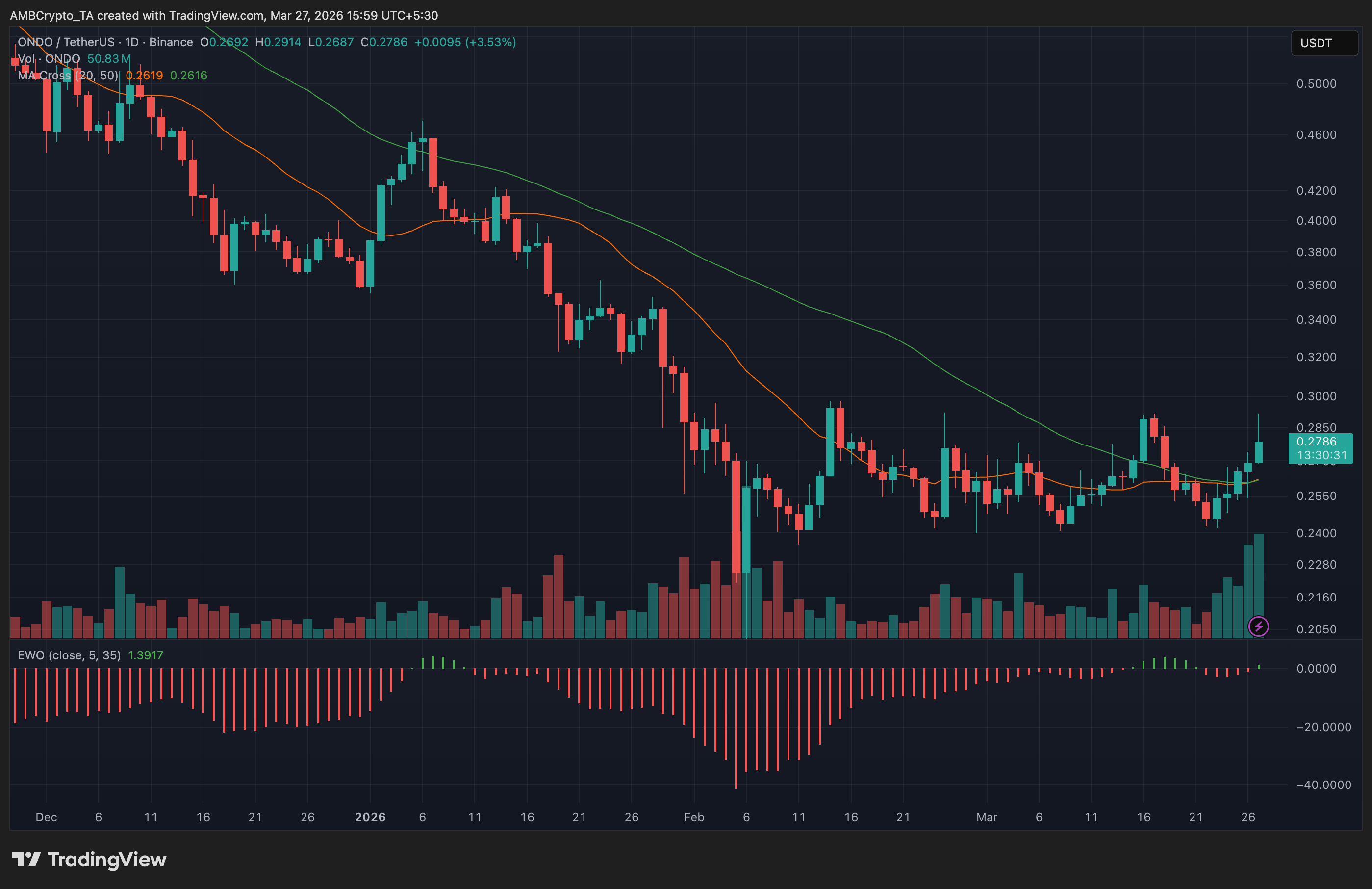
ONDO rebounded toward $0.27 after defending the $0.25 zone, with price reclaiming the 20 and 50 MAs and testing overhead pressure near $0.29.
The EWO flipped into positive territory while rising volume supported the latest move, signaling strengthening bullish momentum after a prolonged downtrend.
What you should know:
ONDO traded around $0.27 after bouncing from the $0.25–$0.26 region, where buyers stepped in following weeks of decline. The MA structure still reflected a broader downtrend, but price recently climbed back above both the 20 and 50 MAs, indicating improving short-term control. The EWO turned positive for the first time in weeks, while expanding volume on green candles confirmed active participation behind the recovery.
On the fundamental side, momentum aligned with Ondo’s ETF tokenization push with Franklin Templeton, alongside expansion of tokenized equities via Hyperliquid and growing dominance in the RWA sector with over $700M in TVL.
If ONDO holds above $0.26, it may challenge $0.29–$0.30, while $0.25 remains key support to watch.
Canton (CC)
Key points:
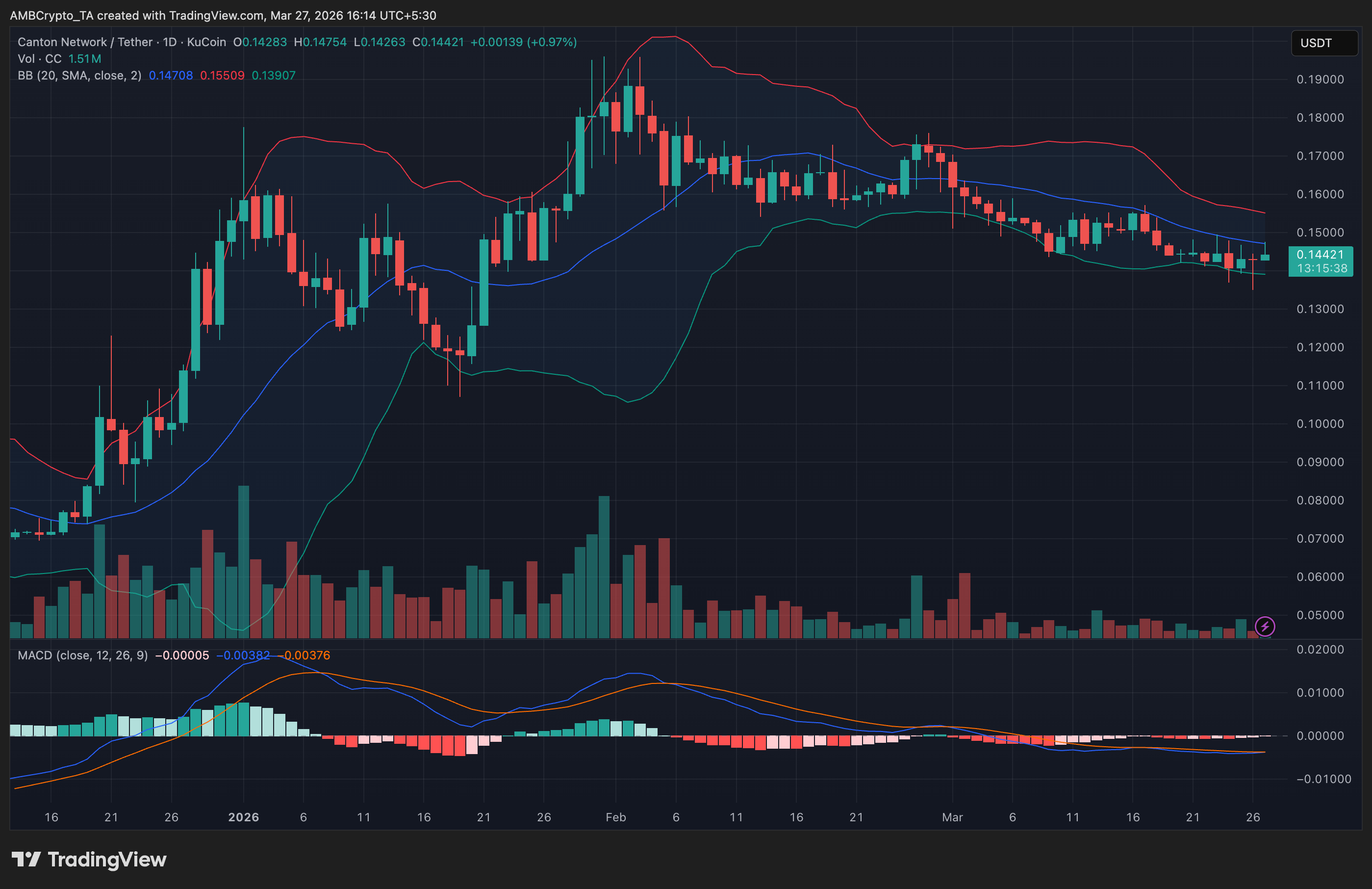
CC steadied around $0.14 after a pullback from $0.18, with price clustering near the middle Bollinger Band and struggling to reclaim the $0.15–$0.16 zone.
The MACD showed fading bearish pressure as the histogram compressed, while low volume signaled a pause rather than a confirmed reversal.
What you should know:
After sliding from its recent highs, CC settled into a tighter range near $0.14, where price action began to compress around the middle Bollinger Band. Volatility cooled noticeably, hinting at consolidation rather than continued aggressive selling. The MACD remained in negative territory, but the shrinking histogram pointed to weakening downside momentum as sellers gradually lost control.
Despite the muted technical setup, institutional developments offered a stronger backdrop. Canton integrated LayerZero to enable compliant cross-chain transfers of tokenized assets, while Visa joined as a Super Validator to support large-scale on-chain settlement. Ongoing token burns tied to institutional usage further reinforced the network’s activity.
If buyers defend $0.14, a move toward $0.15–$0.16 is possible, while losing this level may extend the current range lower.
Bitcoin Cash (BCH)
Key points:
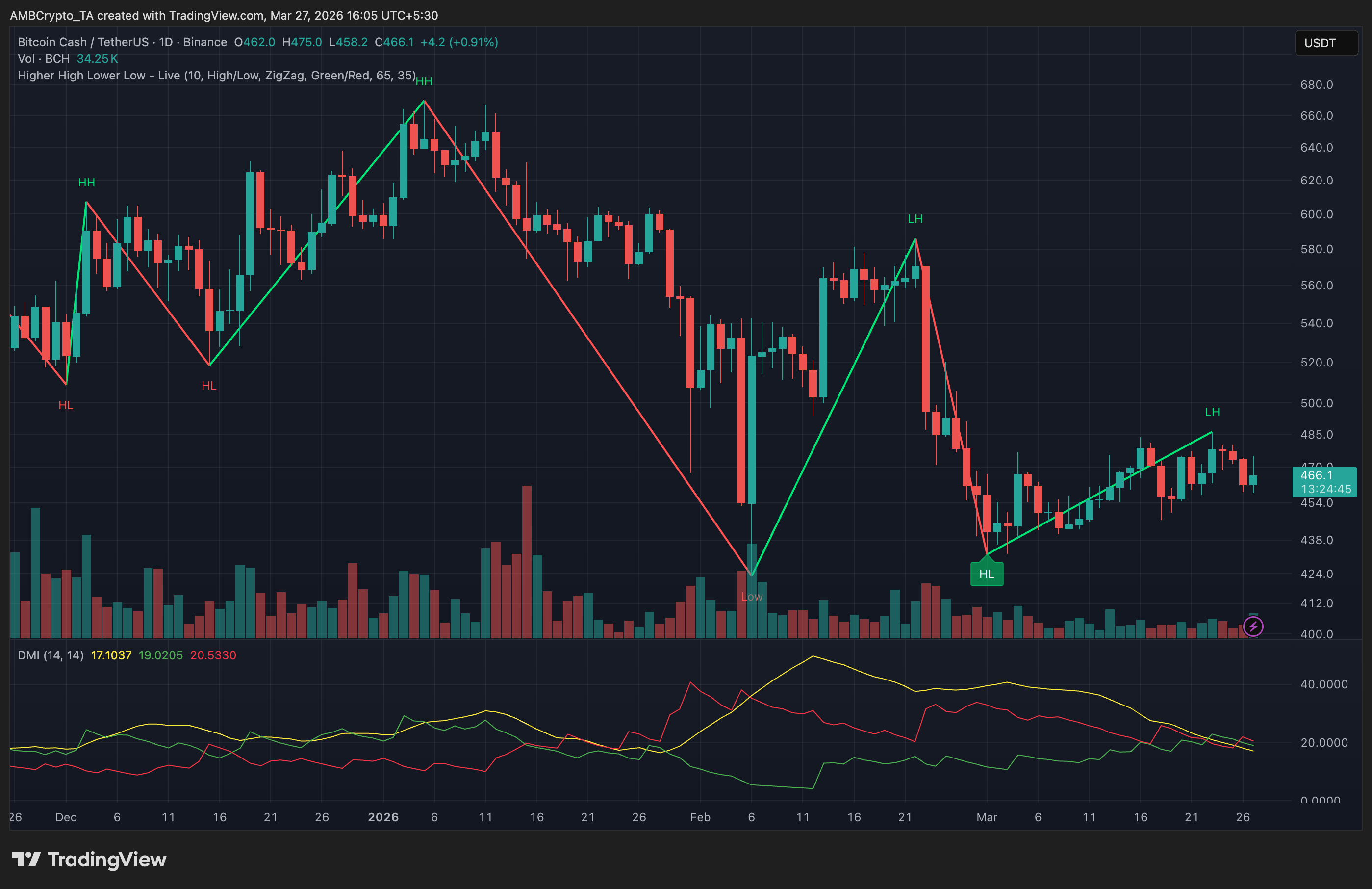
After a volatile stretch, BCH stabilized near $466, with price carving out higher lows despite a prior lower high, signaling a developing recovery phase rather than a confirmed uptrend.
The DMI showed weakening bearish dominance as the negative DI eased, while the positive DI began to recover, hinting at a gradual shift in directional momentum.
What you should know:
Bitcoin Cash attempted to regain footing following its earlier downtrend, with price action forming a sequence of higher lows around the $430–$450 range. However, the structure remained capped by a lower high near $580, keeping the broader trend undecided.
The DMI reflected this transition, as selling pressure cooled and buyers started to re-enter, though without strong conviction yet. Volume remained relatively stable, suggesting accumulation rather than aggressive breakout activity.
On the catalyst side, renewed attention around the upcoming May 15 “Layla” upgrade, which aims to enhance transaction speed and restore full scripting functionality, alongside continued whale accumulation trends, likely supported the recent price stability.
For now, $440 acts as immediate support, while a move above $480 could open the path toward reclaiming a higher high.
How was today's newsletter? |