- Unhashed Newsletter
- Posts
- Bitcoin crash cycles are over?
Bitcoin crash cycles are over?

Reading time: 5 minutes
Elon Musk’s X moves to auto-lock crypto posts amid scam surge

Key points:
X will auto-lock accounts posting about crypto for the first time, requiring verification before further activity.
The feature targets phishing-driven account takeovers used to promote scam tokens and fake projects.
News - Elon Musk’s X is preparing a new safeguard to curb a growing wave of crypto scams, introducing an auto-lock feature for accounts that mention cryptocurrency for the first time.
Under the upcoming system, such accounts will be temporarily restricted until users complete additional verification. X’s Head of Product Nikita Bier said the goal is to eliminate the primary incentive behind these attacks, which often rely on compromised profiles suddenly promoting crypto-related content.
The move follows a spike in phishing campaigns where users receive emails posing as copyright violation notices. These messages redirect victims to fake login pages designed to capture credentials and two-factor authentication codes.
How the scams work - Once access is gained, attackers quickly lock out the original owner and begin promoting fraudulent tokens, memecoins, or fake airdrops. Because the posts originate from legitimate accounts, followers are more likely to trust them.
In one recent case, a user lost control of their account shortly after interacting with such an email, with scammers immediately pushing crypto-related content. In that same case, the user said more than 1,300 additional reports had been logged between two support requests, underscoring the scale of the issue.
Why this matters - By restricting first-time crypto posts, X aims to make hijacked accounts far less effective for scams. The company has previously deployed bot purges and detection systems, but this approach targets the tactic at its starting point.
Cathie Wood says Bitcoin’s 85% crash era is over, $761K target stands

Key points:
Cathie Wood says Bitcoin’s extreme crash cycles are unlikely to return as institutional adoption reshapes market behavior.
Ark Invest maintains a $761,900 BTC target by 2030, supported by rising ETF and corporate holdings.
News - Cathie Wood believes Bitcoin is entering a more stable phase, with institutional capital reshaping its long-term behavior.
Speaking to CNBC, the Ark Invest CEO said Bitcoin has moved beyond its early boom-and-bust cycles, where drawdowns of 80% to 95% were common. She argued that such extreme declines are unlikely going forward, as the asset evolves into a more established financial system.
Even a 50% correction, once considered severe, is now seen as manageable within the crypto ecosystem, reflecting a shift in market structure and broader participation.
At the time of reporting, Bitcoin traded at $67,230, remaining below $70,000 and roughly 47% under its October 2025 peak of $126,080.
Institutions recast Bitcoin’s risk profile - Ark Invest links this shift to rising institutional exposure. U.S. spot Bitcoin ETFs and public companies now hold about 12% of total supply, up from 8.7% a year earlier.
ETF holdings rose from 1.12 million BTC to 1.29 million BTC in 2025, while corporate treasuries expanded from 598,000 BTC to 1.09 million BTC. Wood argued that broader institutional participation is reducing extreme volatility.
Some analysts still expect deeper corrections, with one projection pointing to a potential $34,000 bottom. However, Wood maintains that the era of 85% collapses is over.
Long-term bet remains intact - Ark Invest continues to project a $16 trillion Bitcoin market cap by 2030, implying a price of $761,900 and about 63% annual growth over five years.
The firm recently trimmed its most bullish estimate, citing the expanding role of stablecoins.
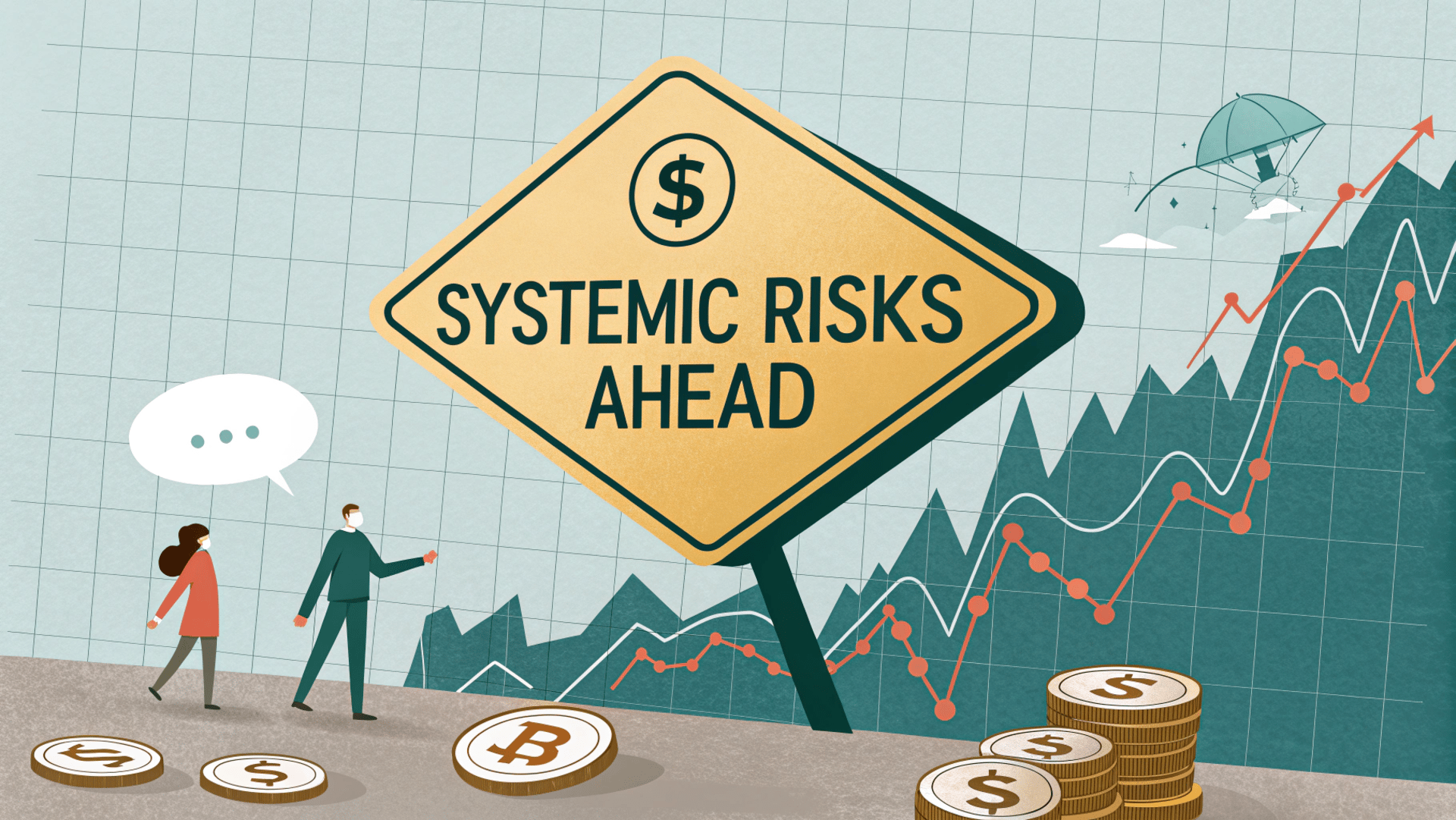
IMF warns tokenization could trigger systemic risks as market scales
Key points:
The IMF warns tokenized finance may introduce systemic risks despite improving efficiency and transparency.
Fragmentation, faster crisis spread, legal gaps, and stablecoin-driven pressure on emerging markets are key concerns.
News - The International Monetary Fund has flagged rising risks in tokenized finance, warning that its impact on global financial stability remains uncertain even as adoption accelerates.
In a recent note, IMF Financial Counselor and Director of the Monetary and Capital Markets Department Tobias Adrian described tokenization as a structural shift in how trust, settlement, and risk management function. While the technology can reduce costs and improve access, it also shifts risk toward shared infrastructure and automated systems.
The IMF outlined four core vulnerabilities. Fragmentation across platforms without common standards could split liquidity and reduce efficiency. Continuous settlement and automated margin calls may speed up how financial shocks spread. Cross-border transactions create legal uncertainty, as resolution frameworks remain jurisdiction-specific. Meanwhile, dollar-based stablecoins could increase capital volatility and weaken monetary sovereignty in emerging markets.
Regulatory tension builds - The Fund noted that while tokenization improves transparency and cross-border efficiency, faster execution leaves less time to respond during market stress.
It also pointed to a growing divide in approach. Regulatory frameworks are being built around permissioned systems with control points, while some jurisdictions are moving toward integrating tokenized assets on permissionless blockchains. Much of today’s institutional RWA activity remains concentrated on a few public chains like Ethereum, adding another layer to fragmentation and oversight concerns.
Growth raises the stakes - Tokenized real-world assets now stand around $26.7 billion on-chain, with holder participation continuing to rise.
With projections ranging from $2 trillion to $16 trillion by 2030, the IMF warned that the window to set global standards is narrowing as financial systems move toward a 24/7, automated model.
Ethereum Foundation locks $143M in ETH as treasury strategy shifts

Key points:
The Ethereum Foundation has staked about $143 million in ETH, nearly completing its 70,000 ETH target.
This changes its strategy from selling ETH to generating yield while strengthening network security.
News - The Ethereum Foundation has accelerated its staking push, committing roughly $93 million in ETH in its latest move and bringing its total staked position to about $143 million.
This puts the foundation just shy of completing its 70,000 ETH target, with over 69,500 ETH now deposited into the Beacon Chain. The latest allocation was executed in multiple batches, marking one of its largest single staking actions.
The shift reflects a broader change in treasury strategy. Instead of relying on periodic ETH sales to fund operations, the foundation is now positioning staking rewards as a recurring income stream. At current rates, the staked ETH could generate roughly $3.9 million to $5.4 million annually.
From treasury sales to yield generation - The move follows criticism over past ETH sales that often created visible sell pressure. Under its updated treasury policy, the foundation aims to preserve its core holdings while funding research, grants, and ecosystem development through yield.
Despite nearing its initial target, the foundation still holds more than 100,000 ETH outside staking. It has not indicated whether it will expand the program or maintain those holdings as liquid reserves.
Supply tightens, confidence builds - The staking push aligns with a broader rise in ETH locked across the network, reducing liquid supply and reinforcing validator participation.
By putting dormant treasury assets to work, the foundation is not only supporting network security but also signaling long-term confidence in Ethereum’s proof-of-stake model.
The 15-Minute Retirement Plan

Retirement savings face two quiet threats: cash flow gaps and inflation eroding purchasing power over time. The 15-Minute Retirement Plan helps investors with $1,000,000 or more account for both and build a portfolio designed to last the distance.
More stories from the crypto ecosystem
Crypto scams uncovered
Fake Ledger wallets tricked users until the DOJ clawed funds back: The U.S. Attorney’s Office recovered over $600,000 in crypto from a fraud scheme that sold counterfeit hardware wallets mimicking Ledger devices. Victims unknowingly used pre-compromised wallets, allowing attackers to drain funds as soon as assets were transferred.
Ronin’s $600M breach came down to just five validator approvals: The 2022 hack of the Ronin Network, used by Axie Infinity, allowed attackers to steal over $600 million after compromising 5 out of 9 validator nodes, enabling fraudulent withdrawals. It exposed how validator centralization can become a critical single point of failure.
A front-end attack drained $120M from users who trusted the interface: In December 2021, the BadgerDAO exploit used a malicious front-end injection that tricked users into signing transactions, leading to losses of over $120 million (initial estimates were ~$60M). The incident showed how attackers can bypass smart contract security by targeting user interfaces instead.
Forget Nvidia — These 5 Stocks Could Soar Next
MarketBeat's analysts just released their five highest-rated stocks for March 2026, and none of the usual suspects made the cut. Not Apple. Not Nvidia. See which companies earned a spot on this month's list.
Top 3 coins of the day
Algorand (ALGO)

Key points:
ALGO surged toward $0.119 after breaking out of its prior range, with momentum accelerating on strong buying interest.
The Madrid Ribbon flipped into a wide bullish expansion while the Squeeze Momentum bars strengthened, confirming sustained upside pressure.
What you should know:
ALGO rallied sharply after rebounding from the $0.080 base, with price rapidly clearing the $0.100 zone and pushing close to $0.120. The move gained traction as the Madrid Ribbon shifted from compressed red to a fully expanded green setup, signaling a decisive trend reversal. Momentum also built steadily, with the Squeeze indicator printing stronger green bars as volume spiked alongside the breakout. The surge aligned with renewed interest following a Google Quantum AI paper highlighting Algorand’s post-quantum capabilities, along with growing institutional traction through integrations like Quantoz’s Visa-linked payments. If momentum holds, $0.120 remains the immediate resistance, while $0.105 serves as the key support to watch.
Pepe (PEPE)

Key points:
PEPE stabilized near $0.00000346 after forming a higher low, hinting at early recovery within its recent range.
DMI showed improving +DI strength while ADX remained subdued, indicating a developing move but no strong trend yet.
What you should know:
PEPE showed signs of stabilization after its recent decline, with price forming a higher low near the $0.00000320 zone before edging higher toward $0.00000346. While the broader structure remained range-bound, the shift toward higher lows suggested buyers were beginning to step in earlier. Momentum also improved slightly, with +DI gaining ground over -DI, though ADX stayed low, reflecting limited trend strength. Volume remained moderate, pointing to gradual accumulation rather than aggressive buying. This behavior aligned with on-chain trends showing whale accumulation and reduced exchange sell pressure. For now, $0.00000350 remains the immediate resistance, while $0.00000320 serves as the key support to hold.
Hedera (HBAR)

Key points:
HBAR rebounded toward $0.090 after defending the $0.084 zone, showing early signs of stabilization.
The 9-day SMA turned supportive while the Awesome Oscillator printed green bars below zero, signaling improving but still developing momentum.
What you should know:
HBAR attempted a recovery after sliding to the $0.084 region, with price climbing back above the 9-day SMA and testing the $0.090 area. The bounce reflected easing selling pressure, supported by the Awesome Oscillator shifting to green bars while remaining below zero, indicating early bullish momentum without full confirmation. Volume picked up modestly during the move, suggesting cautious buying rather than aggressive inflows. The recovery aligned with renewed attention following Hedera’s enterprise push, including McLaren joining its governing council and ongoing DevDay announcements around network upgrades. For continuation, $0.092 remains the immediate resistance, while $0.087 acts as the key support.
How was today's newsletter? |