- Unhashed Newsletter
- Posts
- Bitcoin tolls for oil tankers?
Bitcoin tolls for oil tankers?

Reading time: 5 minutes
NYT revives Satoshi hunt, Adam Back pushes back

Key points:
Adam Back denied claims that he is Bitcoin’s creator after a NYT investigation named him the strongest Satoshi candidate.
Despite detailed writing analysis and historical overlaps, critics say the case remains circumstantial without cryptographic proof.
News - A fresh attempt to identify Satoshi Nakamoto has reignited debate across the crypto community, with a New York Times (NYT) investigation pointing to British cryptographer and Blockstream CEO Adam Back as the most likely match.
Led by John Carreyrou, the report analyzed decades of mailing list activity using stylometric techniques across more than 130,000 posts. It narrowed hundreds of candidates down to Back, citing shared phrasing, formatting quirks, and early discussions resembling Bitcoin’s design.
Back rejected the claim, stating that similarities stem from his long-standing work in cryptography, privacy, and electronic cash research since the 1990s. “I’m not Satoshi,” he said, attributing overlaps to shared cypherpunk ideas.
Evidence, gaps, and timing - The investigation highlighted Back’s role in creating Hashcash and outlining key elements of decentralized digital money years before Bitcoin. It also noted his absence from mailing list discussions around Bitcoin’s 2008 debut and his later public involvement.
However, the case remains unresolved without cryptographic proof.
Back also recently addressed Bitcoin’s future risks, saying quantum computing is not an immediate threat but urging gradual preparation, including a potential decade-long transition to quantum-resistant keys.
Why the mystery holds - Skepticism remains strong. Analysts and early Bitcoin contributors questioned stylometric methods, noting that many cypherpunks shared similar ideas and language.
Others warned that identifying Satoshi could pose real-world risks. Back echoed that view, suggesting the continued anonymity of Bitcoin’s creator may benefit its positioning as a distinct digital asset class.
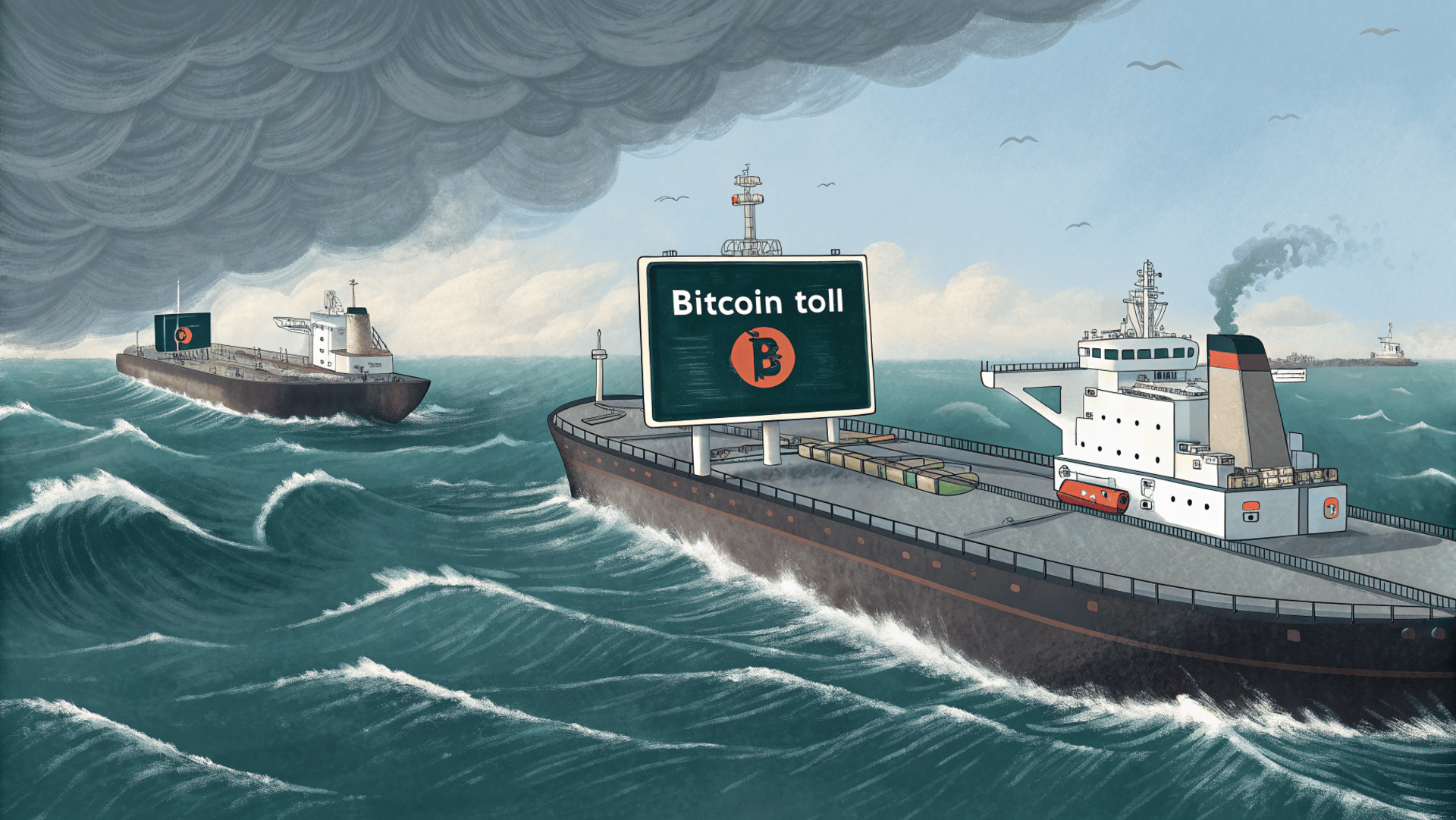
Iran eyes Bitcoin tolls for Hormuz oil ships: FT
Key points:
Iran is reportedly considering charging oil tankers Bitcoin-based transit fees through the Strait of Hormuz during a two-week ceasefire.
The move could bypass sanctions, challenge dollar dominance in oil trade, and raise tensions with global shipping players.
News- Iran is weighing a proposal to charge oil tankers in Bitcoin for passage through the Strait of Hormuz, according to a report by the Financial Times (FT), following a temporary ceasefire with the United States.
Under the plan, ships carrying oil would pay a toll of $1 per barrel, potentially reaching up to $2 million per fully loaded tanker. Vessels must first submit cargo details via email, after which Iranian authorities assess the shipment and issue payment instructions. Operators would then have only seconds to complete the Bitcoin transaction, a design intended to prevent tracing or seizure under sanctions. Empty tankers would pass without charge.
Sanctions workaround or strategic leverage? - Iranian officials said the system would help monitor cargo during the ceasefire and prevent weapons transfers. At the same time, crypto-based payments allow Tehran to bypass dollar-linked financial channels, reinforcing its use of digital assets under sanctions pressure.
The proposal also signals Iran’s intent to retain control over the waterway. Reports suggest vessels may be routed closer to Iran’s coastline, raising risks for Western and Gulf-linked shipping firms.
Global stakes in focus - Roughly a third of the world’s crude oil supply passes through the strait, meaning any shift in toll enforcement or payment methods could ripple across energy markets. The plan may also face resistance from regional exporters, while its implications for dollar dominance in oil trade remain uncertain as negotiations evolve.
Ceasefire rally lifts crypto, but cracks begin to show

Key points:
Bitcoin climbed above $70,000 after the U.S.-Iran ceasefire, but leverage data and weak institutional flows point to a cautious rally.
Zcash led altcoin gains with a sharp surge, though positioning and technical signals hint at potential downside risks.
News - Crypto markets jumped after a surprise U.S.-Iran ceasefire, pushing Bitcoin above $70,000 and triggering over $600 million in liquidations, largely from bearish positions caught off guard. The move briefly lifted BTC toward the $72,000 to $73,000 range, while altcoins rallied alongside broader risk assets.
Yet beneath the surface, conviction appears uneven.
Leveraged long positions on Bitfinex remain elevated above 80,000 BTC, near multi-year highs, even as prices recover. Historically, such positioning has acted as a contrarian signal, often building during stress and easing as prices rise. At the same time, the Coinbase Bitcoin Premium Index continues to swing between premium and discount, suggesting inconsistent demand from U.S. investors.
Altcoins surge, risks build - Among altcoins, Zcash stood out with gains of over 20% to 30%, supported by strong breakout volume and accumulation from large holders. However, derivatives data shows a sharp rise in open interest alongside negative funding rates, indicating aggressive short positioning.
That divergence sets up a fragile balance. A continued rally could trigger short liquidations and extend gains, but failure to sustain momentum may expose downside levels, with large clusters of leveraged longs sitting below current prices.
Signal vs speculation - Separate from price action, three newly created wallets reportedly made nearly $485,000 betting on a ceasefire outcome on Polymarket shortly before the announcement. The activity has raised concerns around potential insider trading.
Calm above, tension below - Volatility has eased across crypto and traditional markets, while equities and crypto-linked stocks have moved higher. Still, Bitcoin remains within its broader range, and uncertainty around the ceasefire’s durability keeps the rally on fragile footing.
White House report backs crypto in stablecoin yield clash
Key points:
White House economists found banning stablecoin yield would barely boost bank lending, challenging core banking industry claims.
The findings could influence stalled negotiations around the Clarity Act, where crypto firms and banks remain divided.
News - A new report from the White House’s Council of Economic Advisers strengthens the crypto industry’s position in the ongoing debate over stablecoin yields, arguing that restricting such rewards would have minimal impact on the banking system.
The analysis found that banning yield on stablecoins would increase total bank lending by about $2.1 billion, or roughly 0.02%, with community banks seeing around $500 million in additional lending. These findings directly counter claims that yield-bearing stablecoins could drain deposits and weaken credit creation.
Banking fears vs economic data - Banking groups have warned that stablecoin yield could pull funds away from deposits, especially from smaller lenders. However, the report suggests those concerns may be overstated.
Funds used to purchase stablecoins are often reinvested into assets like Treasury bills and ultimately flow back into the banking system, limiting any lasting impact on overall deposits. Even under extreme assumptions, such as a significantly larger stablecoin market, the effect on lending remains limited.
Costs fall on users, not banks - While gains for banks appear marginal, the report estimates a net welfare loss of about $800 million if stablecoin yield is banned, as users lose access to competitive returns.
The findings arrive as lawmakers continue debating updates to the Clarity Act, with stablecoin yield emerging as a key sticking point in broader crypto regulation efforts.
Protect Client Trust in Volatile Markets

When markets get shaky, advisors don’t just manage portfolios. They manage a surge of client emails, questions, and last-minute meetings. BELAY’s free Financial Advisor’s Delegation Guide shows how better delegation protects responsiveness, reduces bottlenecks, and helps your firm stay client-facing when pressure and volume rise fast across the entire firm.
More stories from the crypto ecosystem
Did you know?
Crypto ATMs are becoming a fraud flashpoint, not just a convenience tool: Australia’s AUSTRAC identified 90 scam victims, money mules, and suspected offenders among the country’s top crypto ATM users, with one woman in her 70s depositing more than A$430,000 after romance and investment scams.
El Salvador’s volcano mining experiment turned into real state-owned Bitcoin reserves: El Salvador has mined nearly 474 BTC since 2021 using geothermal power from the Tecapa volcano, adding directly to the government’s Bitcoin holdings.
Tron, not Bitcoin, became the bigger crypto trail in one terror-finance crackdown: Israel’s crypto seizures revealed a shift toward Tron wallets, with 143 wallets frozen between July 2021 and October 2023 tied to suspected terrorist financing activity.
Trade from the subway, golf course, or toilet
Liquid enables users to go long or short on any market from your phone or desktop 24/7.
No matter what time of day it is or where you are, you can monitor the situation with Liquid.
Top 3 coins of the day
NEAR Protocol (NEAR)
Key points:
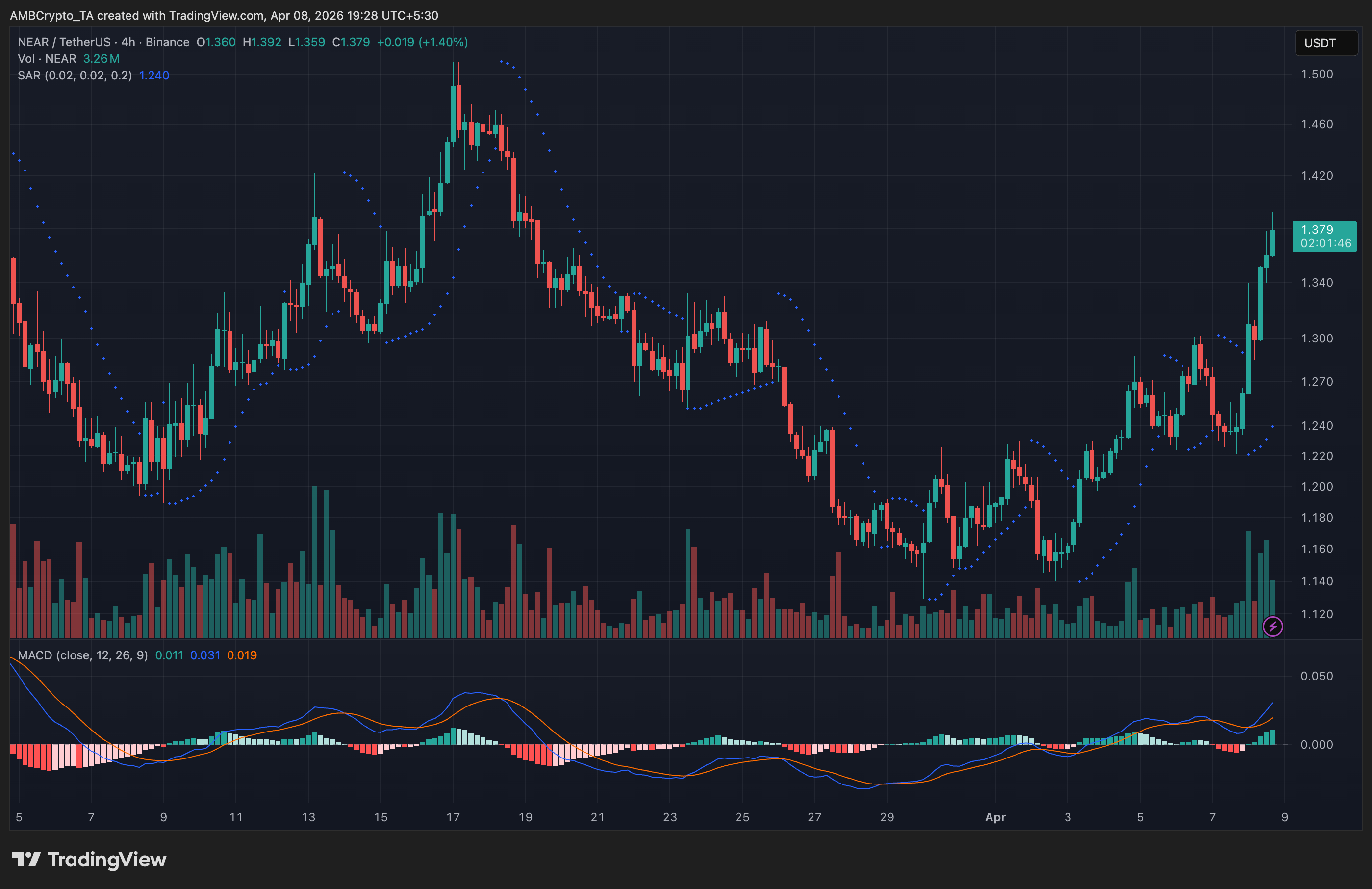
NEAR climbed to $1.37 after breaking out of its $1.29–$1.30 base, with a strong bullish candle pushing price toward local highs.
Momentum strengthened as MACD expanded above the zero line, while Parabolic SAR remained below price and volume picked up during the move.
What you should know:
NEAR’s latest advance unfolded as a sharp expansion following a period of tight consolidation between $1.22 and $1.30, with buyers stepping in aggressively and driving price toward $1.37. The move aligned with rising interest in AI-linked tokens, supported by NEAR’s positioning in the agentic economy and growing ecosystem activity, including over $2.1B processed on-chain in the past month. On the chart, the Parabolic SAR stayed below price, reinforcing the ongoing uptrend, while the MACD showed increasing separation above the zero line, signaling accelerating momentum. Volume also increased compared to prior sessions, confirming participation. Holding above $1.30 keeps the structure constructive toward $1.50, while a drop below $1.22 would weaken the current setup.
OFFICIAL TRUMP (TRUMP)
Key points:
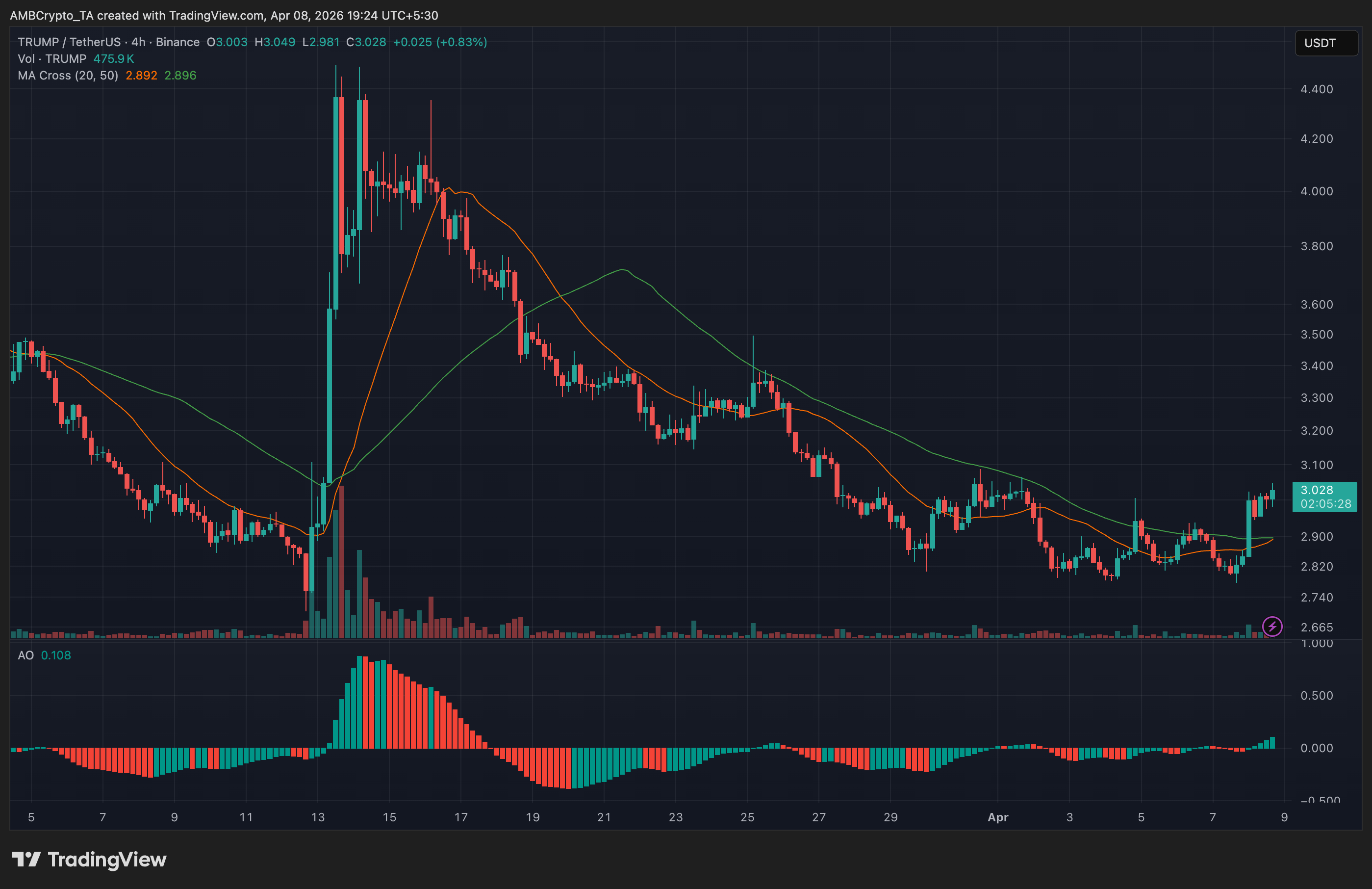
TRUMP hovered near $3.02 after climbing off the $2.80 floor, with price pressing into a nearby resistance band.
The Awesome Oscillator shifted into green territory, while the 20 MA tightened toward the 50 MA and volume remained steady.
What you should know:
TRUMP’s recent price behavior showed buyers gradually stepping back in after an extended slide, with the token lifting from sub-$2.80 levels and pushing into the $3.00–$3.10 range. This move aligned with a broader market upswing triggered by U.S.–Iran ceasefire headlines, which tend to amplify flows into high-beta tokens like TRUMP. At the same time, positioning ahead of the April 10 Mar-a-Lago qualification deadline drove accumulation among larger wallets seeking event access. Technically, the 20 MA closed the gap with the 50 MA but has not crossed, reflecting early recovery rather than a confirmed trend shift. The Awesome Oscillator printed strengthening green bars, signaling improving momentum. A sustained move above $3.10 would open room for a test toward $3.20, while rejection near current levels could drag price back toward $2.80 support.
Internet Computer (ICP)
Key points:
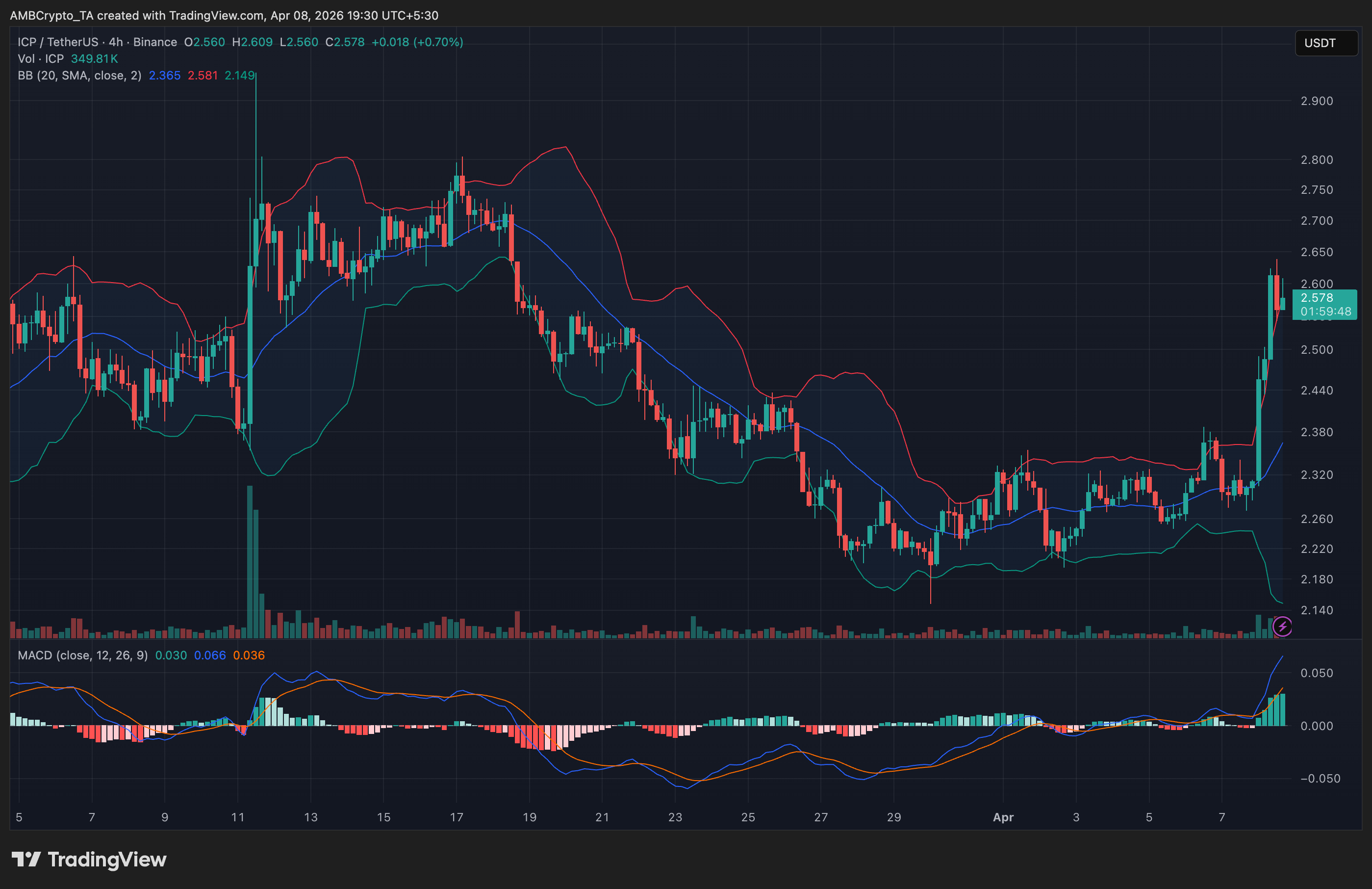
ICP surged to $2.57 following a rapid upward repricing from the $2.30 range, with price briefly stretching beyond the upper Bollinger Band.
Bullish momentum intensified as MACD expanded above the zero line, while a sharp rise in volume confirmed strong participation.
What you should know:
A quiet stretch of sideways trading gave way to a sudden influx of buyers, lifting ICP sharply into the $2.60 zone before momentum began to cool. The move followed the approval of the Mission 70 proposal, which targets a 70% reduction in token inflation, alongside broader market strength tied to easing geopolitical tensions. On the chart, candles pushed beyond the upper Bollinger Band as volatility expanded, hinting at short-term exhaustion after the spike. The MACD remained firmly in bullish territory with growing histogram bars, while volume rose sharply during the breakout phase. Acceptance above $2.50 would signal continued demand absorption, whereas fading activity could drag price back toward the $2.30 range.
How was today's newsletter? |