- Unhashed Newsletter
- Posts
- Crypto toll scam hits Hormuz ships
Crypto toll scam hits Hormuz ships
In partnership with


Reading time: 5 minutes
Crypto toll scam hits Hormuz chaos, ships at risk

Key points:
Fraudsters posing as Iranian authorities are demanding Bitcoin and USDT from stranded ships for “safe passage.”
Even attempted payments could expose firms to sanctions risks, as the broader oil disruption deepens.
News - Shipping companies stuck near the Strait of Hormuz are being targeted by a new wave of crypto-related fraud, with scammers impersonating Iranian officials and demanding payments in Bitcoin or USDT for transit clearance. Maritime risk firm MARISKS flagged the scheme, warning that these messages are not legitimate, despite mimicking official language and procedures.
The scam appears to exploit earlier reports that Iran was considering crypto-based tolls for vessels during the conflict. Fraudulent messages instruct operators to submit documentation for review before being assigned a crypto “fee,” promising safe passage at a scheduled time.
A crisis creating perfect conditions - The broader disruption has left vessels increasingly exposed. The Strait of Hormuz, once responsible for nearly 20% of global oil flows, remains heavily constrained, with hundreds of ships and thousands of seafarers stranded.
MARISKS believes at least one vessel that may have complied with such fraudulent instructions was later fired upon while attempting to exit, underscoring that these payments offer no guarantee of safe passage.
Sanctions risk meets market strain - Experts warn that paying such fees, even unknowingly, could trigger serious legal consequences. Any transaction perceived as supporting Iranian-controlled operations may violate international sanctions, regardless of whether the recipient is legitimate or a scammer.
At the same time, the oil market strain continues to build. Analysts suggest tanker traffic may take over three months to recover even if tensions ease, with supply disruptions already pushing the system beyond earlier stress points.
Arbitrum freezes $71M, hacker moves fast

Key points:
Arbitrum froze 30,766 ETH tied to the $292M Kelp DAO exploit, limiting access to a governance-controlled wallet.
The attacker has already moved $175M in ETH across new addresses, with smaller amounts routed through THORChain and Umbra in apparent laundering attempts.
News - The fallout from the Kelp DAO exploit is escalating, with Arbitrum’s Security Council stepping in to freeze 30,766 ETH, worth about $71 million, linked to the attacker. The emergency move, carried out with input from law enforcement, transferred the funds into an intermediary wallet that can only be accessed through further governance action.
The exploit itself saw roughly 116,500 rsETH, valued near $292 million at the time, drained from Kelp DAO’s bridge infrastructure. In response, the freeze has effectively blocked access to a portion of the stolen assets, representing roughly a quarter of the total haul.
Hacker activity accelerates across Ethereum - Despite the freeze, the attacker has begun actively moving funds elsewhere. On-chain data shows around 75,700 ETH, worth roughly $175 million, being redistributed across multiple transactions and addresses. Smaller transfers have also been routed through protocols like THORChain and Umbra, suggesting attempts to obscure transaction trails.
Analysts note that such non-custodial pathways complicate tracking and recovery, especially as the attacker splits funds across addresses to reduce visibility.
DeFi impact and governance debate - The incident has rippled across DeFi. The attacker used stolen assets as collateral on Aave, contributing to potential bad debt scenarios and liquidity strain. Borrowing rates surged, while total value locked on the platform dropped sharply following the exploit.
At the same time, Arbitrum’s intervention has reignited debate around decentralization. While some praised the rapid response, others questioned whether a council with emergency powers could undermine the core principles of permissionless systems.
This AI Breakthrough Could Trigger the Next 70X Boom — And It's Not a Coin

Crypto investors already know the next wave of wealth isn't in tokens — it's in the infrastructure behind them. The $1B money manager who spotted Nvidia early just identified an AI company at the center of that shift. Watch his free presentation and get the ticker symbol before this goes mainstream.
South Korea tightens crypto oversight as CBDC push grows

Key points:
South Korea’s tax agency is seeking new software to track crypto transactions and target tax evasion ahead of its 2027 rollout.
The Bank of Korea is prioritizing CBDCs and deposit tokens, with stablecoins notably absent from its policy direction.
News - South Korea is stepping up crypto oversight, with the National Tax Service opening bids for transaction-tracking software aimed at strengthening tax enforcement. The proposed system is expected to monitor transactions in real time, trace wallet flows across exchanges, and support investigations into hidden assets, offshore activity, and unreported transfers.
The move comes as the country prepares for its delayed crypto tax framework, set to take effect in January 2027. Under the plan, gains above 2.5 million won will face a 22% levy, though the policy remains politically contested.
Central bank charts digital currency path - At the same time, the Bank of Korea is sharpening its digital finance strategy. In his first policy address, Governor Shin Hyun-song emphasized central bank digital currencies and bank-issued deposit tokens as the foundation of Korea’s evolving payment system.
Initiatives such as Project Hangang and cross-border tokenization efforts are central to that strategy. Notably, stablecoins were absent from the address, despite earlier indications they could play a complementary role.
Regulation meets market reality - The policy shift comes as lawmakers debate the Digital Asset Basic Act, which could define stablecoin issuance rules. The Bank of Korea also signaled closer scrutiny of crypto markets and non-bank finance.
Meanwhile, energy-driven volatility has unsettled traditional markets, while Bitcoin has traded within a relatively narrow range, reinforcing its appeal as a potential hedge during geopolitical stress.
EU faces pressure to speed up crypto rules as banks move ahead

Key points:
A coalition of 39 firms is urging the EU to fast-track DLT rules, warning delays could shift liquidity and market activity toward the U.S.
European banks are advancing a MiCA-compliant euro stablecoin, while investor demand for bank-based crypto access keeps building.
News - Pressure is mounting on European regulators to accelerate crypto and blockchain reforms, with a group of 39 financial firms calling for urgent changes to the EU’s Distributed Ledger Technology Pilot Regime. The coalition, which includes major players like Nasdaq and Boerse Stuttgart, wants the framework separated from a broader legislative package to avoid delays that could slow adoption.
The DLT Pilot Regime, launched in 2023, allows firms to test blockchain-based trading and settlement of assets such as stocks and bonds. Industry participants argue that current limits on asset size, issuance caps, and time-bound licenses are restricting its ability to scale.
Banks push euro stablecoin strategy - At the same time, Europe’s banking sector is advancing its own digital asset initiatives. A consortium of 12 banks, led by Qivalis, has partnered with Fireblocks to develop a euro-denominated stablecoin under the EU’s MiCA framework, targeting a launch in the second half of 2026.
The project is designed to support institutional use cases such as settlement and treasury operations, while reducing reliance on dollar-backed stablecoins, which dominate nearly all of the global market.
Regulation meets rising demand - The push for faster rulemaking comes as crypto adoption edges closer to mainstream banking. A recent survey found that 35% of European investors would consider switching banks for better crypto services, while nearly one in five expect their main bank to offer crypto access within the next three years.
At the same time, regulatory clarity remains a key barrier, even as MiCA has begun improving trust among investors.
10 AI Stocks to Lead the Next Decade

AI isn’t a tech trend – it’s a full-blown, multi-trillion dollar race, and 10 companies are already pulling ahead.
These are the innovators driving real revenue, attracting institutional attention, and positioning for massive growth.
Get all 10 tickers in The 10 Best AI Stocks to Own in 2026, free today.
More stories from the crypto ecosystem
Strategy’s 34K Bitcoin buy highlights reliance on major buyers: Is this sustainable?
Inside Bitmine’s largest Ethereum purchase since December: ‘Crypto winter is ending’
‘Security over speed’: Why Vitalik Buterin’s narrative shift matters for Ethereum
Why AI agents may be pushing Solana and Ethereum into separate roles
Interesting facts
Gold-backed crypto tokens quietly built a multi-billion dollar market: By 2026, nearly 20 gold-backed tokens had grown into a market worth around $6 billion, signaling rising demand for tokenized real-world assets beyond stablecoins.
Sanctions pressure pushed Venezuela to experiment with crypto oil payments: State oil firm PDVSA explored using digital currencies like USDT for crude exports in 2024, reflecting how geopolitical constraints are driving real-world crypto adoption.
Telegram’s crypto push quietly turned TON into a breakout ecosystem: TON surged in 2024 as its integration with Telegram opened crypto access to an estimated 900 million users, positioning it as one of the fastest-growing networks of the year.
Defense Tech Is the New Frontier for Investors

Record defense budgets are flowing into AI, satellite infrastructure, and advanced aerospace platforms. Our free research report names 5 companies at the center of this spending shift, before Wall Street catches up.
Top 3 coins of the day
MemeCore (M)
Key points:
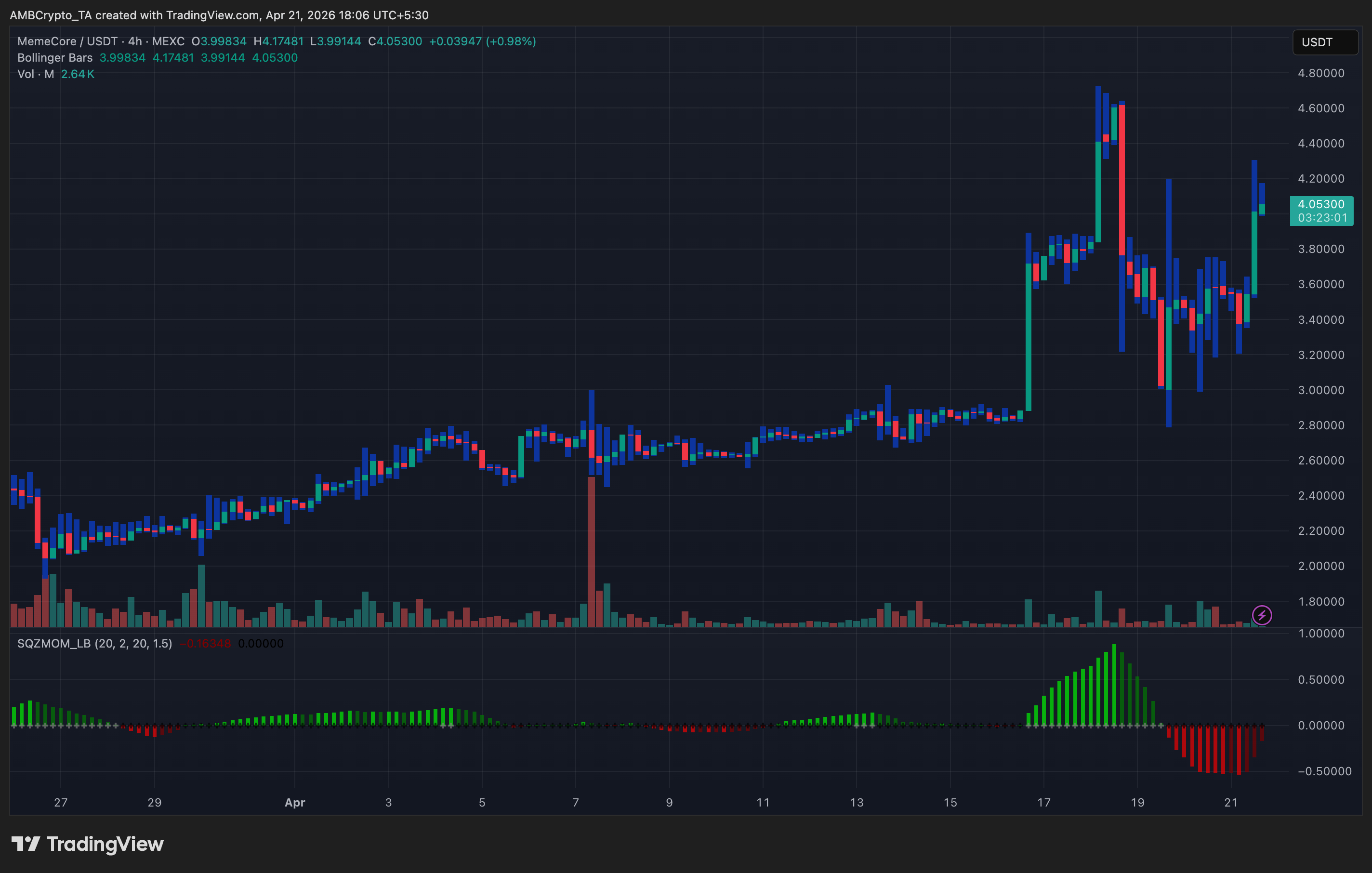
M rebounded sharply to around $4.05 after consolidating between $3.30 and $3.80, signaling a fresh attempt to reclaim lost ground.
The Squeeze Momentum Indicator remained negative despite the bounce, while volume surged again, pointing to continued volatility rather than a confirmed trend shift.
What you should know:
MemeCore rallied aggressively earlier, climbing from sub-$3 levels to above $4.50 before facing a steep rejection that dragged price back toward the $3.00–$3.20 zone. It then moved sideways with erratic swings before pushing higher again, with the latest candles testing the $4.00 area. Price approached the upper Bollinger range but has not yet confirmed a full expansion, suggesting this is a reclaim attempt rather than a breakout. The move followed renewed interest after recent network upgrades that improved transaction efficiency and community-driven defense against scrutiny surrounding supply concentration. Holding above $3.60 could support further upside, while slipping below $3.30 may reopen downside risk toward $3.00.
JUST (JST)
Key points:
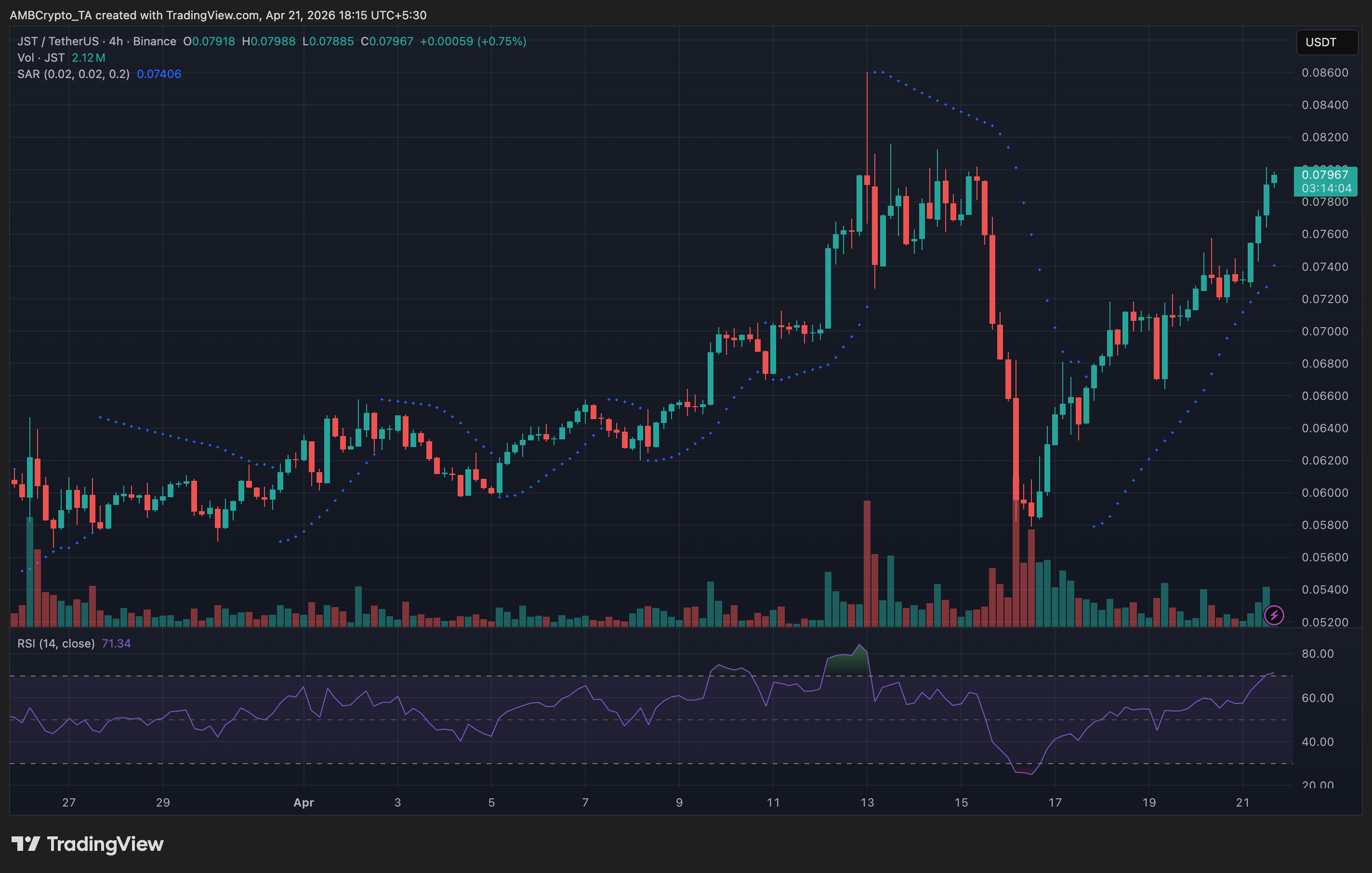
JST rebounded from the $0.058–$0.060 zone and climbed back toward $0.080, approaching a key resistance band near recent highs.
The Parabolic SAR flipped below the candles while the RSI rose above 70, reflecting strong momentum with early signs of overextension.
What you should know:
JST saw a sharp drop earlier before staging a strong recovery, with price pushing steadily higher and reclaiming the $0.075 level. The latest candles approached the $0.080 zone, signaling a retest of prior highs following a clean V-shaped rebound. This move coincided with the JustLend DAO’s mid-April burn of over 270 million tokens, which reduced circulating supply and reinforced bullish sentiment. Momentum strengthened alongside the recovery, as reflected by the RSI climbing into overbought territory, while the Parabolic SAR remained supportive below price. Holding above $0.075 could sustain the current trend, while rejection near $0.080 may lead to a pullback toward $0.070 if buying pressure cools.
Stellar (XLM)
Key points:
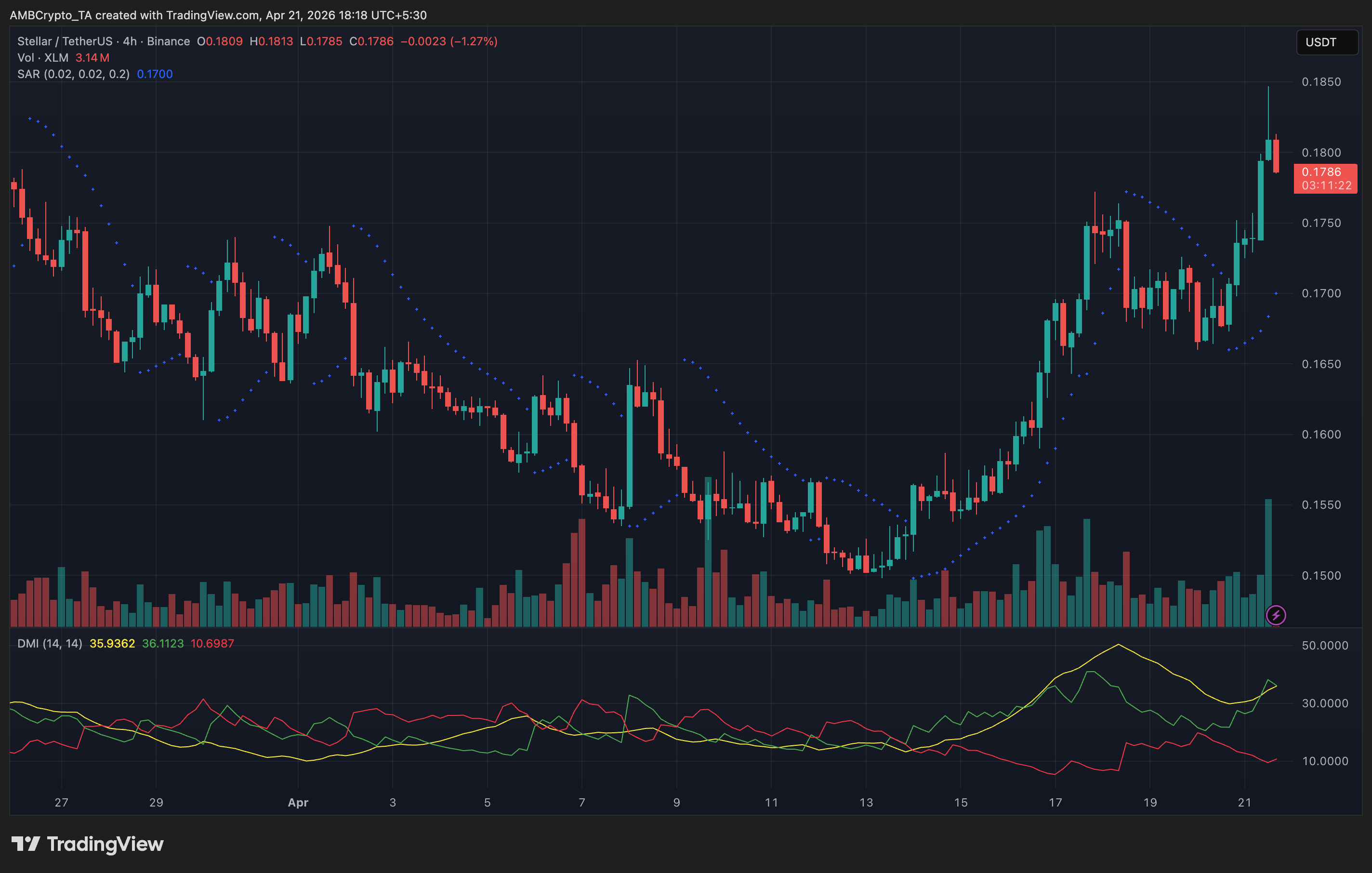
XLM advanced toward the $0.180–$0.182 range before encountering immediate resistance, with the latest candle turning red near the highs.
The Parabolic SAR stayed below price while the DMI showed +DI leading -DI with a rising ADX, confirming a strong but contested uptrend.
What you should know:
XLM reversed its earlier downtrend and climbed steadily from the $0.150 zone, forming higher highs as it approached the $0.180 level. The move was backed by consistent volume and strengthening trend signals, with the DMI indicating firm bullish control. However, the latest candle showed rejection at resistance, suggesting buyers are facing pressure near this zone. The rally coincided with a breakout above $0.180 supported by a surge in trading activity, alongside a spike in network usage that saw over 14 million transactions processed in a single day. Holding above $0.175 could keep the trend intact, while a drop below this level may pull price back toward $0.165 if momentum weakens.
How was today's newsletter? |