- Unhashed Newsletter
- Posts
- Did a weather sensor move markets?
Did a weather sensor move markets?

Reading time: 5 minutes
Toobit DEX+ lists pre-IPO assets with 24/7 stablecoin trading

Offers tokenised exposure to firms like SpaceX and OpenAI with instant liquidity
Secondary market activity grows, with 2026 volume projected at $250B
Toobit has introduced pre-IPO assets on its DEX+ interface, allowing traders to gain exposure to private companies such as SpaceX, OpenAI, and Anthropic, settled entirely in stablecoins. This move essentially removes traditional barriers associated with private equity, including limited access and long lock-up periods, by enabling around-the-clock, on-chain trading with immediate liquidity.
The launch comes as interest in secondary markets and alternative investment opportunities accelerates. Users can enter or exit positions without relying on intermediaries or specialised brokerage accounts, while accessing emerging sectors like AI and blockchain through a simplified interface.
Toobit is an award-winning DEX, known for its deep liquidity and focus on providing a secure, transparent trading experience.
FTX’s $3B missed bet fuels fresh debate

Key points:
FTX’s bankruptcy estate sold a 5% Cursor stake for $200,000 in April 2023, a holding now implied to be worth about $3 billion after SpaceX secured rights to acquire the AI startup at a $60 billion valuation.
The missed upside has revived scrutiny over FTX’s early asset liquidations, while SBF simultaneously withdrew his retrial motion as his broader appeal continues.
News - A routine bankruptcy sale has turned into a fresh flashpoint in the FTX saga. Alameda Research acquired the stake in Anysphere in April 2022 for $200,000, and the FTX estate sold it in April 2023 for the same amount. Following SpaceX’s proposed acquisition terms, that position would now be worth roughly $3 billion.
The episode has reignited debate over whether FTX administrators sold certain assets too early during the bankruptcy process. Critics point to other reportedly missed gains across holdings such as Anthropic, SpaceX, Solana, and Robinhood, adding to questions around how much upside creditors forfeited despite being repaid in dollar terms plus interest.
A bankruptcy decision under new scrutiny - The Cursor reversal has strengthened criticism that some early disposals left substantial upside on the table. The implied 15,000x jump in value has made the sale one of the sharpest examples yet of opportunity costs tied to the estate’s restructuring strategy.
At the same time, the case has reopened discussion around Sam Bankman-Fried’s (SBF) claims that value was destroyed during bankruptcy, even as courts upheld fraud convictions tied to FTX’s collapse.
Legal pressure still lingers - Separately, SBF withdrew his motion seeking a new trial, saying he may revisit it after decisions on his appeal and request for judicial reassignment. With pardon speculation, appeals, and bankruptcy criticism all resurfacing, the FTX story remains far from closed.
Paris Polymarket weather scandal triggers Vitalik Buterin’s oracle warning

Key points:
Suspicious temperature spikes at Paris Charles de Gaulle Airport helped Polymarket traders collect roughly $34,000 to $37,000, prompting a Météo-France complaint over suspected data tampering.
The episode renewed scrutiny of single-source prediction markets, with Vitalik Buterin urging multi-source settlement to reduce manipulation risks.
News - A pair of Paris weather contracts has pushed Polymarket back into controversy after abrupt temperature spikes on April 6 and April 15 triggered sizable payouts and a formal French investigation. The anomalies helped settle market outcomes in favor of a handful of traders, while nearby stations reportedly showed no similar readings.
Météo-France said it filed a complaint with the Roissy Air Transport Gendarmerie Brigade after reviewing sensor data and physical observations linked to the station. Meteorologists cited the isolated nature of the spikes as a major reason for suspecting outside interference, with some experts saying a portable heat source, including the widely discussed hair dryer theory, could plausibly have influenced the sensor.
One sensor, one big vulnerability - The incident has revived debate over a long-known weakness in crypto prediction markets: even if execution is automated, a single compromised data input can distort an entire market.
That concern intensified because the Paris contracts reportedly relied on one sensor, exposing a clear single point of failure.
Buterin’s fix meets the oracle problem - Vitalik Buterin said markets like these should rely on the median of at least three independent sources, while also arguing conditional markets can improve resilience and truth-seeking.
Polymarket has reportedly shifted its Paris weather resolution source to Le Bourget Airport, but the broader oracle problem remains: decentralized markets can still be undermined when one offchain data source determines the outcome.
Bitcoin near $80K faces test as ETF demand meets macro risks

Key points:
Bitcoin approached $80,000 as U.S. spot ETFs extended a seven-day inflow streak, led by BlackRock, while traders watched whether BTC could reclaim its bull market support band on the weekly close.
But rising oil-driven inflation risks, profit-taking signals, and warnings that perpetual futures, not spot demand, are driving the rally have tempered bullish conviction.
News - Bitcoin briefly pushed toward three-month highs before slipping back, leaving the upcoming weekly close in focus as traders watch whether the asset can regain its bull market support band for the first time since October 2025. The move has been supported by strong institutional flows, with U.S.-listed spot Bitcoin ETFs attracting roughly $1.9 billion over seven sessions, while BlackRock’s IBIT continued to dominate inflows.
Yet the rally’s durability is under debate. Analysts have warned much of the recent upside appears driven by derivatives positioning rather than broad spot demand, reviving concerns that momentum could fade near the $80,000 zone.
Institutional demand meets distribution risk - The ETF story has strengthened the bullish case, with rolling flow metrics turning positive across tracked periods and cumulative inflows nearing record territory. At the same time, onchain signals, including elevated short-term holder realized profits, suggest some investors may be nearing profit-taking territory.
That push and pull has left markets weighing whether institutional demand can absorb potential distribution pressure.
Oil, inflation, and the Fed loom large - Macro risks have added another layer of caution. Rising oil prices, amplified by Pentagon warnings that clearing mines in the Strait of Hormuz could take at least six months, alongside expectations the Federal Reserve will hold rates steady, have complicated the breakout narrative.
For now, Bitcoin’s path higher appears tied not just to ETF momentum, but also to whether macro headwinds ease enough for spot demand to take over where leveraged positioning may be losing steam.
Ethereum eyes $2.6K as whale buying meets resistance test

Key points:
Aggressive taker buying, Bitmine’s expanding ETH accumulation, and renewed whale inflows have strengthened the case for Ethereum to challenge the $2,475 to $2,634 liquidity zone.
Still, bearish divergence signals, long-leaning derivatives positioning, and resistance near $2,400 suggest the rally faces an important test before a cleaner breakout can form.
News - Ethereum is pressing against a crucial inflection point as strong buyer aggression in derivatives coincides with fresh accumulation from whales and Bitmine. On Binance, net taker volume has surged, while Bitmine’s push toward controlling 5% of ETH supply has reinforced a broader demand narrative.
That has kept attention on the $2,475 to $2,634 zone, where a liquidity gap and technical overlap have become key upside targets if ETH can decisively clear resistance near $2,400.
Accumulation strengthens the bullish case - The constructive case has been supported by more than one signal. Alongside persistent buy-side pressure in futures, whale reserve growth and large transfers routed to BitGo have added to signs of strategic accumulation.
This matters because recent positioning differs from the setup that preceded last week’s near 9% correction. Funding has flipped slightly positive, while whale behavior has, so far, leaned supportive rather than distributive.
But warning signals have not vanished - Even so, caution remains. A renewed bearish divergence has resurfaced, and analysts have flagged $2,377 and $2,252 as important levels in determining whether ETH sustains upside momentum or slips into a deeper pullback.
That leaves Ethereum balancing two competing forces: accumulation-driven optimism and a technically fragile breakout attempt. For now, a decisive move above resistance appears necessary before traders fully price in a run toward the $2.6K liquidity gap.
Defense Tech Is the New Frontier for Investors

Record defense budgets are flowing into AI, satellite infrastructure, and advanced aerospace platforms. Our free research report names 5 companies at the center of this spending shift, before Wall Street catches up.
More stories from the crypto ecosystem
Interesting facts
Tether’s blacklist has grown into one of crypto’s biggest policing tools: By February 2026, Tether said it had frozen about $4.2 billion in USDT linked to illicit activity, underlining how the largest stablecoin issuer can still act like a centralized gatekeeper when law enforcement steps in.
Bolivia’s dollar crunch pushed crypto into its energy trade playbook: In 2025, Bolivia’s state energy firm YPFB moved to use cryptocurrency for energy imports as the country grappled with dollar shortages and fuel stress, showing how digital assets can move from speculation into emergency trade logistics.
A court-approved Bitcoin payout could become crypto’s largest creditor windfall: Creditors of FTX began preparing for repayments tied to recovered assets, with distributions expected to return billions in one of crypto’s biggest bankruptcy recoveries.
Trade from the subway, golf course, or toilet
Liquid enables users to go long or short on any market from your phone or desktop 24/7.
No matter what time of day it is or where you are, you can monitor the situation with Liquid.
Top 3 coins of the day
Zcash (ZEC)
Key points:
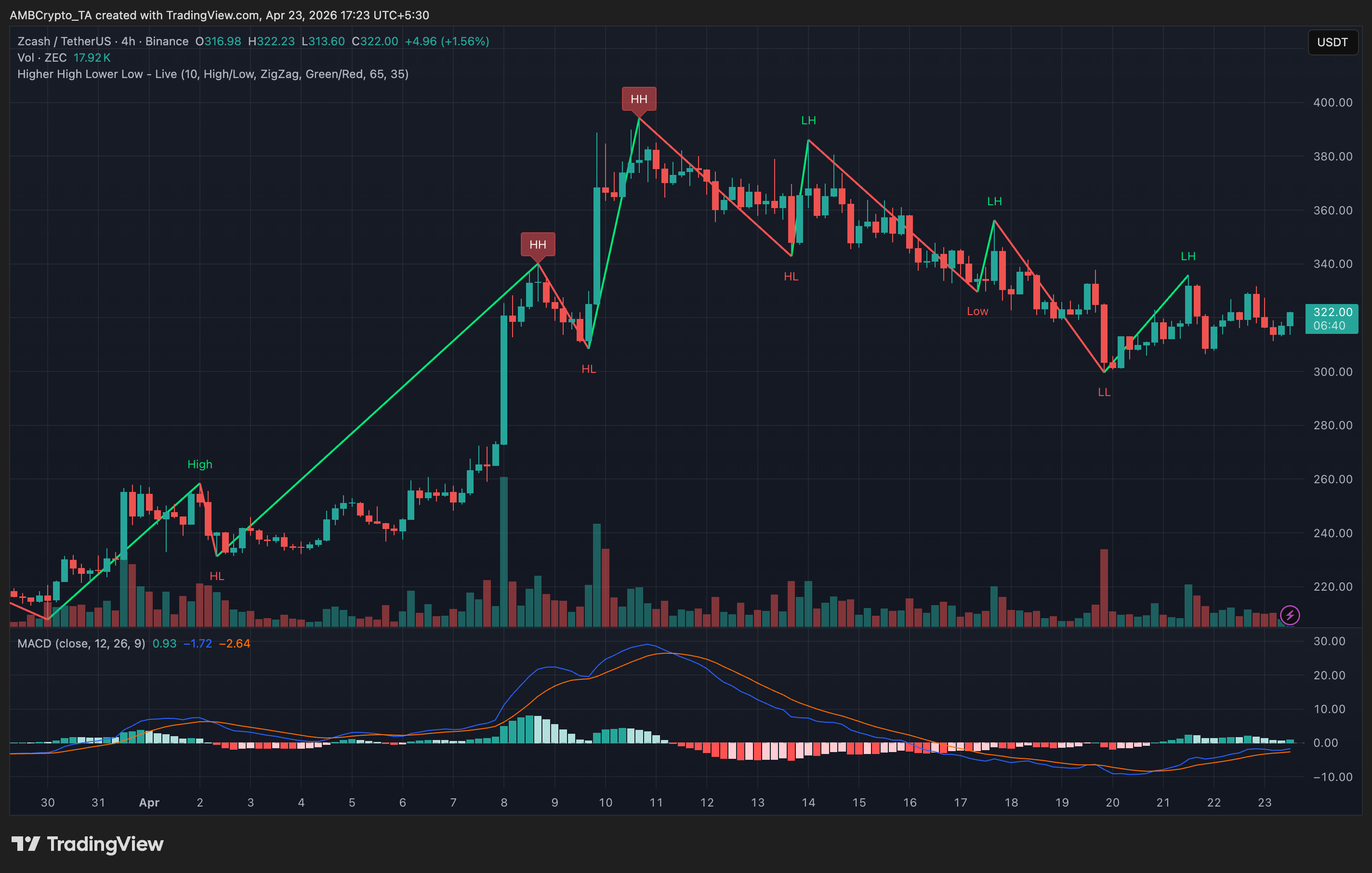
ZEC stabilized above the $300 zone and pushed back toward the $330 resistance area, though a lower-high structure suggested broader upside continuation was still being tested.
MACD momentum improved with the histogram flipping positive, while volume supported a steadier recovery rather than an overheated breakout.
What you should know:
ZEC recovered from its recent corrective slide and attempted to rebuild momentum, with buyers defending the $300 area while price consolidated below the $330–$335 structural hurdle. The move likely drew support from Foundry USA’s Zcash mining pool launch and renewed optimism around the $25 million ZODL funding round, both reinforcing the privacy narrative revival around the asset. On the technical side, the MACD showed improving upside momentum, though the latest lower-high structure kept a full trend continuation unconfirmed. Holding above $315–$320 could support another challenge of $330, while losing the $300 support zone may weaken the recovery setup and shift focus back toward downside pressure.
Monero (XMR)
Key points:
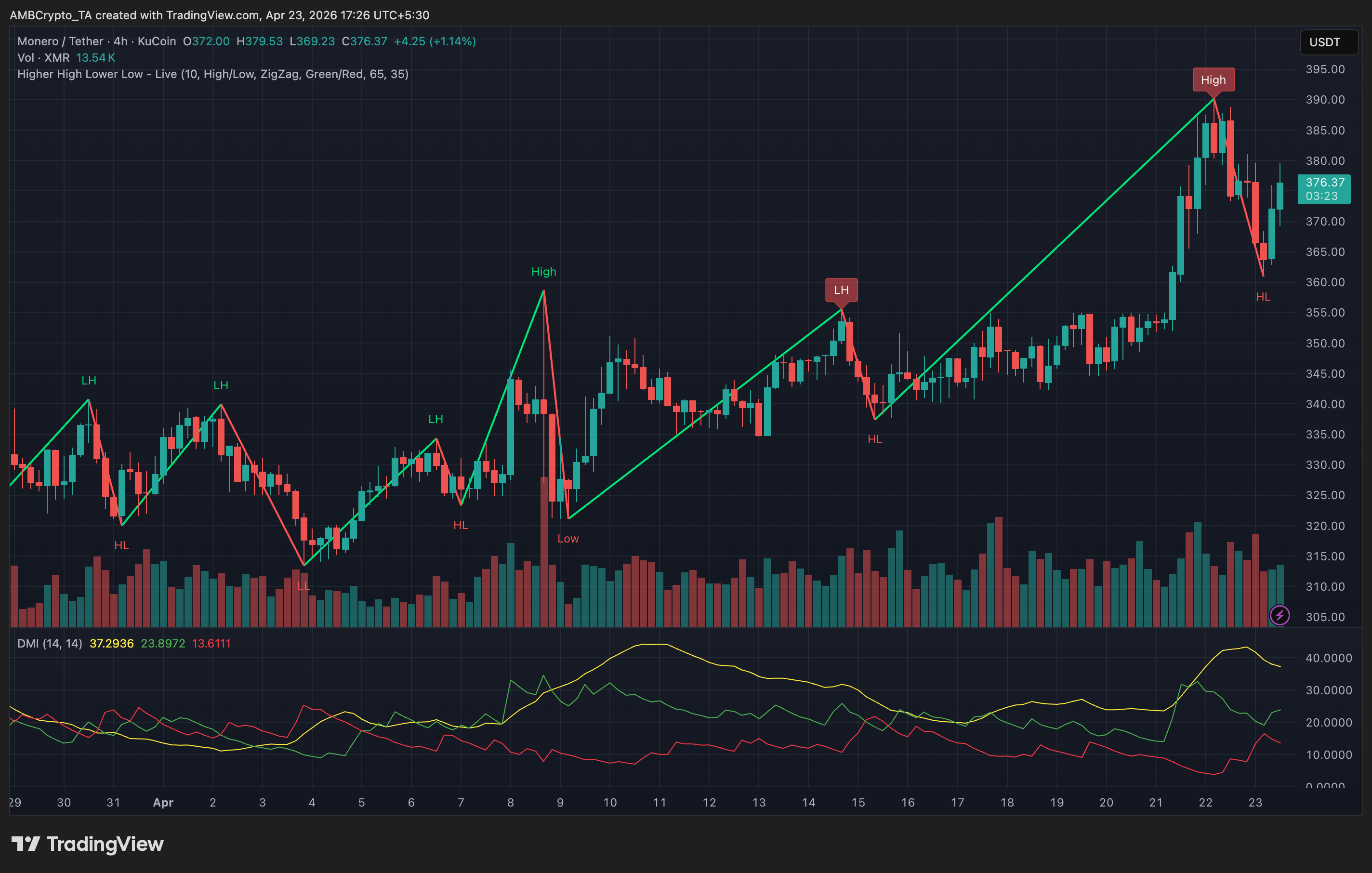
At the time of writing, XMR traded at $376 after rebounding from the $362 higher-low zone, while a push toward $390 kept the broader uptrend intact.
The DMI favored buyers with +DI above -DI and elevated ADX, while volume held firm during the rebound, suggesting trend strength remained constructive.
What you should know:
Monero regained upside traction after defending a higher-low structure near $362–$365, with $390 remaining the immediate resistance zone while $350–$355 serves as deeper support. Unlike a straight breakout narrative, this move was reinforced by trend continuation signals, as DMI strength held while the rebound followed an orderly pullback. Beyond the chart, sentiment was aided by MoneroRun-related supply squeeze dynamics, where exchange withdrawals tightened circulating liquidity, while THORChain integration continued supporting decentralized access to XMR. If buyers sustain control above the higher-low zone and ADX remains firm, the market may keep pressing toward the recent highs, though rejection near $390 could trigger consolidation.
Hyperliquid (HYPE)
Key points:
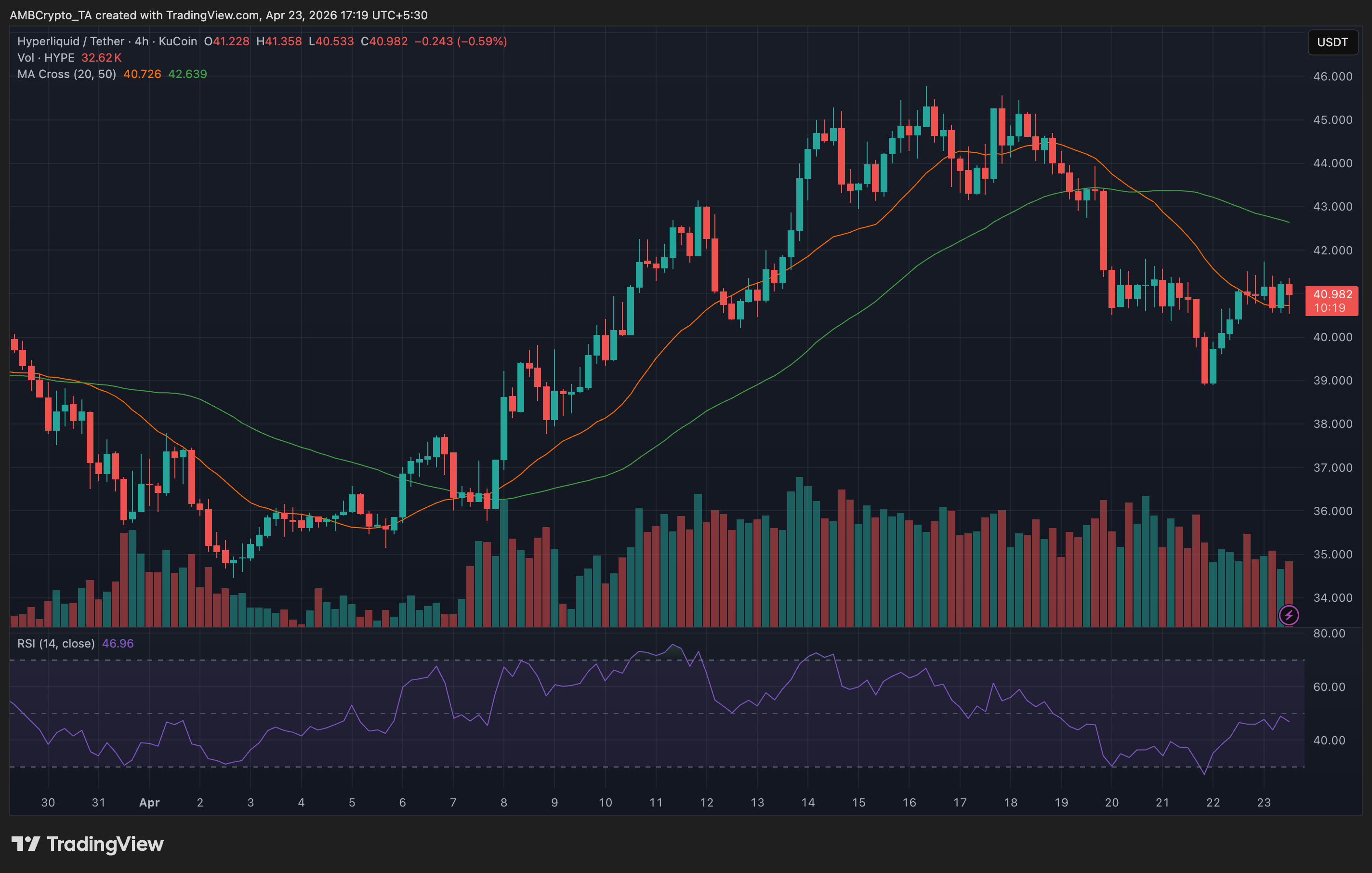
HYPE stabilized near $40.98 after reclaiming the 20 MA at $40.73, while the 50 MA at $42.64 remained the next resistance barrier to watch.
The RSI recovered to 46.96 but stayed below neutral, while softer volume pointed to consolidation rather than a decisive trend breakout.
What you should know:
Hyperliquid attempted to regain footing after bouncing from the $39 zone, with the reclaimed 20 MA offering near-term support while $42.60-$43 remains the immediate upside hurdle. Unlike a momentum-led breakout, this move reflected recovery inside a broader consolidation range, as the 50 MA continued capping upside pressure. The RSI improved but had not yet confirmed full bullish strength. Beyond the chart, sentiment was shaped by cooling speculative demand in perpetual markets and caution ahead of the May 6 token unlock, though the upcoming HIP-4 prediction markets launch offered a constructive counterweight. If buyers hold above $40, a retest of the 50 MA remains possible, while weakness below $39 could revive downside pressure.
How was today's newsletter? |