- Unhashed Newsletter
- Posts
- Fake war panic hits crypto
Fake war panic hits crypto

Reading time: 5 minutes
ZachXBT flags AI-driven war panic as new crypto scam funnel

Key points:
Blockchain investigator ZachXBT uncovered a coordinated network of fake X accounts using geopolitical fear and AI personas to push crypto scams.
On-chain evidence tied the activity to six-figure profits, showing how engagement farming can quickly turn into financial fraud.
News - On-chain sleuth ZachXBT has revealed how viral war-related posts on X are being used to funnel users into crypto scams. His investigation identified more than 10 linked accounts that shared exaggerated or fabricated geopolitical updates to attract millions of views before shifting to fraudulent giveaways and pump-and-dump tokens.
The network allegedly relied on purchased accounts with established follower bases and AI-generated personas designed to imitate recognizable online figures. After engagement surged, operators promoted scam campaigns, including a February push tied to the token Oramama. On-chain tracking suggests the coordinated effort generated six-figure gains before the accounts pivoted or went silent.
Fear-driven virality becomes a scam distribution channel - According to ZachXBT, the operation followed a repeatable pattern. Sensational posts about political tensions or conflict triggered rapid reactions, while coordinated reposting among related accounts amplified reach. In several cases, larger profiles unknowingly interacted with the content, helping expand its visibility across crypto timelines.
Moderation gaps raise broader risks - The findings come as X rolls out stronger anti-bot detection tools and user flags for AI-generated content. ZachXBT warned that coordinated manipulation can still scale faster than platform defenses. He also cautioned that similar tactics could pose wider risks if adopted by more sophisticated actors, urging users to verify account histories before engaging with viral claims.
Iran headlines jolt Bitcoin, macro risks deepen

Key points:
Bitcoin swung sharply after U.S. President Donald Trump announced a five-day pause in planned strikes on Iranian infrastructure, triggering large liquidations and a brief relief rally.
Rising Treasury yields, slowing ETF inflows, and Fed caution continue to shape crypto sentiment despite short-term geopolitical easing.
News - Crypto markets experienced sharp volatility after Trump signaled a temporary halt to potential U.S. attacks on Iranian energy infrastructure, citing productive diplomatic discussions. Bitcoin quickly rebounded above $71,000 during the reaction, supported by falling oil prices and a softer dollar.
The relief proved fragile. Iranian officials denied any meaningful negotiations, reversing part of the risk-on move and pushing Bitcoin back toward the $70,000 range. Within hours, leveraged traders were caught on both sides of the shift, with more than $400 million in liquidations across long and short positions. The episode underscored how derivatives-dominated trading can amplify modest price changes into severe losses during headline-driven sessions.
Macro pressures remain in focus - Beyond geopolitics, broader financial conditions continue to guide crypto markets. The U.S. 10-year Treasury yield has climbed notably since the Iran conflict escalated in late February, strengthening the dollar and tightening global liquidity. Analysts are closely watching the 4.5% area as a potential threshold that could intensify pressure on Bitcoin and gold.
Institutional flows also showed mixed signals. Crypto investment products posted about $230 million in weekly inflows, extending a multi-week streak but marking a sharp slowdown after post-FOMC outflows dented momentum. Bitcoin-linked funds attracted most of the capital, while Ether products recorded renewed withdrawals.
Relief rally meets cautious positioning - Although the geopolitical pause briefly boosted risk appetite, options data indicates traders remain defensive. The latest rebound has yet to resolve concerns over macro tightening, geopolitical uncertainty, and yield-driven capital shifts across global markets.
Strategy reloads Bitcoin firepower with fresh $44B equity push

Key points:
Strategy has expanded its capital-raising capacity, giving itself roughly $44 billion in fresh equity firepower to support future Bitcoin purchases.
The company’s latest buy was far smaller than its recent billion-dollar acquisitions, suggesting a slower pace even as its long-term treasury strategy remains intact.
News - Strategy has revealed a new multibillion-dollar capital plan that could significantly extend its Bitcoin buying capacity. The company disclosed fresh at-the-market programs tied to its common stock and preferred shares, including $21 billion in Class A common stock, $21 billion in STRC preferred stock, and another $2.1 billion tied to STRK.
The move comes just after Strategy added 1,031 BTC for $76.6 million, bringing its total holdings to 762,099 BTC. Unlike some of its larger recent acquisitions, this latest purchase was funded through common stock sales and marked a sharp step down from the billion-dollar buying pace seen over the prior two weeks.
Why the funding mix matters - Recent filings show Strategy is leaning on a broader mix of instruments to keep its Bitcoin treasury model running. STRC had played a major role in earlier purchases, but the latest buy suggests common stock has returned to the forefront, at least for now. The company has also expanded its sales syndicate, adding new Wall Street partners to support gradual market issuance.
Big ambition, slower near-term pace - Despite the new fundraising capacity, Strategy’s recent buying tempo has cooled. Its Bitcoin stash, accumulated at an average cost of $75,694 per coin, remains below water at current market prices near $70,000 to $71,000. Even so, the company appears to be preserving flexibility rather than stepping back, keeping significant capital options open for future accumulation.
USR stablecoin crash exposes deeper DeFi trust risks

Key points:
Resolv Labs’ USR stablecoin lost its peg after an attacker minted roughly 80 million unbacked tokens using a compromised privileged key.
The exploit triggered a rapid price collapse, liquidity stress across integrated protocols, and fresh concerns about centralized risk in DeFi systems.
News - Decentralized finance markets were shaken after Resolv Labs confirmed an exploit that sent its USR stablecoin sharply below its intended $1 value. Investigators found that an attacker gained access to a key tied to the minting mechanism, enabling the creation of tens of millions of uncollateralized tokens.
The newly minted USR was quickly sold on decentralized exchanges and converted into other assets, allowing the attacker to extract about $23 million to $25 million. The token plunged dramatically within minutes, briefly trading near a few cents before stabilizing at higher but still deeply discounted levels.
Design assumptions under scrutiny - Analysts said the incident stemmed from structural weaknesses rather than a coding bug. Mint approvals relied on an off-chain service controlled by a single privileged account, while the contract lacked caps, oracle checks, or strict collateral validation. This setup created a clear single point of failure that enabled excessive token issuance once the key was compromised.
The fallout extended beyond Resolv itself. Lending vaults and yield strategies with exposure to USR also suffered losses as automated liquidity continued supporting trading activity after the attack.
Containment steps and trust challenges - Resolv Labs paused core protocol functions, burned part of the illicit supply, and prepared redemption plans for affected users while coordinating with law enforcement and analytics firms. Although the team said most collateral remained secure, the episode highlighted how fragile confidence can destabilize stablecoins even when underlying reserves are largely intact.
What Your Financial Software Isn’t Telling You

Automation tracks transactions. It doesn’t spot opportunities
The Future of Financial Leadership reveals where AI falls short and how real financial oversight reveals true margins, cash flow, and unlocks long-term growth.
More stories from the crypto ecosystem
Did you know?
A self-custody wallet just got a notable U.S. regulatory break: On March 17, 2026, the CFTC issued a no-action position for Phantom’s self-custodial wallet software, signaling that certain wallet tools connecting users to regulated crypto derivatives may not automatically trigger broker registration requirements, provided specific conditions are met.
Stablecoins are now big enough to worry central banks, not just crypto traders: In a paper highlighted on March 3, 2026, the ECB warned that wider stablecoin use in the euro zone could weaken monetary policy transmission and pressure bank funding, especially because most major stablecoins remain dollar-denominated.
Bitcoin’s fourth halving has already reshaped miner economics: After the April 2024 Bitcoin halving, block rewards dropped from 6.25 BTC to 3.125 BTC, intensifying competition among mining firms and accelerating industry consolidation as weaker operators struggled with lower revenues.
Good Credit Could Save You $200,000 Over Time

Better credit means better rates on mortgages, cars, and more. Cheers Credit Builder is an affordable, AI-powered way to start — no score or hard check required. We report to all three bureaus fast. Many users see 20+ point increases in months. Cancel anytime with no penalties or hidden fees.
Top 3 coins of the day
DeXe (DEXE)
Key points:
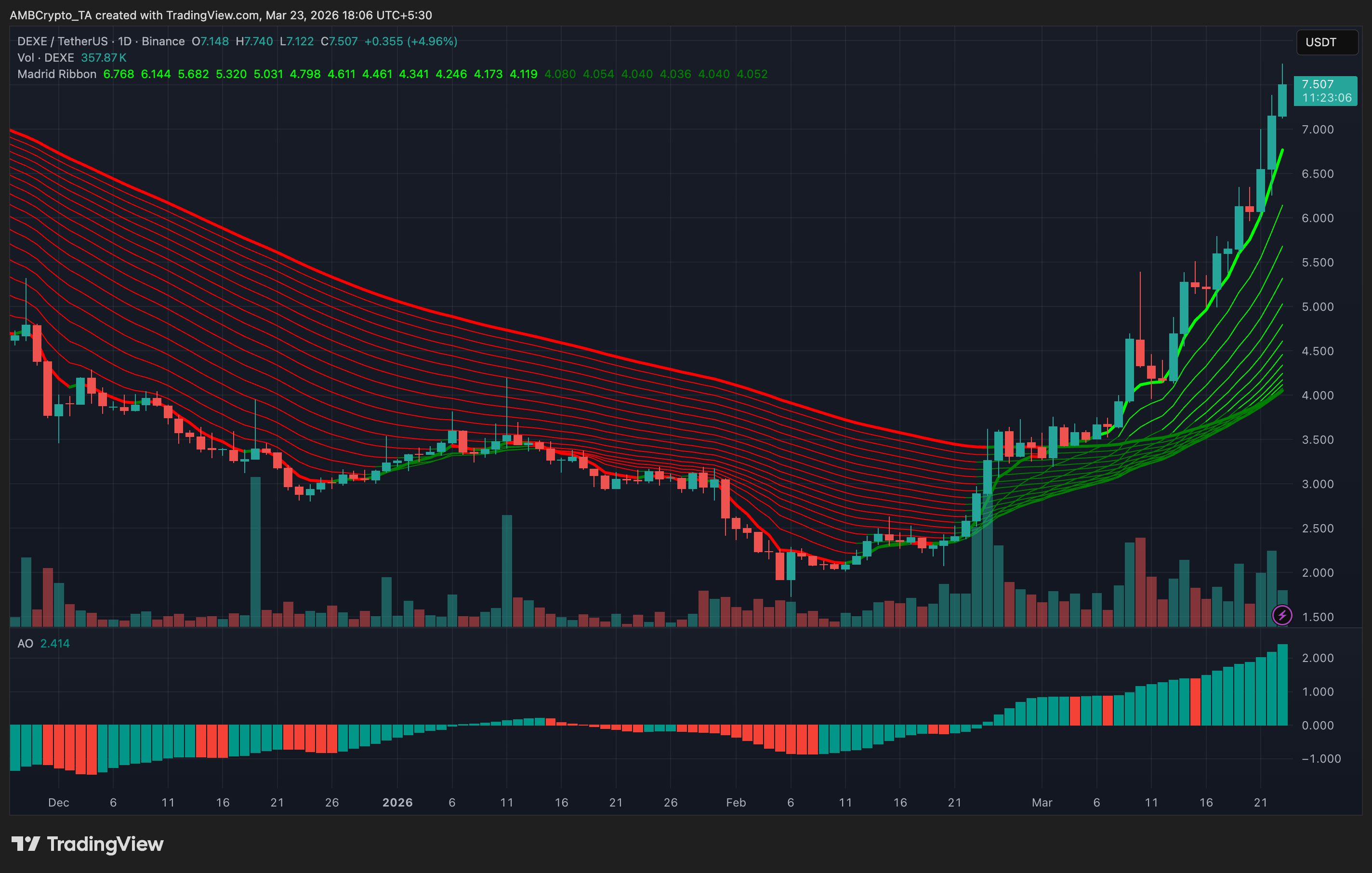
DEXE climbed to around $7.51 after a sharp daily advance, continuing its strong upward move from the late-February base.
The Madrid Ribbon stayed fully green and fanned upward while the Awesome Oscillator printed expanding positive bars, reflecting strengthening bullish momentum.
What you should know:
Price action accelerated through March as DEXE pushed higher from the $3 region, forming successive higher highs with only brief pauses. Rising trading activity during breakout sessions reinforced the move, while the ribbon’s upward slope confirmed sustained trend strength. The latest candles showed continuation buying interest near the $7.50 zone. Fundamental tailwinds also supported sentiment, including renewed capital rotation into AI-focused tokens and DeXe Network’s plan to integrate artificial intelligence into its DAO infrastructure. Additional demand signals emerged from the onboarding of multiple DAOs in March and reduced circulating supply due to governance token locking. Immediate resistance stands near $7.70, while support is seen around $6.00 and lower near $5.30.
Avalanche (AVAX)
Key points:
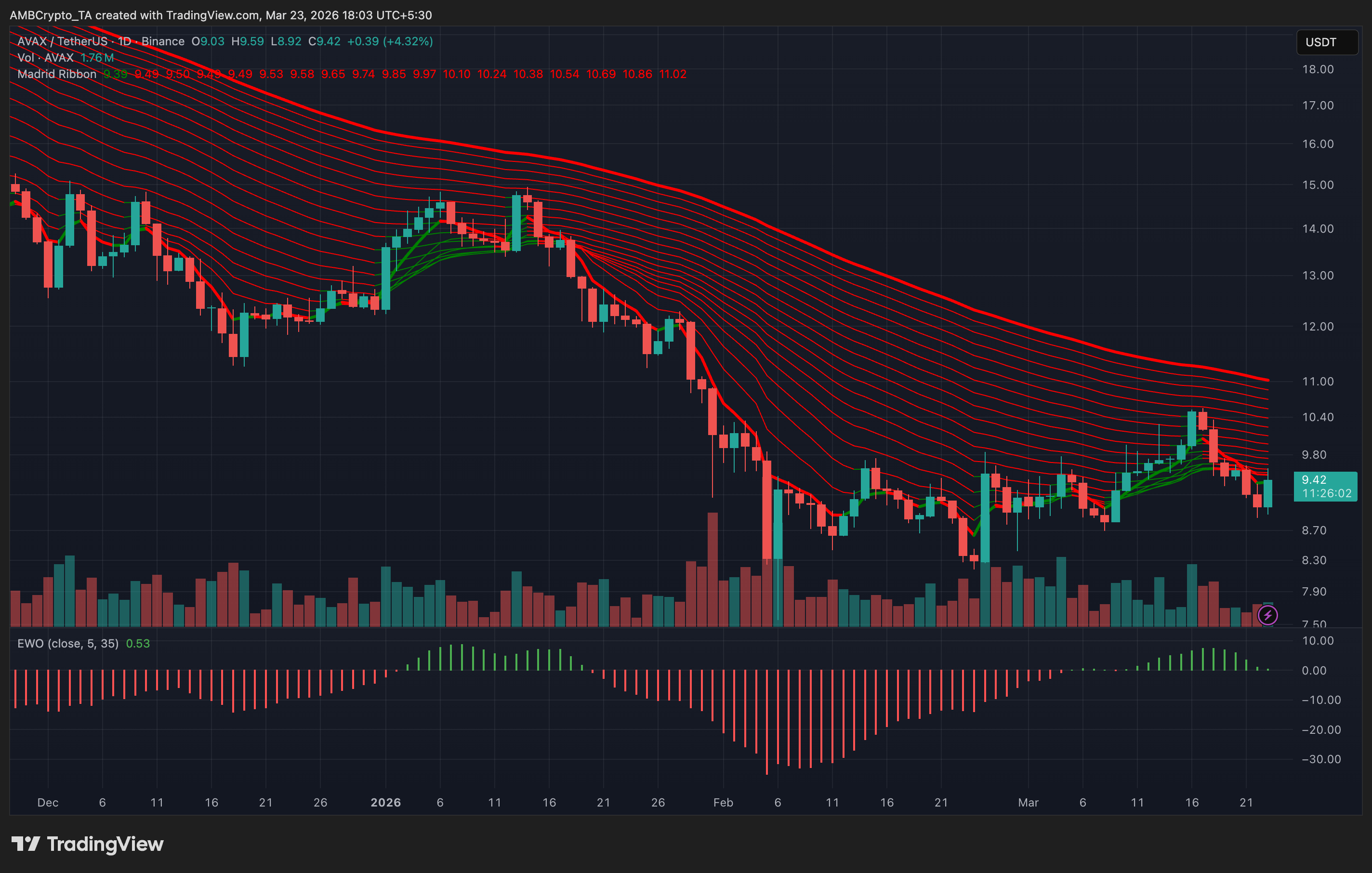
AVAX was last seen trading near $9.42 after slipping from the recent swing high around the $10.40 zone.
The Madrid Ribbon remained fully red and trending lower, while the EWO histogram showed fading positive bars, indicating easing upside momentum.
What you should know:
After a prolonged decline into early February, AVAX attempted a measured recovery through March but struggled to sustain strength above key overhead supply. The latest candles reflected renewed selling pressure following a rejection near $10.40, with price drifting back toward the $9.40 region. Trading participation stayed uneven after the rebound phase, suggesting cautious conviction among buyers. Market sentiment received support from specific developments such as Animoca Brands’ strategic investment to expand Avalanche’s ecosystem reach across Asia and the Middle East. Continued institutional flows linked to the VanEck AVAX product launch and accelerating growth in tokenized real-world assets also helped anchor demand expectations. Immediate support rests near $9.00, while resistance stands around $10.40 and higher.
Ethereum (ETH)

Key points:
ETH hovered around $2,142 after recovering from a recent dip toward the $2,000 region earlier this month.
The Parabolic SAR lately flipped above price while the RSI stabilized near the midline, signaling a pause in directional momentum.
What you should know:
Ethereum faced intense selling pressure in late January and early February before settling into a volatile recovery range through March. A mid-month attempt to push toward the $2,380 zone lost strength, leading to renewed sideways movement near current levels. Participation picked up mainly during the earlier decline, with recent sessions showing more measured trading activity. Sentiment received a lift from fresh institutional accumulation, including a reported purchase of over 65,000 ETH by Bitmine Immersion Technologies. Improved regulatory clarity around Ethereum’s classification also supported investor confidence, while more than 30% of supply remaining locked in staking contracts continued to tighten available liquidity. Immediate resistance stands near $2,380, while support is seen around $2,000 and lower.
How was today's newsletter? |