- Unhashed Newsletter
- Posts
- High-stakes week ahead for Bitcoin
High-stakes week ahead for Bitcoin

Reading time: 5 minutes
Strategy doubles down on Bitcoin despite $14.4B hit

Key points:
Strategy added 4,871 BTC for ~$330M, taking total holdings to 766,970 BTC, even as Q1 unrealized losses hit $14.46B.
The firm continues buying below its cost basis while broader corporate Bitcoin accumulation has slowed sharply.
News - Strategy resumed Bitcoin purchases with a $329.9 million buy of 4,871 BTC at an average price of $67,718, lifting total holdings to 766,970 BTC. The company has spent roughly $58 billion on Bitcoin at an average cost near $75,600.
The update follows its Q1 2026 disclosure of a $14.46 billion unrealized loss on digital assets. Despite this, Strategy has continued accumulating aggressively, adding close to 90,000 BTC year-to-date.
The latest purchase was primarily funded through sales of STRC preferred stock, reinforcing its reliance on equity-linked capital to sustain its Bitcoin strategy.
Buying while others pull back - Strategy’s accumulation stands in contrast to a broader slowdown across corporate buyers. Non-Strategy treasury firms have sharply reduced purchases since 2025, with several even selling Bitcoin to manage liquidity.
Meanwhile, Strategy has continued buying below its cost basis, gradually improving its average entry price. Over the past month, it accounted for the bulk of corporate Bitcoin purchases, further widening its lead.
The firm now controls roughly 3.8% of Bitcoin’s circulating supply.
STRC strategy sets it apart - Strategy’s use of preferred equity, particularly STRC, has enabled continued accumulation without liquidating holdings. The firm raised over $1.5 billion through STRC in March alone.
As peers like MARA and Riot sell BTC to manage debt and liquidity pressures, Strategy’s model highlights a growing divide in how Bitcoin treasury firms navigate market stress.
Bitcoin faces macro crunch week as $70K volatility returns

Key points:
Bitcoin hovered near $69K after briefly reclaiming $70K, triggering over $75M in liquidations amid rising volatility.
A packed week of U.S. macro data, including CPI, PCE, GDP, and FOMC minutes, is expected to drive sharp price swings.
News - Bitcoin entered the week near $69,000 after briefly crossing $70,000, a move that triggered over $75 million in liquidations within an hour. The spike was short-lived, with price slipping back below the key level soon after.
The broader backdrop remains volatile. Bitcoin is down roughly 23% year-to-date, while market sentiment has stayed in extreme fear territory. At the same time, geopolitical tensions and rising oil prices continue to shape inflation expectations.
Macro data in focus - Markets are now watching four key U.S. releases between Wednesday and Friday: FOMC minutes, core PCE inflation, GDP data, and CPI. These data points are expected to influence rate expectations and risk assets.
Bitcoin’s correlation with the S&P 500 has recently reached 0.94, underscoring its sensitivity to macro signals. Inflation surprises, particularly in CPI and PCE, could quickly shift expectations around rate cuts.
Volatility builds under the surface - The move above $70,000 triggered aggressive short liquidations, while total liquidations across the market crossed $300 million over 24 hours. Data also shows limited resistance above $70,500, increasing the likelihood of sharp moves.
With Bitcoin caught between macro uncertainty, geopolitical developments, and leveraged positioning, this week’s data cycle is likely to dictate near-term direction.
Bitcoin’s Quantum split deepens as Circle builds, and Mow warns

Key points:
Circle is building quantum-resistant infrastructure into its Arc blockchain, starting with opt-in post-quantum wallets and signatures at mainnet launch.
In Bitcoin, debate is intensifying, with JAN3 CEO Samson Mow warning that rushing a quantum fix could introduce new vulnerabilities.
News - Quantum computing risks are moving from theory to active planning across crypto. This week, Circle outlined a phased post-quantum roadmap for its Arc blockchain, while Bitcoin stakeholders debated whether acting too early could backfire.
Circle said Arc will launch with an opt-in post-quantum signature scheme, enabling quantum-resistant wallets from day one. Later phases will extend protections to balances, transactions, validators, and supporting infrastructure. Arc is currently on public testnet, with mainnet expected sometime in 2026.
Rising urgency, uneven response - The push comes as research from Google and Caltech renewed concerns about quantum timelines. One finding suggested a future quantum computer could theoretically derive a Bitcoin private key from its public key in about nine minutes.
Since crypto wallets rely on cryptographic signatures to authorize transactions, such a capability would challenge current security assumptions.
Bitcoin’s cautionary stance - Within the Bitcoin ecosystem, there is no clear consensus. JAN3 CEO Samson Mow warned that rushing a post-quantum transition could reduce efficiency, introduce compatibility issues, and increase signature sizes, potentially affecting throughput.
He emphasized that preparation should continue, but not at the cost of exposing Bitcoin to present-day risks. With proposals like BIP-360 still years away, the debate is shifting toward timing rather than necessity.
Drift hack fallout deepens as DPRK ties strengthen, negligence claims surface

Key points:
Drift now links the $285M exploit to a six-month DPRK-affiliated infiltration involving social engineering, malware, and pre-positioned access.
Legal and industry scrutiny is rising, with claims of civil negligence and broader warnings around systemic DeFi security risks.
News - New details around the $285 million Drift exploit suggest the breach was a coordinated, months-long operation rather than a single-point failure. The protocol said it has “medium-high confidence” the attack was carried out by UNC4736, a North Korean state-affiliated group.
Attackers reportedly presented themselves as a quantitative trading firm, met contributors in person, deployed malicious tools, and deposited over $1 million into the protocol before executing the exploit. Once triggered, the attack unfolded rapidly, with funds drained and chats and malware scrubbed after execution.
From breach to infiltration - The latest update shifts the narrative from a technical exploit to a sustained social engineering campaign. Attackers used fabricated identities, developer tooling vulnerabilities, and compromised environments to influence transaction approvals.
Security experts warned that this model challenges traditional defenses. Multisignature setups, often viewed as a safeguard, may fail if signers cannot independently verify transaction intent.
Industry-wide alarm grows - The implications extend beyond Drift. Researchers claim North Korean IT workers have infiltrated more than 40 DeFi projects over the past seven years, raising concerns about long-term exposure across the sector.
Legal pressure is also mounting. Ariel Givner, a crypto attorney, said the incident may qualify as civil negligence, citing failures in basic operational security, including key isolation and contributor due diligence. Reports of potential class action lawsuits have begun circulating.
Protect Client Trust in Volatile Markets

When markets get shaky, advisors don’t just manage portfolios. They manage a surge of client emails, questions, and last-minute meetings. BELAY’s free Financial Advisor’s Delegation Guide shows how better delegation protects responsiveness, reduces bottlenecks, and helps your firm stay client-facing when pressure and volume rise fast across the entire firm.
More stories from the crypto ecosystem
Did you know?
Washington’s two biggest market watchdogs now have a formal crypto coordination pact: On March 11, 2026, the SEC and CFTC announced a formal memorandum of understanding to coordinate on crypto-related regulation, market integrity, and innovation. That makes it one of the clearest recent signs that U.S. crypto oversight is shifting toward a more structured joint framework rather than siloed enforcement.
Crypto scams did not just grow in 2025, they got an AI upgrade: Chainalysis said $17 billion was estimated stolen through crypto scams and fraud in 2025, with impersonation scams up 1,400% year over year. It also found that AI-enabled scams were 4.5 times more profitable than traditional ones, showing how fraud infrastructure is evolving fast.
The ceremony that helped Ethereum scale drew more than 140,000 contributors: Ethereum’s KZG ceremony, a cryptographic setup tied to proto-danksharding, logged 140,000+ contributions before Dencun went live on mainnet in March 2024. That still matters now because it underpins Ethereum’s broader roadmap for cheaper and more scalable data availability.
200+ AI Side Hustles to Start Right Now

AI isn't just changing business—it's creating entirely new income opportunities. The Hustle's guide features 200+ ways to make money with AI, from beginner-friendly gigs to advanced ventures. Each comes with realistic income projections and resource requirements. Join 1.5M professionals getting daily insights on emerging tech and business opportunities.
Top 3 coins of the day
Filecoin (FIL)

Key points:
FIL pushed toward $0.89 after breaking out of its $0.82–$0.85 range, with a sharp volume-backed surge confirming fresh buying interest.
Momentum accelerated as price climbed above the 9-SMA, while the Stochastic RSI jumped into overbought territory.
What you should know:
After several sessions of choppy movement, FIL broke higher from its recent consolidation and advanced toward the $0.90 level. The move was reinforced by a near 90% jump in spot volume, alongside reports of two large long positions totaling over $800k opened on Binance Futures, pointing to strong speculative inflows. Price moved decisively above the 9-SMA, suggesting a shift in short-term trend, while the Stochastic RSI surged into overbought levels, signaling elevated momentum. Holding above the $0.85 region keeps the upside case intact toward $0.92. A slip below $0.81 would put the structure at risk and could invite renewed selling pressure.
Ethereum (ETH)
Key points:
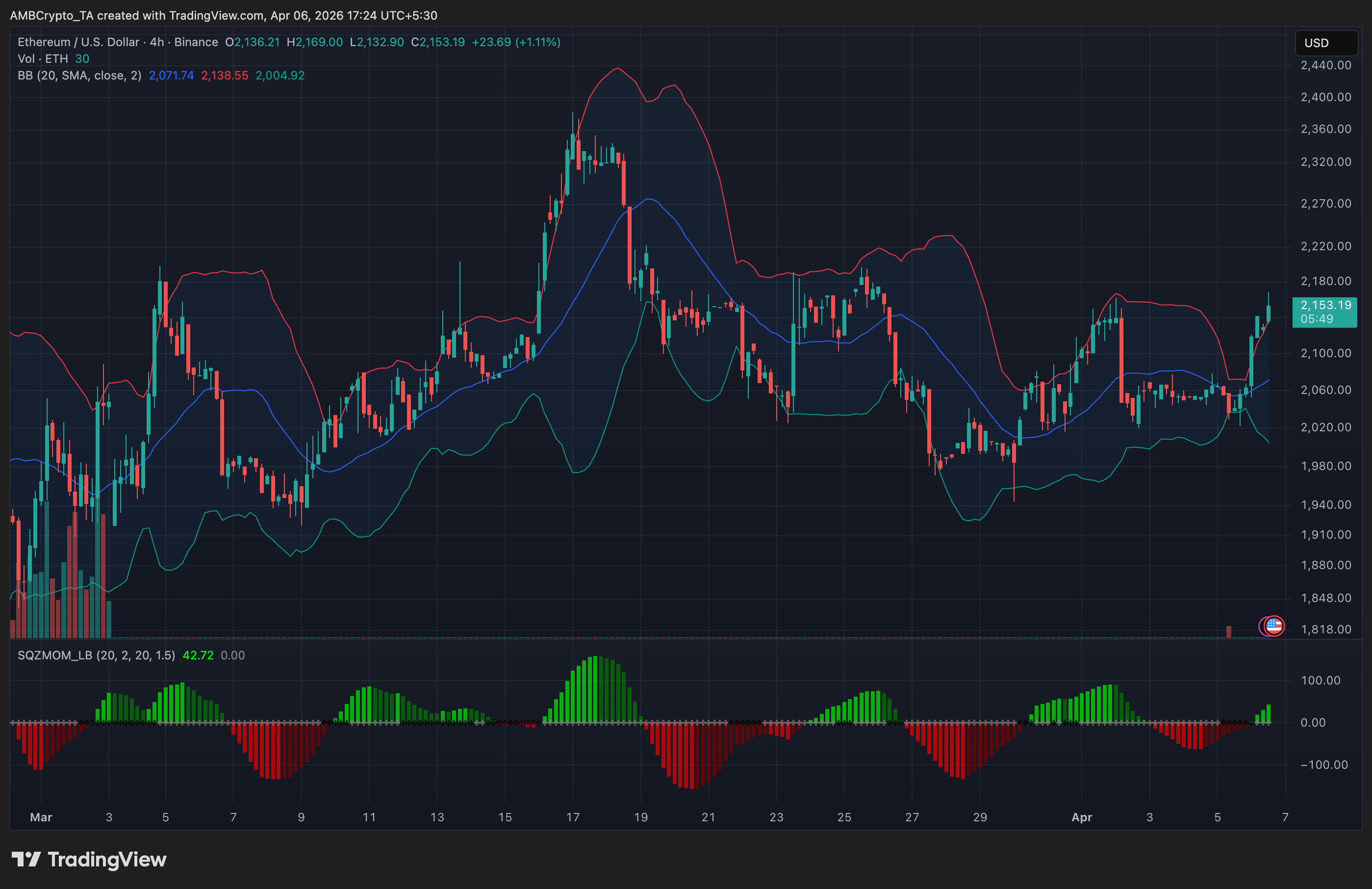
ETH surged around $2,153 with a sharp upswing that briefly carried price above the upper Bollinger Band, signaling strong short-term expansion.
Momentum flipped firmly positive as the Squeeze indicator printed rising green bars, while volume showed a gradual increase.
What you should know:
Ethereum’s move higher developed after multiple failed attempts to hold below $2,100, with buyers stepping in and driving price into the $2,150 region. The breakout extended beyond the upper Bollinger Band, reflecting a burst of directional strength rather than a slow grind higher. This shift aligned with a change in derivatives positioning, as net taker volume turned positive, pointing to aggressive buying pressure. ETH also outperformed the broader market during the same window, suggesting capital rotation into the asset. The Squeeze Momentum Indicator confirmed this shift with expanding green bars, while volume improved without matching earlier peaks. Sustained acceptance above $2,065 keeps upside intact toward $2,200, while losing $2,000 would weaken momentum.
Avalanche (AVAX)

Key points:
AVAX flipped back above $9.00 with a late-session surge that lifted price to $9.45, reclaiming control after repeated dips below the level.
Momentum turned positive as the EWO crossed into green territory, while price moved above the 9-SMA with a visible rise in activity.
What you should know:
The $9.00 level acted as a pivot for AVAX, with price briefly slipping below it before quickly reversing and pushing higher toward $9.45. This shift came with a noticeable increase in trading activity, aligning with a broader pickup in market participation and a reported surge in volume tied to renewed buying interest. The move also followed strength across the wider market, with Bitcoin’s advance supporting sentiment while AVAX showed relative outperformance. On the chart, the EWO crossed into positive territory and continued to build, while price reclaimed the 9-SMA, signaling a shift in short-term control. Holding above $9.00 keeps the structure favorable toward $9.80–$10.00, while a break below $8.80 would weaken this setup.
How was today's newsletter? |