- Unhashed Newsletter
- Posts
- Investors fearful of directional BTC bets
Investors fearful of directional BTC bets

Reading time: 5 minutes
Spot Bitcoin ETF flows break 4-week inflows streak as investors wait for clarity

Key points:
The run of four consecutive weeks of spot ETF inflows totaling $2.2 billion was broken by the previous week’s $296.18 million in outflows.
The current macro backdrop, defined by “surface stability, internal imbalance”, meant capital is unwilling to make directional bets.
News - Spot Bitcoin exchange-traded funds (ETFs) finally saw a week of outflows amid deepening geopolitical uncertainties, tensions in the Middle East, and developments in the US-EU trade agreement.
The run of inflows gave a warning sign the previous week. Inflows fell from $767.33 million on the week ending on Friday, March 13, to a crawling pace of just $95.18 million the following week. The most recent week saw spot ETF outflows of $296.18 million.
The run of ETF inflows accompanied a Bitcoin short-term uptrend from $63.8k to $76k in under a month.
Unresolved risks take a toll on investor confidence - The rally beyond $72k did not see sustained demand for Bitcoin. Instead, as the ETF flows reflected, holders were happy to take profits during the bounce and exit the market.
Analysts attributed the lack of bullish belief to geopolitical risks, which remained unresolved even as policymakers outwardly maintained a calm outlook. Fears of worsening inflation were weighing Bitcoin down.
Bitcoin has more room to fall- The crypto market Fear and Greed Index was at 8, showing extreme fear. Rising oil and gas prices increase inflation risks and will keep the Federal Reserve from cutting interest rates.
The macro uncertainty and slowed economic growth made for choppy market conditions that are driven by headlines. In this scenario, additional shocks can see Bitcoin fall to the $60k support. On the other hand, de-escalation in the US-Iran conflict and falling oil prices could push Bitcoin back above $70k.
“Ethereum Economic Zone” project proposal to help fix the fragmented L2 ecosystem

Key points:
Developers from Gnosis and Zisk have proposed a new framework to address Ethereum’s well-documented L2 fragmentation problem.
Founding members of the EEZ collective include Aave, Titan, Beaver Build, and xStocks.
News - At the EthCC conference in Cannes, developers from Gnosis and Zisk, with backing from the Ethereum Foundation, announced a new project that seeks to fix Ethereum’s fragmentation problem.
The new framework aims to unify the fragmented Layer-2 ecosystem. It will do this by allowing smart contracts on different roll-ups to execute synchronously across networks without relying on bridges.
Ethereum relies on these L2 networks to function as scaling solutions, but they also splinter liquidity, infrastructure, and user activity across separate environments.
Addressing the L2 fragmentation problem - The Ethereum Economic Zone is designed to let smart contracts on connected roll ups call contracts on the mainnet or other EEZ roll ups as if they were deployed on Ethereum itself.
It requires no additional bridging infrastruture and uses ETH as the default gas token. This reduces the need for duplication and cross-chain transfers.
According to Gnosis co-founder Friederike Ernst, “Ethereum doesn’t have a scaling problem. It has a fragmentation problem”. He likened each newly launched L2 with its own liquidity pool and bridge as “its own walled garden”.
The project launch comes alongside the informal collective called the Ethereum Economic Zone Alliance. The founding members of this alliance include DeFi protocol Aave, block builders Titan and Beaver Build, tokenized equities project xStocks, and real-world asset platform Centrifuge.
Canada proposes a ban on crypto political donations in election bill

Key points:
The bill groups crypto along with prepaid cards and money orders as payment methods that are difficult to trace.
No major Canadian federal party has ever publicly accepted crypto contributions. Neither were crypto donations disclosed during the 2021 or 2025 federal elections.
News - The Canadian federal government proposed tightened legislation that would ban cryptocurrency donations to political parties, candidates, and third-party election advisors.
Introduced on March 26, Bill C-25, the Strong and Free Elections Act, prohibited money orders, prepaid cards, and crypto payment methods in the federal political system. These payment methods are difficult to trace.
Government House Leader Steven MacKinnon said that these amendments targeted foreign interference in electoral processes and democratic institutions.
The crypto donation financing route has seen little traffic - In 2019, Canada allowed crypto donations, classifying them as “non-monetary” contributions.
Under the 2019 rules, crypto contributions were not eligible for tax receipts. This further disincentivized donors from choosing the crypto route.
Due to these obstacles, no crypto contributions were disclosed in either the 2021 or 2025 elections. Neither has any major party publicly accepted them.
The pseudonymous nature of crypto donations also makes contributor identification difficult, paving the way for a crypto donations ban.
The remarkable timing - There were parallels to the recent UK announcement of a moratorium on crypto donations to British political parties.
Britain’s Prime Minister, Keir Starmer, also cited foreign interference and illicit financing as the reasons behind the ban.
Interestingly, the US has permitted crypto donations since 2014, though several individual states restrict or prohibit crypto donations. The 2024 election cycle saw the crypto industry spend more than $190 million through super PACs.
Prediction market transactions surge on geopolitical bets and media coverage

Key points:
Prediction markets were doing nearly 3,000% more volume than in March 2025.
This remarkable growth was due to the perception of these markets as forward-looking indicators, and coverage by mainstream media.
News - Prediction market transactions hit record highs in March. Growing interest in political and geopolitical event contracts, positive industry regulations, and improved accessibility contributed to the rising transaction numbers, which were currently 191 million so far in March.
Data tracked by Dune showed a 2,838% increase in the number of transactions in March 2026 compared to the same time last year. This whopping uptick was likely due to Google Finance and mainstream media coverage of prediction platforms.
So much so that they are used as real-time indicators of geopolitical and macroeconomic events, said blockchain intelligence firm TRM Labs.
Macro decisions and US politics attract heavy interest - Prediction markets allow market participants to trade the outcome of future events. So far, the monthly notional trading volume has reached $23.9 billion in March, and only measured $1.9 billion in March 2025.
It was US politics and geopolitical events that attracted the highest volumes, Polymarket data showed. The top two contracts by volume were the Democratic and Republican Presidential nominees for 2028, per data on Monday.
Scrutiny over insider trading - The optimistic outlook for prediction markets is that, as participation increases and liquidity deepens, these markets could be increasingly forward-looking indicators. They can complement and might even compete with traditional forecasting tools, said TRM Labs.
At the same time, prediction markets face increased scrutiny over allegations of insider trading and potential violations of gambling law.
Go from AI overwhelmed to AI savvy professional

AI will eliminate 300 million jobs in the next 5 years.
Yours doesn't have to be one of them.
Here's how to future-proof your career:
Join the Superhuman AI newsletter - read by 1M+ professionals
Learn AI skills in 3 mins a day
Become the AI expert on your team
More stories from the crypto ecosystem
Bitcoin struggles below $72.5k- Short-term holders sell at losses
Solana vs Ethereum: Assessing if SOL/ETH could reclaim 0.05 in Q2
DeFi stops the liquidation leak: Protocol reclaims billions lost to MEV bots
Stablecoin inflows return, but is crypto liquidity truly back? Assessing…
Celestia breaks down: Sell pressure builds ahead of TIA’s $85k token unlock
Did you know?
It is well-known that only 21 million Bitcoin can ever exist due to onchain limitations. However, the advent of a “parallel financial layer” through cash-settled futures, perpetual swaps, options, wrapped BTC, prime brokerage lending, and total return swaps creates synthetic exposure to BTC. A single BTC may be used simultaneously across multiple financial products. This phenomenon is known as “synthetic float expansion”, or “paper Bitcoin”, and price discovery can move away from just spot supply and demand.
Prediction markets are used to trade on the outcome of future events, such as a political race. While advocates of prediction markets argue that they more resemble insurance underwriting than mere gambling, a more insidious challenge is present. Insider trading by entities with information disparity underscored the true extent of information asymmetry in these markets, challenging their evolution into a recognized financial category.
DAOs, or decentralized autonomous organizations, are actually far less decentralized than we think. A European Central Bank working paper examined the governance structures of Aave, MakerDAO, Ampleforth, and Uniswap. Using late 2022 to mid-2023 data, the paper found that the top 100 holders controlled more than 80% of the total governance token supply.
The Best Place to Invest $1,000 Right Now

This AI tech could go down in history as the crown jewel of Elon's career. It could send ChatGPT offline forever and trigger a 70X investment boom. Watch the free presentation.
Top 3 coins of the day
Bitcoin (BTC)

Key points:
Bitcoin could be in a consolidation phase. It appeared to have formed a range between $66k and $75k.
Profit-taking activity combined with a lack of demand over the past ten days has reset the March momentum.
What you should know:
Bitcoin saw a bullish short-term trend established in the final week of February. By March 17, this trend had taken Bitcoin prices to a local high of $76k. Various onchain metrics pointed toward increased profit-taking activity from short and long-term holders, although some metrics also signaled accumulation from long-term holders. The price charts showed a quick rejection from $76k and a retracement toward the $65.6k lows, which had also served as support earlier in March. The price has not yet fallen below it, justifying the range formation. Even though momentum and buying pressure favored the sellers, it is possible that BTC would bounce to $70.2k-$71.7k next. On the other hand, a drop below $65k would signal a bearish trend continuation.
Dogecoin (DOGE)

Key points:
Dogecoin was also trading within a range from $0.088 to $0.104, but it exhibited bearish potential due to the trendline resistance.
The pessimistic market sentiment might dissuade capital flows into the memecoin sector.
What you should know:
Dogecoin has bounced 2.24% in the past 24 hours, and CoinMarketCap data showed that the memecoin’s daily trading volume was up by 15%. This was an encouraging start to the week, but the price chart showed there could be trouble ahead for the bulls. The range lows at $0.088 was less than 5% away from the current market price of $0.093. At the same time, a descending trendline resistance (yellow) has been in place over the past two weeks. The MACD was below the zero line, and the OBV did not show aggressive buyers near the range lows. Dogecoin was fast approaching a decision time, and it remains to be seen if prices will break the trendline resistance or the range low support.
DeXe (DEXE)
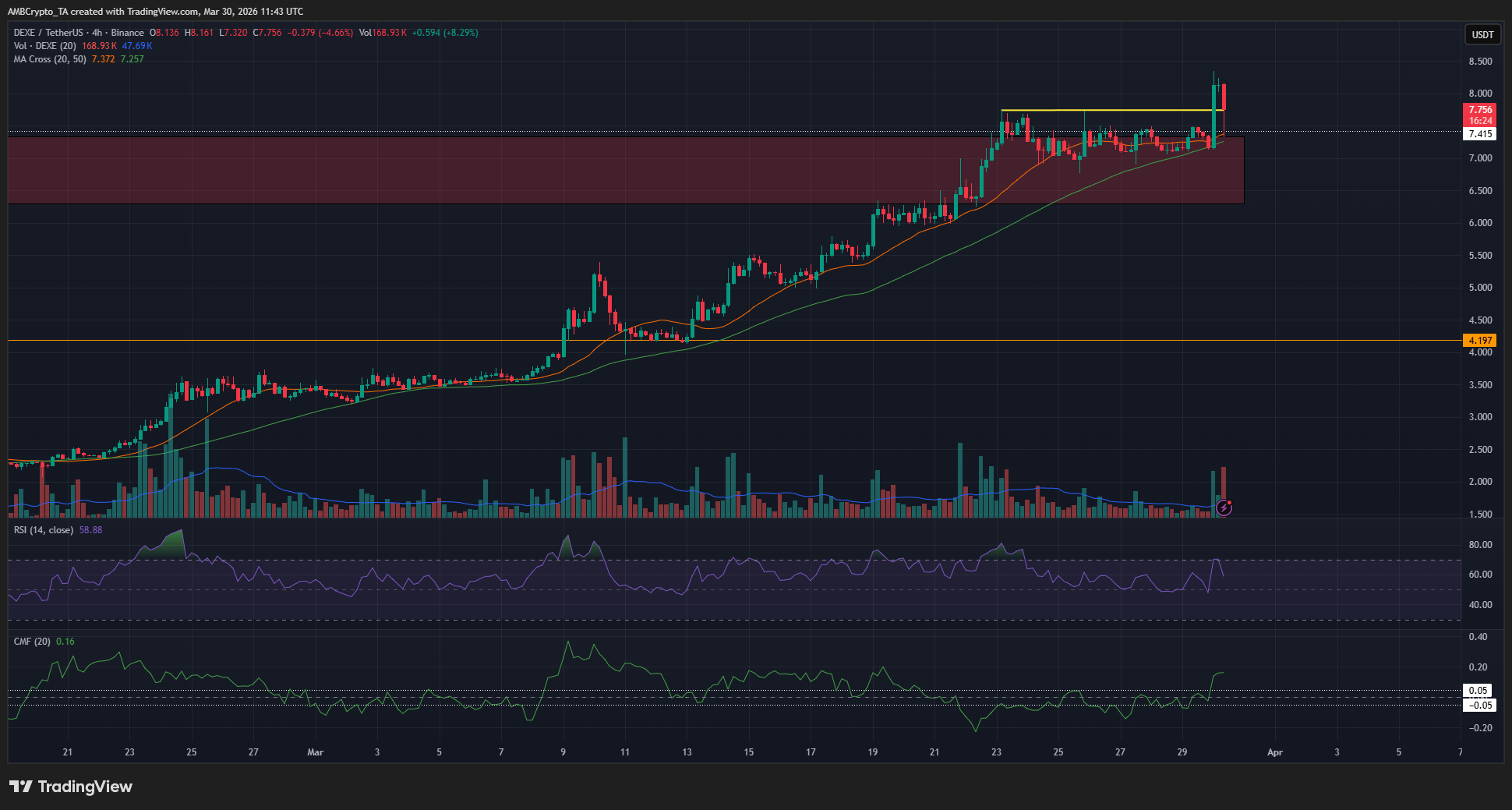
Key points:
The popular AI sector token has been trending bullishly since the second week of February.
DEXE has managed to pierce a higher timeframe resistance zone at $7.4 and has flipped the level to support.
What you should know:
Since the market-wide crash on February 6, DEXE has rallied 346% in under two months. It was an impressive performance from an asset with a $644.8 million market cap. The sustained buying pressure has pushed the AI token above the $7.4 resistance area from October 2025. The moving averages and the RSI showed strong bullish momentum on the chosen timeframe. Another significant development was the high trading volume breakout past the $7.7 local resistance from last week. The CMF spiked above the +0.05 level to show increased buying pressure. This breakout is likely to send DEXE on its next leg higher to $8.6.
How was today's newsletter? |