- Unhashed Newsletter
- Posts
- Ripple’s JPMorgan fight heats up
Ripple’s JPMorgan fight heats up
In partnership with


Reading time: 5 minutes
Bithumb’s CEO problem just got harder to ignore

Key points:
South Korean police booked Bithumb CEO Lee Jae-won as a bribery suspect in a hiring probe linked to lawmaker Kim Byung-ki.
The case adds to Bithumb’s 2026 legal pressure, including police raids, a $24.5 million AML fine, and a six-month partial suspension that is temporarily blocked.
News - Bithumb’s 2026 troubles deepened after South Korean police booked CEO Lee Jae-won as a bribery suspect in a hiring probe tied to National Assembly member Kim Byung-ki.
According to local reports cited by the sources, investigators are examining whether Lee hired Kim’s second son after a November 2024 restaurant meeting in Seoul’s Mapo district. Kim’s son reportedly joined Bithumb in January 2025 and worked there for about six months. Police are also looking into Bithumb’s hiring of one of Kim’s aides last September.
Why investigators are interested - Kim served on the National Assembly’s Political Affairs Committee, which oversees financial regulation. Investigators reportedly suspect that Kim used his position to target Dunamu, the operator of rival exchange Upbit, including by raising concerns about Upbit’s market dominance.
Mounting pressure on Bithumb - The probe follows two police raids at Bithumb’s headquarters this year, on February 24 and June 8. It also comes after South Korean regulators imposed a $24.5 million fine and a six-month partial suspension in March over anti-money laundering (AML) and know-your-customer (KYC) failures. A court temporarily blocked the suspension in late April after Bithumb challenged it.
What you should know - The timing is awkward for Bithumb. Its board had reportedly been expected to reappoint Lee for another two-year term, signaling continuity. Instead, the bribery probe has turned that continuity bet into a governance risk question while Bithumb is already fighting compliance penalties and police scrutiny.
Ripple’s big-bank fight meets XRP’s cautious chart

Key points:
Ripple CEO Brad Garlinghouse accused JPMorgan CEO Jamie Dimon of attacking the CLARITY Act to protect JPMorgan’s payments business.
XRP held above $1.10 as institutional inflows rose, but its chart still showed caution despite Ripple’s Mastercard-linked institutional momentum.
News - Ripple’s fight for institutional crypto adoption sharpened after CEO Brad Garlinghouse criticized Jamie Dimon over the CLARITY Act, arguing that the JPMorgan chief was protecting a highly profitable payments business rather than fairly assessing the bill.
Garlinghouse said JPMorgan generates $20 billion in payments revenue and more than $5 billion in profit, framing Dimon’s criticism as an effort to defend the status quo. He also argued that clearer U.S. crypto rules could help bring offshore digital asset trading activity back into the country.
Why Ripple is leaning into the moment - The policy clash arrived as Ripple’s institutional case gained fresh visibility. Garlinghouse also backed Flare founder Hugo Philion’s view that the industry is now copying Ripple and XRP’s once-mocked “banker coin” strategy.
That argument gained more weight after Mastercard named Ripple among more than 30 partners for Agent Pay for Machines, a service for permissioned, machine-speed payments between AI agents. Ripple said the XRP Ledger and RLUSD would help support trusted agent-driven payments.
Market reality check - XRP’s price action remained more cautious. The token held the $1.10 area and gained about 1% during the session, while XRP-linked investment products attracted another $6.75 million, lifting cumulative ETF inflows to roughly $1.44 billion.
What you should know - Ripple’s institutional case has fresh visibility, but XRP still needs price confirmation. The $1.10 level remains key support, while $1.12 to $1.13 is the first resistance zone traders are watching.
Pick the 2026 World Cup Winner. Split $1 Million.

Kalshi is running a free tournament contest. Pick which country wins the World Cup, sign up, and if your pick is right, you split $1 million with every other person who called it.
The markets are already moving. Every country has a price, and that price shifts with every result, every injury, every upset. These aren't opinions. They're real money backing real conviction, updating in real time as the tournament unfolds.
Kalshi is the official regional partner of the Argentine National Team and the only federally regulated prediction market exchange in the US. Make your pick and get $10 free to trade alongside it.
Trade responsibly.
Strategy’s Bitcoin math faces a trust test

Key points:
Michael Saylor and Jack Mallers reopened the debate over Strategy’s mNAV, dilution, and how investors should value its Bitcoin-heavy balance sheet.
Even after MSTR’s sharp slide, smart money wallets built long exposure, making the stock’s rebound case heavily dependent on Bitcoin.
News - Strategy’s Bitcoin treasury model is facing fresh scrutiny after Michael Saylor and Twenty One Capital (XXI) CEO Jack Mallers debated multiple-to-net asset value (mNAV) and dilution at BTC Prague.
Mallers asked how Strategy defines mNAV, especially when investors account for out-of-the-money convertibles. Saylor said mNAV could include common equity, preferred equity, and convertible debt, but argued that investors could also look at gross assets per share or net assets per share.
Why the metric matters - The exchange went viral because mNAV is central to how investors judge digital asset treasury companies, yet even Saylor’s answer took several minutes to unpack. Strategy itself lists an mNAV of 1.18x, while its filings warn that “BTC NAV” is not the same as traditional net asset value.
Saylor also rejected the idea that issuing equity for cash or Bitcoin is automatically dilutive, arguing that shareholders receive tangible assets in return and that capital raises can strengthen Strategy’s balance sheet.
Market setup - The debate landed as MSTR remained under pressure. The stock has lost roughly 41% in a month, compared with Bitcoin’s own slide. Still, Nansen-labeled smart money wallets on Hyperliquid held a $2.5 million net long in MSTR perps, with $6.1 million long against $3.5 million short.
What you should know - Strategy’s valuation debate is no longer just theoretical. With MSTR closely tied to Bitcoin, any rebound depends on whether BTC can hold near the $60,000 area and whether smart money positioning stays constructive.
AudiA6 takedown puts crypto laundering services on notice

Key points:
Authorities arrested two alleged senior AudiA6 members in Georgia over a Bitcoin laundering operation tied to more than $389 million.
The takedown froze crypto assets, blocked Telegram accounts, seized digital devices, and placed seizure banners on AudiA6-linked sites.
News - An international enforcement operation has taken down AudiA6, a crypto laundering service accused of helping customers hide the source of Bitcoin linked to criminal activity.
Ruslan Igorevich Tkachuk, 37, and Alexander Vladimirovich Ledenev, 25, were arrested in Batumi, Georgia, and charged with conspiracy to launder monetary instruments and sting money laundering. U.S. authorities are now seeking their extradition to the Eastern District of Pennsylvania.
How the service worked - Prosecutors described the two men as senior members of AudiA6 and alleged managers of Dark2Web, a cybercrime forum where the laundering service advertised. According to the complaint, AudiA6 offered to conceal the source of customers’ crypto assets that could be traced to criminal activity, charging fees of up to 5% of the amount laundered.
Blockchain analysis showed AudiA6 wallets received roughly 10,333 BTC since 2021, worth about $389 million at the time of the transactions. Around $19 million was deposited directly from known illicit sources.
Why the takedown matters - The case was built through parallel investigations involving U.S. agencies and international partners. Authorities blocked Telegram accounts, froze and seized crypto assets, searched properties, seized digital devices, and placed seizure banners on AudiA6 and Dark2Web sites.
What you should know - The case shows how investigators are targeting laundering services across forums, messaging platforms, crypto wallets, and websites. If convicted, each defendant could face up to 20 years in prison.
Copy BlackRock's $10 Trillion Playbook
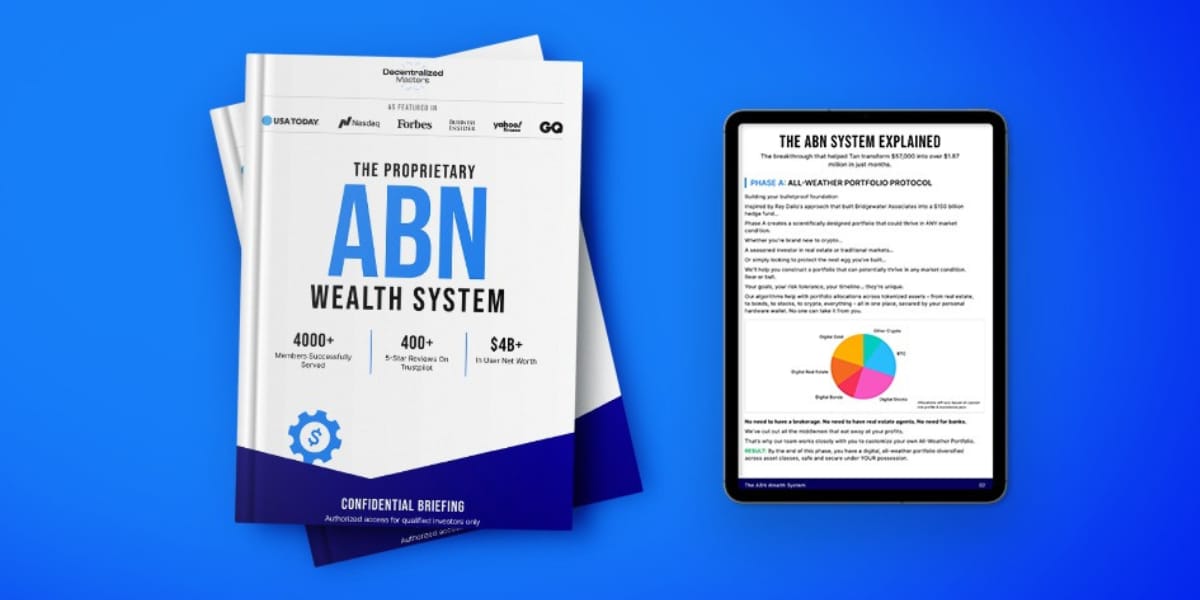
BlackRock manages $10 trillion using a playbook hidden from retail investors - until now.
The ABN Framework reverse-engineers their three-phase system: protect your base, collect fees like a bank, and get into markets before major listings.
4,000+ investors are already using it but the window is closing.
For educational purposes only. Results will vary. DM Intelligence LLC is not liable for losses.
More stories from the crypto ecosystem
Fold sells $45 mln worth of Bitcoin amidst volatile market conditions – Debt alarm?
Zcash pushes auditable Ironwood upgrade as Orchard activity faces renewed scrutiny
Curve DAO rises by 43% in 5 days – But CRV’s relief rally may not last long
Why is WLFI’s price up today? USD1 buzz, Binance transfer & more…
Why is XMR’s price up today? 3 catalysts drive Monero’s 17% recovery
Interesting facts
Stablecoins are starting to disappear inside regular money apps: Cash App users can now send and receive USDC over Polygon directly from their cash balance, with no separate stablecoin wallet, no fees, and incoming USDC converting back into dollars instantly.
A private stablecoin issuer is stepping into national currency territory: Tether plans to launch GELT, a token representing the Georgian lari, with support from Georgia’s government, making it an unusual case of a private company tying a stablecoin project to a national currency.
DeFi teams are moving after bridge risk got too expensive: Chainlink said seven major teams moved more than $4B in value to its infrastructure within two weeks, signaling how cross-chain security is becoming a survival issue rather than a backend choice.
Wall Street is shifting billions into a select group of stocks, and MarketBeat’s updated 10 Best Stocks to Own in 2026 report reveals exactly which ones. Get the 10 names attracting fresh capital before the crowd catches on. Send My Free Report
Top 3 coins of the day
DeXe (DEXE)

Key points:
DEXE traded near $20.75 on the 4H chart, rising 0.65% after recovering above the Bollinger Band basis at $20.25.
The Squeeze Momentum Indicator stood at -1.64, while volume came in at 1.05K as price held below the upper band near $23.24.
What you should know:
DEXE’s rally had already cleared the earlier $15 to $16 consolidation zone before volatility pulled price back from the $22 to $23 area. The latest recovery kept the token above the Bollinger Band basis at $20.25, but the Squeeze Momentum reading of -1.64 showed that pressure had not fully reset. Resistance sits near $21 to $22, followed by the upper band around $23.24, while $18 to $19 is the recovery base to watch. The move higher was fueled by a wave of short liquidations that forced bearish traders to cover positions, adding momentum to the rally. At the same time, renewed interest in DeFi and DAO governance tokens provided broader support for the advance.
Sky (SKY)

Key points:
SKY traded at $0.057 on the 4H chart, gaining 0.12% after recovering above the MA 20 at $0.0565.
The Squeeze Momentum Indicator stayed slightly negative at -0.00028, while volume came in at 31.96K and price remained below the MA 50 at $0.0589.
What you should know:
SKY’s rebound leaned more on supply-side conviction than breakout strength. Protocol revenue-backed buybacks and burn mechanics gave the token a deflationary support narrative, while institutional staking accumulation reduced the amount of liquid SKY available for immediate selling. On the chart, price recovered above the MA 20 at $0.0565, but the MA 50 at $0.0589 remains the first barrier to a cleaner recovery. The Squeeze Momentum reading stayed slightly negative at -0.00028, showing downside pressure had eased but not fully flipped. Support sits near $0.0565, followed by $0.054 to $0.055, while $0.064 to $0.066 is the next higher resistance zone.
Morpho (MORPHO)

Key points:
MORPHO traded near $1.90 on the 4H chart, falling 0.89% after sellers rejected the recent push toward the $2.10 to $2.15 zone.
The MACD line sat below the signal line at 0.050 versus 0.056, while volume came in at 6.52K as price slipped under the Bollinger Band basis at $1.92.
What you should know:
MORPHO’s pullback looked like digestion after a funding-led rally, not a full reversal. The token had surged after Morpho announced a $175M round co-led by Paradigm and a16z, but short-term profit-taking dragged price back below the Bollinger Band basis at $1.92. MACD also weakened, with the histogram at -0.006 showing momentum cooled after the run. A reclaim of $1.93 to $2.00 is needed before buyers can retest $2.10 to $2.11. Support sits near $1.89, followed by $1.74 to $1.75. Broader market weakness and scheduled daily token unlocks add supply-side pressure.
How was today's newsletter? |