- Unhashed Newsletter
- Posts
- SEC exit sparks crypto power struggle
SEC exit sparks crypto power struggle

Reading time: 5 minutes
SEC enforcement chief exits amid Trump-crypto clashes

Key points:
Former SEC enforcement head Margaret Ryan resigned after internal disputes over pursuing cases tied to Justin Sun, Elon Musk, and figures linked to U.S. President Donald Trump.
The exit has intensified scrutiny of the regulator’s shifting crypto enforcement priorities under Chair Paul Atkins.
News - A sudden leadership exit at the U.S. Securities and Exchange Commission (SEC) is reigniting debate over how firmly the agency plans to police the crypto sector.
According to Reuters, Margaret Ryan stepped down as director of the SEC’s Division of Enforcement on March 16, barely six months into the job. The SEC confirmed her resignation and named Sam Waldon acting chief, offering no further explanation.
Sources cited by Reuters said Ryan had clashed with senior officials over whether fraud and misconduct cases involving individuals linked to Trump should be pursued more aggressively.
Crypto entrepreneur Justin Sun became a key flashpoint in those tensions. Sun’s legal battle drew heightened attention after his financial backing of the Trump family-linked World Liberty Financial venture. Public reporting shows he invested $30 million in the project’s tokens in November 2024 before increasing his exposure to $75 million in January 2025.
Settlement underscores changing enforcement tone - The SEC first sued Sun and three of his companies in 2023, alleging unregistered securities sales and manipulative wash trading tied to Tronix and BitTorrent. Earlier this month, the agency moved to settle the case for $10 million, with one of Sun’s companies agreeing to pay the penalty without admitting or denying the allegations.
Ryan also reportedly disagreed with the SEC’s handling of its lawsuit against Elon Musk, who is now in settlement discussions over claims he disclosed his Twitter stake too late.
The twin disputes are sharpening questions over whether the SEC’s crypto enforcement path is being reshaped by legal strategy, political dynamics, or a broader policy pivot.
BitMine doubles down as ETH winter thaws

Key points:
BitMine chairman Tom Lee said Ethereum may be nearing the end of a mini crypto winter as the firm accelerated large-scale ETH purchases.
Mixed on-chain signals suggest continued accumulation interest even as whale selling capped recent price gains.
News - A fresh wave of corporate accumulation is adding fuel to speculation that Ethereum’s recent slump could be entering its final stretch.
BitMine Immersion Technologies has stepped up its buying pace in recent weeks, acquiring 65,341 ETH, worth about $139 million, and lifting its total holdings to roughly 4.6 million tokens. That stash represents close to 3.86% of Ethereum’s circulating supply, reinforcing the company’s ambition to build one of the largest digital asset treasuries in the market.
Chairman Tom Lee argued that Ethereum is likely in the closing phase of a mini crypto winter. He pointed to the token’s 18% rise during heightened geopolitical tensions involving Iran, framing the performance as evidence that crypto is increasingly being viewed as a wartime store of value.
Accumulation narrative faces short-term volatility - Even as institutional conviction builds, Ethereum’s price action has remained uneven. The asset recently traded near $2,135, still below its mid-March highs after large whale wallets reduced exposure during the rally.
However, a sharp drop in exchange balances offers a counter-signal. Around 870,000 ETH moved off trading platforms within two days, a shift often associated with long-term positioning rather than immediate selling pressure.
Regulatory momentum could also shape sentiment. Lee highlighted the advancing CLARITY Act as a potential tailwind, with market expectations increasingly favoring passage later this year.
Together, the competing signals point to a market still searching for direction, where institutional demand and macro catalysts may ultimately determine whether Ethereum’s correction gives way to sustained recovery.
Stablecoin policy shifts split U.S. and Europe

Key points:
U.S. lawmakers are moving forward with stablecoin oversight at both state and federal levels, but new draft language could restrict yield incentives.
European policymakers and industry participants are instead focusing on legal clarity and settlement infrastructure needed to scale tokenized finance.
News - Stablecoin regulation is gathering pace globally, with policymakers in the United States and Europe pursuing different paths to bring digital money further into mainstream finance.
Across jurisdictions, the debate now centers less on whether stablecoins should be regulated and more on how rules should balance innovation, investor protection, and financial stability.
U.S. proposals tighten oversight framework - In Delaware, lawmakers have introduced legislation aimed at creating a licensing regime for stablecoin issuers and digital asset service providers as part of a broader modernization of the state’s banking code.
The proposal incorporates elements from federal initiatives such as the GENIUS Act and outlines safeguards including reserve remediation requirements, capital standards, redemption timing rules, and anti-money-laundering (AML) obligations.
At the federal level, draft provisions tied to the Senate’s CLARITY Act are drawing industry scrutiny. The latest text would reportedly prohibit platforms from offering yield on stablecoin balances, while allowing narrower activity-based rewards. The SEC, CFTC, and Treasury would then be tasked with defining permissible incentives and anti-evasion standards within a year.
Europe focuses on settlement scale and market access - European officials are placing greater emphasis on infrastructure and legal alignment. ECB Executive Board member Piero Cipollone said tokenized deposits and stablecoins require tokenized central bank money to scale financial markets effectively.
At the same time, stablecoin issuer Circle has urged regulators to lower market access thresholds, arguing current rules make it difficult for euro-denominated stablecoins such as EURC to gain traction in settlement activity.
Australia pension giant eyes crypto shift

Key points:
Hostplus is exploring offering Bitcoin and other digital assets through its self-managed ChoicePlus option as member demand rises.
Growing national crypto ownership and regulatory uncertainty are shaping how pension funds approach exposure.
News - Crypto could soon move deeper into Australia’s retirement system as major pension fund Hostplus weighs allowing members to invest in digital assets. The proposal, still in its early design phase, comes amid rising interest in digital assets among Australian investors.
Retirement savings meet digital assets - Hostplus, one of Australia’s largest superannuation funds by membership and assets, is assessing whether to introduce Bitcoin and other crypto investments through its ChoicePlus platform. The option currently accounts for a small share of total fund assets but allows individuals to manage a portion of their retirement portfolios independently.
Executives say the initiative is driven by persistent member inquiries and could launch as early as the next financial year, subject to regulatory approval and additional consumer protection measures. The review also extends beyond Bitcoin, with potential exposure to a broader set of digital assets, including tokenized investments tied to emerging sectors.
Adoption tailwinds and lingering caution - The exploration comes as crypto ownership in Australia reaches new highs. Surveys indicate roughly one in three Australians now holds digital assets, with participation strongest among younger demographics seeking alternatives to traditional wealth-building paths.
Institutional hesitation remains, however. Market volatility has prompted some funds, including early adopter AMP Super, to reduce crypto exposure after recent downturns. Even so, industry observers suggest that if large retirement funds begin offering access, competitive pressure could accelerate wider adoption across the sector.
Unlock The $4 Trillion Rent Roll: Compound Your Wealth Like the 1%

Institutional giants use the $4 trillion rental market to compound millions. Now you can too. mogul offers fractional ownership in elite rental properties with 18.8% average IRR and zero property management required. Secure your share of the wealth Wall Street once kept for itself.
Past performance isn't predictive; illustrative only. Investing risks principal; no securities offer. See important Disclaimers
More stories from the crypto ecosystem
Interesting facts
Crypto is increasingly used as a hedge in countries facing currency instability: In regions experiencing high inflation or capital controls, Bitcoin and stablecoins have seen rising grassroots adoption as alternatives for savings and cross-border transfers.
Crypto ownership has already crossed a major global adoption threshold: By 2024, more than 500 million people worldwide were estimated to own digital assets, reflecting rapid growth in emerging markets where crypto is increasingly used for savings and remittances.
Ethereum quietly became one of the largest yield-generating blockchain ecosystems: Following the shift to Proof-of-Stake in 2022, Ethereum validators now collectively earn billions of dollars annually in staking rewards, turning ETH into a major on-chain income-producing asset for institutions and retail holders alike.
The Best Place to Invest $1,000 Right Now

This AI tech could go down in history as the crown jewel of Elon's career. It could send ChatGPT offline forever and trigger a 70X investment boom. Watch the free presentation.
Top 3 coins of the day
Bittensor (TAO)
Key points:
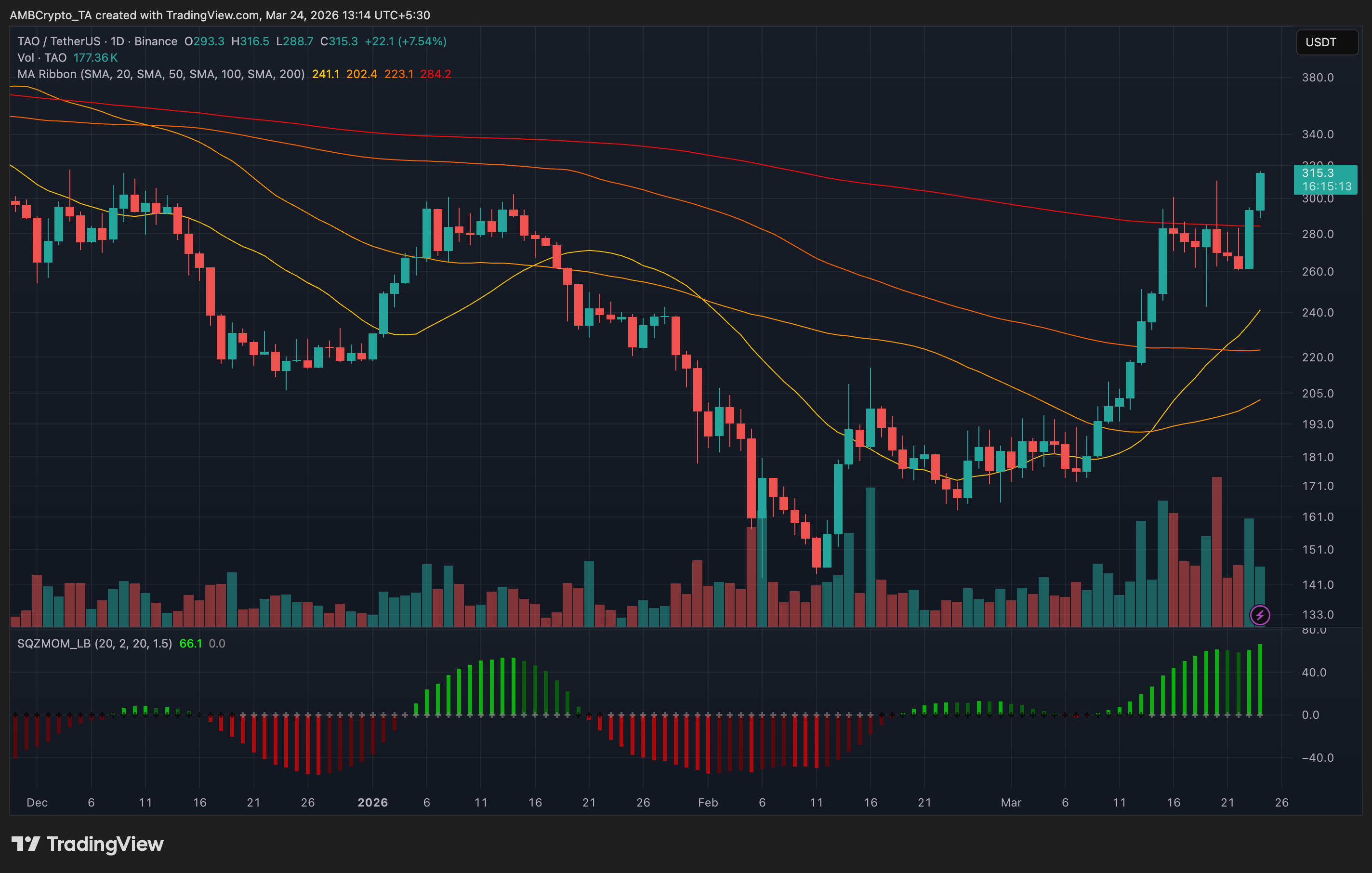
TAO rallied to about $315, building on its sharp recovery from the February bottom.
The latest candle closed above the full MA Ribbon as Squeeze Momentum bars continued rising, highlighting strengthening upside momentum.
What you should know:
Following an extended period of weakness, TAO formed a base in February before shifting into a strong uptrend through March. The move accelerated once price reclaimed the clustered moving averages, with recent candles pushing toward the $315 region on improving participation. Market sentiment also strengthened after NVIDIA CEO Jensen Huang publicly highlighted decentralized AI training models, including Bittensor’s approach, drawing renewed investor focus to the project. Additional support came from the successful Covenant-72B milestone and growing institutional interest linked to filings for a dedicated Bittensor investment vehicle and corporate treasury accumulation. Immediate resistance sits near $330, while support is now seen around $300 and lower near $260.
World Liberty Financial (WLFI)
Key points:
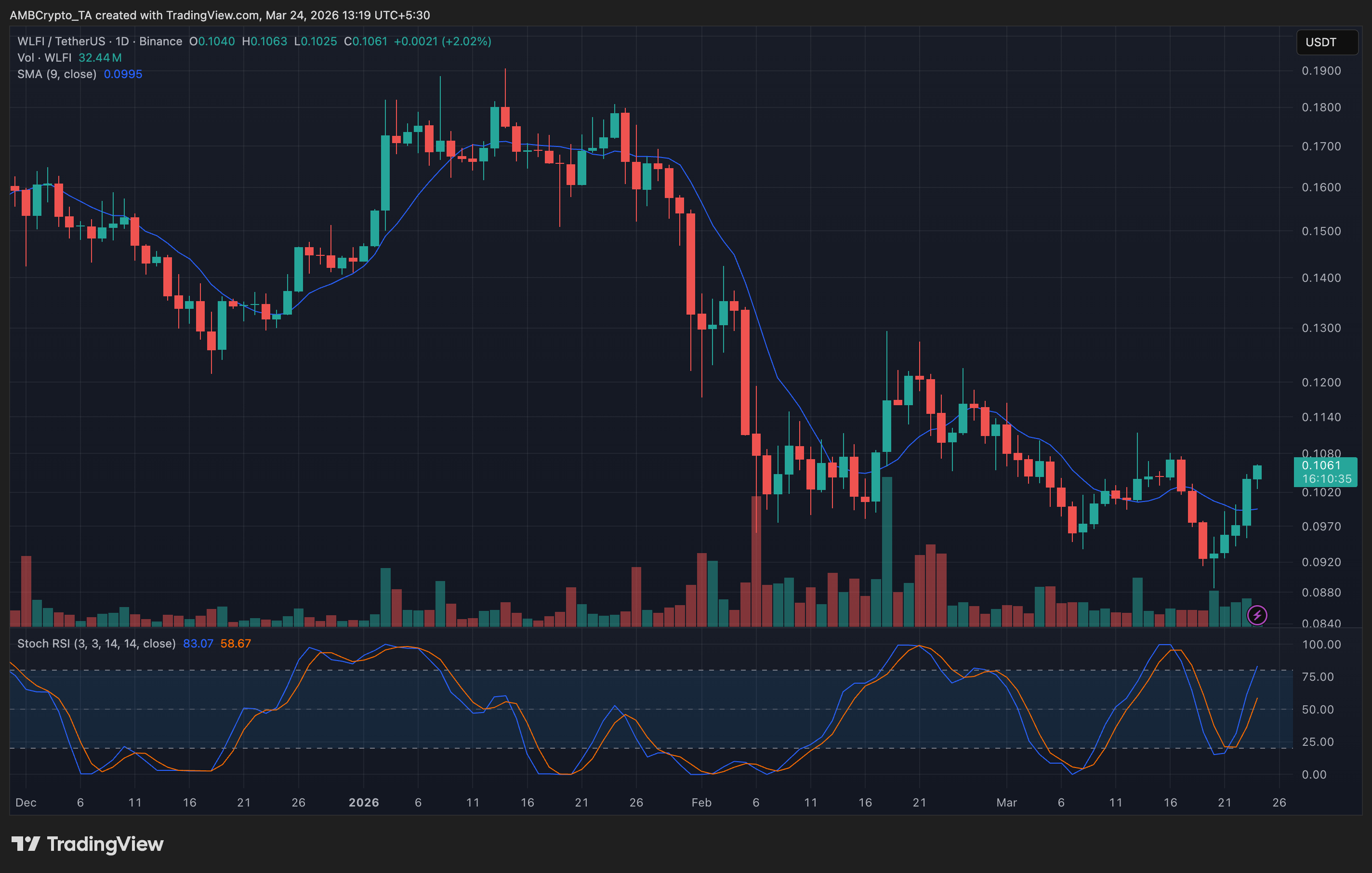
WLFI edged up to roughly $0.106, recovering from a recent slide toward the $0.092 support band.
Price moved back above the 9-day SMA while the Stochastic RSI turned higher toward the upper range, pointing to improving short-term momentum.
What you should know:
After trending lower through late January and early February, WLFI entered a volatile consolidation phase marked by uneven recovery attempts. The latest bounce developed once price reclaimed the short-term average, with buyers stepping in again near the $0.10 psychological zone. Trading activity showed brief bursts of participation during rebound sessions but lacked sustained follow-through. Sentiment gained support from ecosystem-specific developments such as Binance’s large WLFI airdrop campaign linked to USD1 holders and the approval of a governance proposal requiring token lock-ups, which tightened circulating supply. Additional optimism stemmed from the launch of the AgentPay toolkit enabling AI-driven payments and signs of sizable wallet accumulation. Immediate resistance stands near $0.115, while support holds around $0.10 and lower near $0.092.
Chainlink (LINK)

Key points:
LINK hovered near $9.20 after rebounding from the recent dip toward the $8.70 region, signaling stabilizing short-term demand following a prolonged slide.
The MA Ribbon remained overhead while RSI stayed near neutral levels, reflecting tentative recovery momentum amid moderate trading activity.
What you should know:
LINK’s earlier decline was followed by a gradual base-building phase, with price attempting to regain traction near the $9 zone. Institutional developments appeared to underpin sentiment, including $3.34M in spot ETF inflows and continued strategic reserve accumulation by the protocol. Meanwhile, the Economics 2.0 staking milestone, with over 700M LINK locked, has contributed to tightening circulating supply dynamics. Ongoing CCIP adoption and regional tokenisation partnerships also reinforced its infrastructure narrative. From a technical standpoint, sustained acceptance above $9.00 remains key for upside continuation, while rejection at $9.60 could keep LINK range-bound. Traders may continue monitoring RSI behavior and volume trends for confirmation of directional strength.
How was today's newsletter? |