- Unhashed Newsletter
- Posts
- The $100M XRP mistake
The $100M XRP mistake
Sponsored by


Reading time: 5 minutes
Ethereum whales buy the dip as institutions reposition

Key points:
Ethereum whales accumulated roughly $832M worth of ETH during the latest price pullback, even as ETF inflows weakened and traders reduced leverage exposure.
Institutional players continued reshaping their Ethereum strategies, with Wells Fargo increasing ETH ETF holdings while treasury firms doubled down on staking and yield-focused plans.
News - Ethereum’s recent consolidation near the $2,300 range is revealing a growing divide between cautious traders and long-term institutional positioning.
While ETH struggled to reclaim the $2,400 resistance zone, large wallets quietly accumulated around 360,000 ETH during the latest downturn, according to on-chain data. The purchases came as derivatives leverage cooled and open interest declined, suggesting that much of the recent volatility was driven by short-covering rather than aggressive speculative buying.
At the same time, several major institutions continued adjusting their Ethereum exposure behind the scenes.
Institutions keep leaning into ETH - Wells Fargo increased its holdings in Ethereum-linked ETFs during Q1 2026, raising exposure to BlackRock’s ETHA and Bitwise’s ETHW even as spot Ether ETFs recorded months of outflows and ETH posted consecutive quarterly declines.
Ethereum treasury firms also stayed active despite market weakness. Bitmine slowed its pace of ETH accumulation after rapidly expanding its holdings earlier this year, though the company reiterated plans to eventually hold 5% of Ethereum’s circulating supply while staking its reserves for yield generation.
Meanwhile, Sharplink unveiled a new $125M on-chain yield fund with Galaxy after reporting a quarterly loss tied largely to unrealized ETH treasury declines.
Treasury shifts add another layer - The Ethereum Foundation also unstaked nearly $50M in ETH from Lido as it continued reshaping its treasury strategy following months of increased staking activity and reduced direct token sales.
Ripple veteran missed $100M XRP upside

Key points:
Ripple’s former CTO David Schwartz said XRP generated more personal wealth for him than Bitcoin or Ethereum, despite years of reducing his crypto exposure.
Schwartz admitted his conservative investing style led him to sell major holdings too early, potentially missing out on a near-$100M XRP position.
News - David Schwartz, Ripple’s CTO Emeritus and one of the original architects behind the XRP Ledger, has opened up about the investing decisions that shaped his crypto fortune and the upside he believes he left behind.
In a recent discussion on X, Schwartz revealed that XRP delivered the largest lifetime returns of any cryptocurrency he owned “by far,” even outperforming his early Bitcoin and Ethereum positions. At one stage, he held 26 million XRP alongside roughly 1,000 BTC and thousands of ETH before steadily trimming those positions over the years.
While XRP eventually became his most profitable investment, Schwartz admitted that fear and risk aversion heavily influenced many of his earlier sales.
Selling too early - Schwartz disclosed that he sold Ethereum at around $1.05 and reduced his Bitcoin holdings long before BTC crossed six figures. He also confirmed that he gradually sold large portions of his XRP stack whenever the token reached new highs because the growing dollar value made him uncomfortable.
Had he held the full 26 million XRP position through the token’s peak near $3.84, the allocation would have approached $100M in value.
Choosing stability over maximum gains - Despite acknowledging the missed upside, Schwartz defended his cautious approach. He said maintaining peace of mind and manageable risk mattered more to him than maximizing returns through extreme volatility.
Today, most of his remaining crypto exposure is tied to XRP and Ripple equity.
Trade any market, anywhere, any time.

News doesn’t take weekends off, neither should your portfolio. What about when the S&P moves 3% during your commute?
Liquid allows anyone to trade stocks, commodities, FX, pre-IPO companies, crypto, and more with up to 100X leverage, 24/7, from your phone or computer.
Any Market - Trade everything from Gold to Bitcoin, OpenAI to Nvidia, SK Hynix to JPY.
Anywhere - Liquid is available on iOS, Android, and desktop platforms, letting you trade from the subway, your office, and maybe even the bathroom.
Any Time - Liquid markets are open 24/7; so when an unprecedented event happens on Saturday, you can stay on top of your portfolio.
Active traders qualify for rewards each month!
Wall Street critics turn up heat on Bitcoin

Key points:
Ray Dalio argued that Bitcoin’s transparency, stock market correlation, and market structure continue to limit its appeal as a central bank reserve asset.
Peter Schiff called on the SEC to review Michael Saylor and Strategy’s STRC model, warning that the product exposes retirees to excessive risk.
News - Two of Wall Street’s most vocal Bitcoin skeptics reignited criticism of the asset this week, though from very different angles.
Bridgewater founder Ray Dalio questioned Bitcoin’s role as a long-term reserve asset, while economist Peter Schiff escalated his ongoing battle with Michael Saylor over Strategy’s preferred stock product, STRC.
Together, the comments reopened broader concerns around Bitcoin’s stability, transparency, and growing connection to traditional financial markets.
Dalio questions Bitcoin’s reserve asset future - Dalio argued that Bitcoin’s public blockchain creates a major privacy problem for sovereign institutions. In a recent post on X, he said transactions can be monitored and potentially controlled, making the asset less attractive for central banks seeking reserve diversification.
He also pointed to Bitcoin’s strong correlation with the Nasdaq, arguing that the asset still behaves more like a technology trade than an independent safe haven during market stress. Dalio maintained that gold remains more deeply established and globally trusted within the financial system.
Schiff targets Strategy and STRC - Meanwhile, Schiff urged regulators to examine whether Saylor’s public comments around STRC violate SEC antifraud and marketing rules.
The longtime Bitcoin critic argued that Strategy’s preferred stock product is being positioned as suitable for retirees seeking stable income and capital preservation despite its deep exposure to Bitcoin volatility.
Strategy has continued defending its model, recently increasing its Bitcoin holdings to 818,869 BTC after purchasing another 535 Bitcoin for roughly $43M.
Bhutan fast-tracks crypto firms with banking and Bitcoin push

Key points:
Bhutan’s Gelephu Mindfulness City launched an accelerated licensing framework that combines regulatory approval, banking access, and tax incentives for globally regulated crypto firms.
The initiative arrives as Bhutan continues expanding its Bitcoin-linked economic strategy, despite renewed attention around recent BTC outflows tied to the country.
News - Bhutan is moving deeper into crypto-driven economic development through Gelephu Mindfulness City (GMC), a special administrative region positioning itself as a new hub for digital asset and fintech companies.
The newly launched framework allows firms already regulated in jurisdictions such as Singapore, Hong Kong, and Abu Dhabi Global Market to move through licensing, incorporation, and banking as a single coordinated process. Companies approved under GMC’s system also receive direct access to corporate banking through DK Bank, including multi-currency accounts, crypto on- and off-ramp services, and Bitcoin-backed lending.
Officials described the model as an attempt to remove one of the industry’s biggest operational bottlenecks: securing banking access after regulatory approval.
Tax incentives strengthen Bhutan’s pitch - GMC is also pairing the licensing push with major financial incentives. The region offers targeted 0% corporate tax rates for qualifying firms, along with exemptions on capital gains, dividends, inheritance taxes, and certain foreign talent tax exemptions through 2030.
Authorities said the framework is intended to attract companies building long-term operations rather than short-term offshore structures.
Bitcoin reserves remain in focus - The rollout comes as blockchain analysts continue tracking Bitcoin movements linked to Bhutan. On-chain data flagged another transfer of roughly 100 BTC this week, adding to speculation surrounding the country’s reserves.
Bhutan previously pledged up to 10,000 BTC to support GMC’s long-term development, though officials denied reports suggesting the reserves were being sold to fund the project.
The 15-Minute Retirement Plan

Retirement savings face two quiet threats: cash flow gaps and inflation eroding purchasing power over time. The 15-Minute Retirement Plan helps investors with $1,000,000 or more account for both and build a portfolio designed to last the distance.
More stories from the crypto ecosystem
Hyperliquid: 21Shares HYPE ETF debuts as whale activity surges 272%
Crypto inflows jump to $857.9mln as CLARITY Act vote nears – Can momentum last?
The next big move? Bitcoin momentum flips positive as dormant whale moves $40M after 13 years!
Ethereum Foundation just unstaked $49M in ETH – Should you be worried?
BUILDon price rallies – Can Bitcoin’s 81% correlation drive more gains?
Interesting facts
Stablecoins quietly became a retail payment story, not just a trader tool: Visa found that retail-sized volume for USDC, USDT, and PYUSD jumped from $0.5B in 2019 to $69.8B in 2025, marking a 140x rise in six years as smaller stablecoin payments gained traction beyond exchange activity.
Bitcoin payments reached a fast-food counter in Switzerland: McDonald’s began accepting Bitcoin payments in Lugano, Switzerland, as part of the city’s Plan ₿ push to bring crypto into daily payments, from retail purchases to public services. The fact still works today because Lugano remains one of the clearest live examples of a city testing Bitcoin as everyday payment infrastructure.
India has already tested blockchain where paperwork hurts most: India’s official blockchain portal lists land records as a government use case, with property registration data made available through workflow systems and public verification. That makes blockchain less of a market buzzword and more of a practical anti-fraud tool for tracking ownership history.
A 47-yr Wall Street veteran says 2026 will reset the entire AI market. He's sharing the stocks to buy and dump before it hits. Get the Free Picks.
Top 3 coins of the day
Toncoin (TON)
Key points:
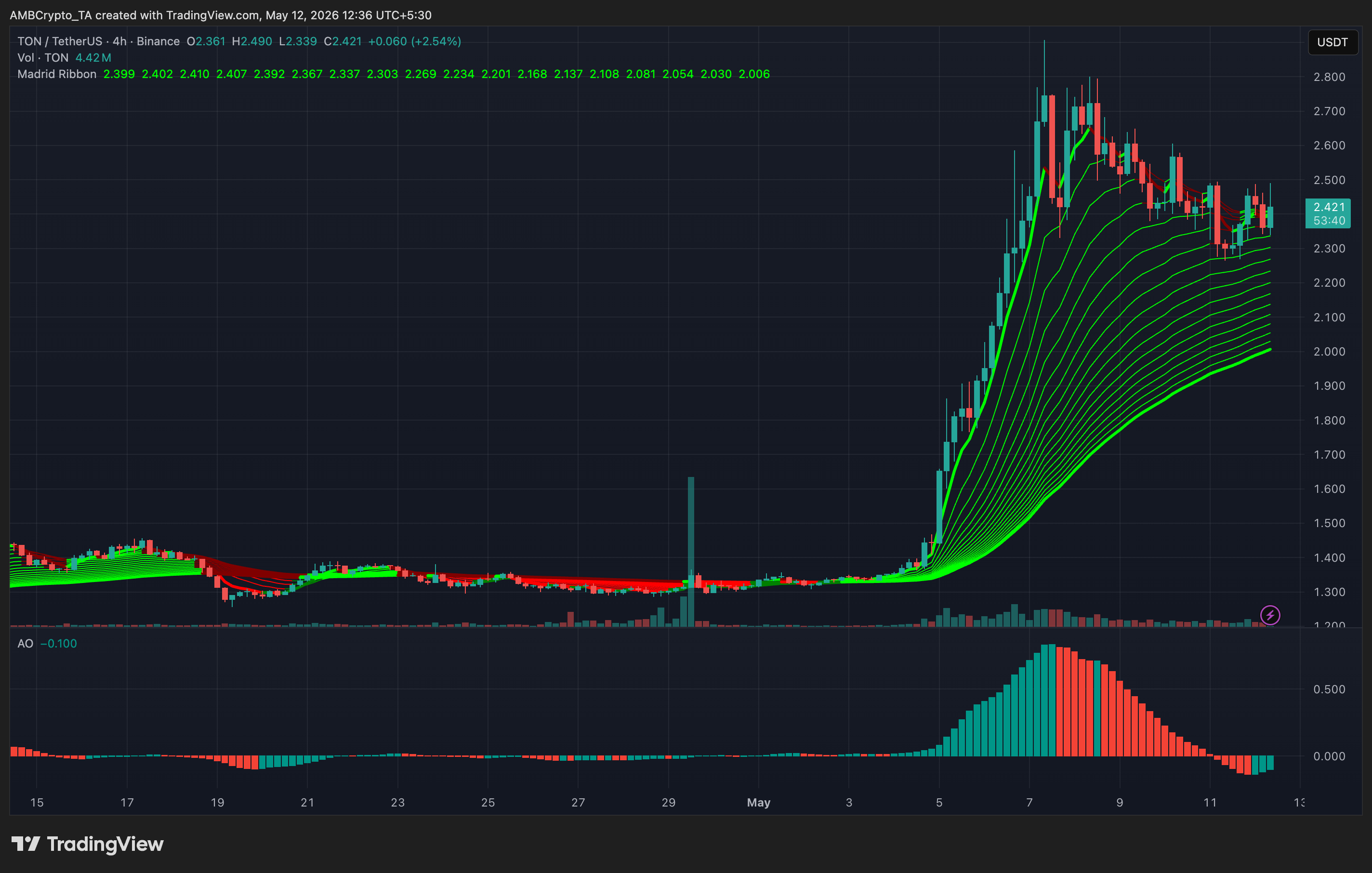
TON stabilized near $2.42 after cooling from its recent rally toward the $2.70-$2.80 region on the 4-hour chart.
The Madrid Ribbon remained broadly bullish, while the Awesome Oscillator printed small green bars below zero, signaling fading bearish momentum.
What you should know:
Toncoin continued consolidating above its recent breakout zone after Telegram founder Pavel Durov confirmed that Telegram would take a larger operational role within the TON ecosystem and become the network’s largest validator. Sentiment also strengthened following the rollout of the Catchain 2.0 upgrade, which reportedly reduced transaction finality times to nearly one second while cutting fees significantly.
Meanwhile, rising staking participation and APR competition continued reducing liquid TON supply across the market. On the chart, price action stayed above most of the Madrid Ribbon structure despite recent lower highs. The Awesome Oscillator remained below zero, though the latest histogram bars suggested selling pressure was gradually cooling near the $2.30-$2.35 support region.
Cronos (CRO)

Key points:
CRO advanced toward the $0.080-$0.083 range after extending its breakout from the earlier $0.068 consolidation zone on the 4-hour chart.
The Awesome Oscillator stayed firmly above zero with expanding green bars, while rising volume reinforced the latest bullish continuation move.
What you should know:
Cronos gained momentum after Crypto.com secured a Stored Value Facilities license from the Central Bank of the UAE, becoming the first virtual asset platform approved to support crypto-based government service payments in the region. The development strengthened investor optimism around CRO’s broader payment utility and long-term adoption prospects.
At the same time, traders reacted positively to Cronos’s updated 2026 roadmap, which includes faster block times and additional Layer-2 scaling improvements. On the technical side, the MA Cross remained decisively bullish as the faster average continued pulling away from the slower line. Meanwhile, elevated trading volume and strengthening Awesome Oscillator momentum suggested buyers still controlled the near-term trend above the $0.077-$0.078 support area.
Ondo (ONDO)
Key points:
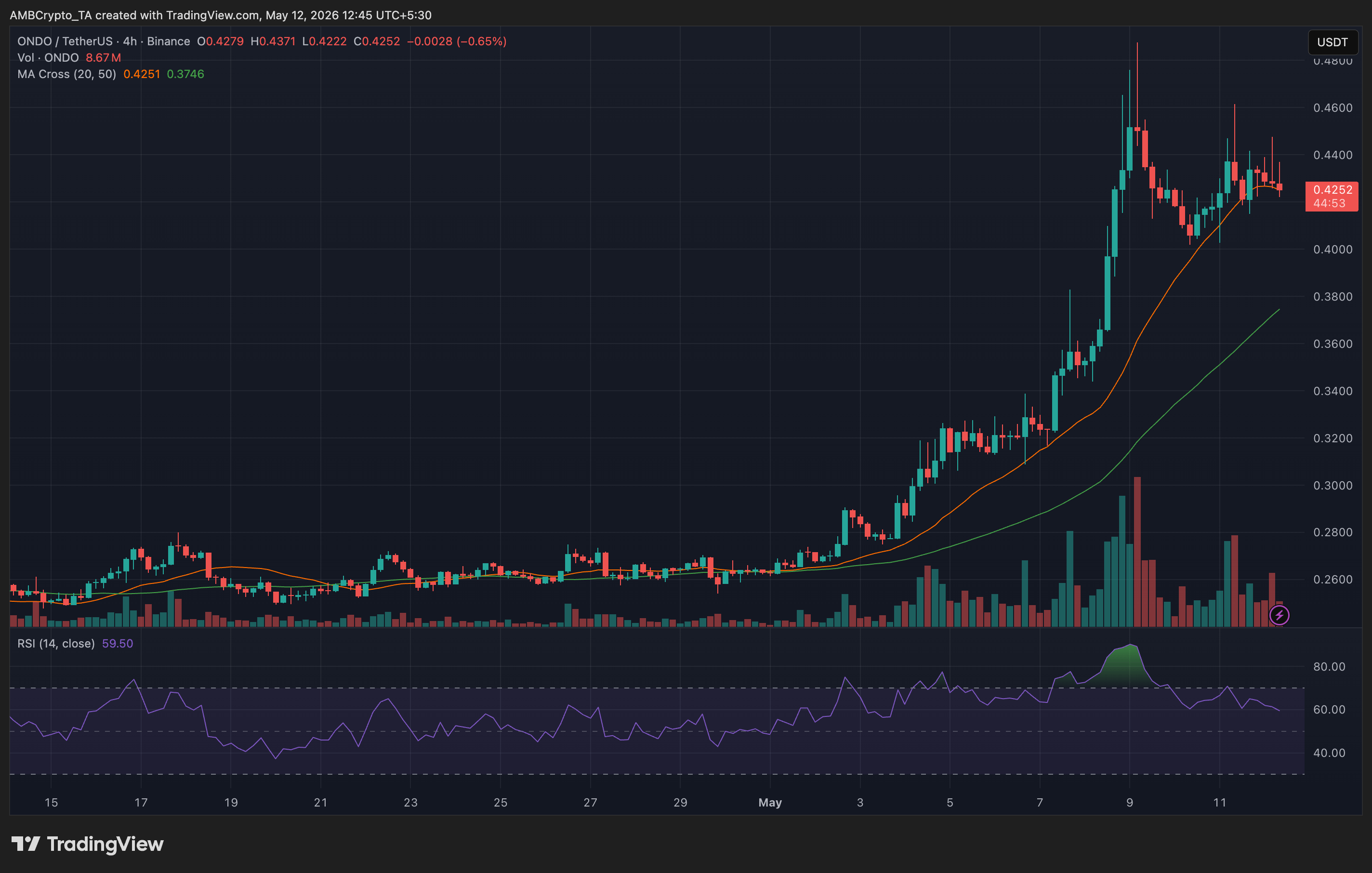
ONDO slipped toward $0.42 after retreating from its recent rally peak near the $0.47-$0.48 region on the 4-hour chart.
RSI cooled back toward neutral territory while declining volume pointed to softer momentum during the latest consolidation phase.
What you should know:
Ondo’s recent pullback followed an aggressive multi-day rally that had been fueled by growing interest in the project’s tokenized treasury initiatives, including its cross-border settlement pilot involving JPMorgan and Mastercard. The slowdown in price action coincided with reduced trading activity, suggesting traders were locking in profits after the sharp advance rather than exiting on heavy panic selling.
On the technical side, ONDO continued trading above both moving averages even after the RSI cooled back toward the 59-60 region from earlier overbought levels above 80. The MA Cross structure remained bullish overall, although the gap between the averages started stabilizing as the rally lost speed. Traders may continue watching the $0.40-$0.41 area as the nearest short-term support zone.
How was today's newsletter? |