- Unhashed Newsletter
- Posts
- Trump’s Fed pick holds crypto, AI bets
Trump’s Fed pick holds crypto, AI bets

Reading time: 5 minutes
X’s crypto tease sparks speculation ahead of X Money launch

Key points:
X’s Head of Product Nikita Bier hinted at a crypto-focused product, fueling speculation just weeks before X Money’s expected rollout.
While X Money is officially fiat-based, recent hires and product signals suggest crypto-related elements have not been ruled out.
News - Nikita Bier, X’s Head of Product, has reignited crypto speculation after hinting that the platform could launch something to “fix” the industry following a difficult year. The timing is notable, with X Money, the company’s long-awaited payments and wallet service, expected to go live in April.
X Money is designed as a fiat-first product, offering peer-to-peer transfers, bank deposits, a debit card, and cashback rewards through a Visa-backed setup. No crypto functionality has been confirmed. However, Bier’s remarks, combined with X’s recent hiring of crypto-focused talent, have raised questions about whether the platform may incorporate elements that overlap with areas crypto has focused on.
The speculation spans multiple directions. Some expect a return of Bitcoin payments, similar to Twitter’s earlier Lightning Network tipping feature. Others point to stablecoin payouts, creator monetization tools, or payment systems that reflect features commonly associated with crypto platforms.
Signals point to deeper crypto intent - X has already hinted at crypto-adjacent features like Smart Cashtags, which would allow users to trade assets directly from their timeline. The hiring of former Aave executive Benji Taylor has also drawn attention due to his background in crypto product design.
Still, skepticism remains. Bier’s ties to Solana and Elon Musk’s public support for Dogecoin have led some to question the direction of any potential rollout.
For now, X’s plans remain unclear, but its next move could significantly shape how users interact with digital finance.
Trump’s Fed pick reveals crypto, AI exposure ahead of hearing

Key points:
Federal Reserve chair nominee Kevin Warsh disclosed over $100 million in assets, including exposure to crypto, AI, and emerging tech.
Several crypto and AI holdings were listed without value ranges, drawing attention as his Senate confirmation approaches.
News - Kevin Warsh, US President Donald Trump’s nominee to lead the Federal Reserve, has disclosed a portfolio exceeding $100 million, spanning crypto, artificial intelligence (AI), and private markets, ahead of his expected Senate confirmation hearing.
The filing, submitted to the US Office of Government Ethics, includes investments in firms such as Compound, Dapper Labs, Blast, and exposure to Bitwise, alongside a broad mix of AI, fintech, and early-stage startups. However, multiple crypto and AI-related holdings were listed without specific value ranges, which is permitted under disclosure rules in certain cases.
Warsh’s largest reported positions include over $50 million in the Juggernaut Fund and more than $10 million in consulting income tied to Stanley Druckenmiller’s Duquesne Family Office. Additional investments are spread across dozens of smaller positions through affiliated entities, covering areas such as crypto infrastructure, fintech, biotech, and AI.
What his portfolio signals for crypto policy - Warsh’s financial exposure has drawn attention as the Federal Reserve faces increasing pressure to define its stance on digital assets. He has previously compared Bitcoin to gold as a potential store of value, while maintaining that it does not replace the US dollar.
He has pledged to divest key holdings, including fund positions linked to his advisory roles, if confirmed. His nomination also comes as leadership gaps persist at major regulators, including the SEC and CFTC, both expected to play central roles in shaping crypto policy.
With his confirmation timeline still uncertain, Warsh’s financial disclosures are likely to remain a focal point for lawmakers.
Fake Ledger app drains $9.5M, exposes App Store risks
Key points:
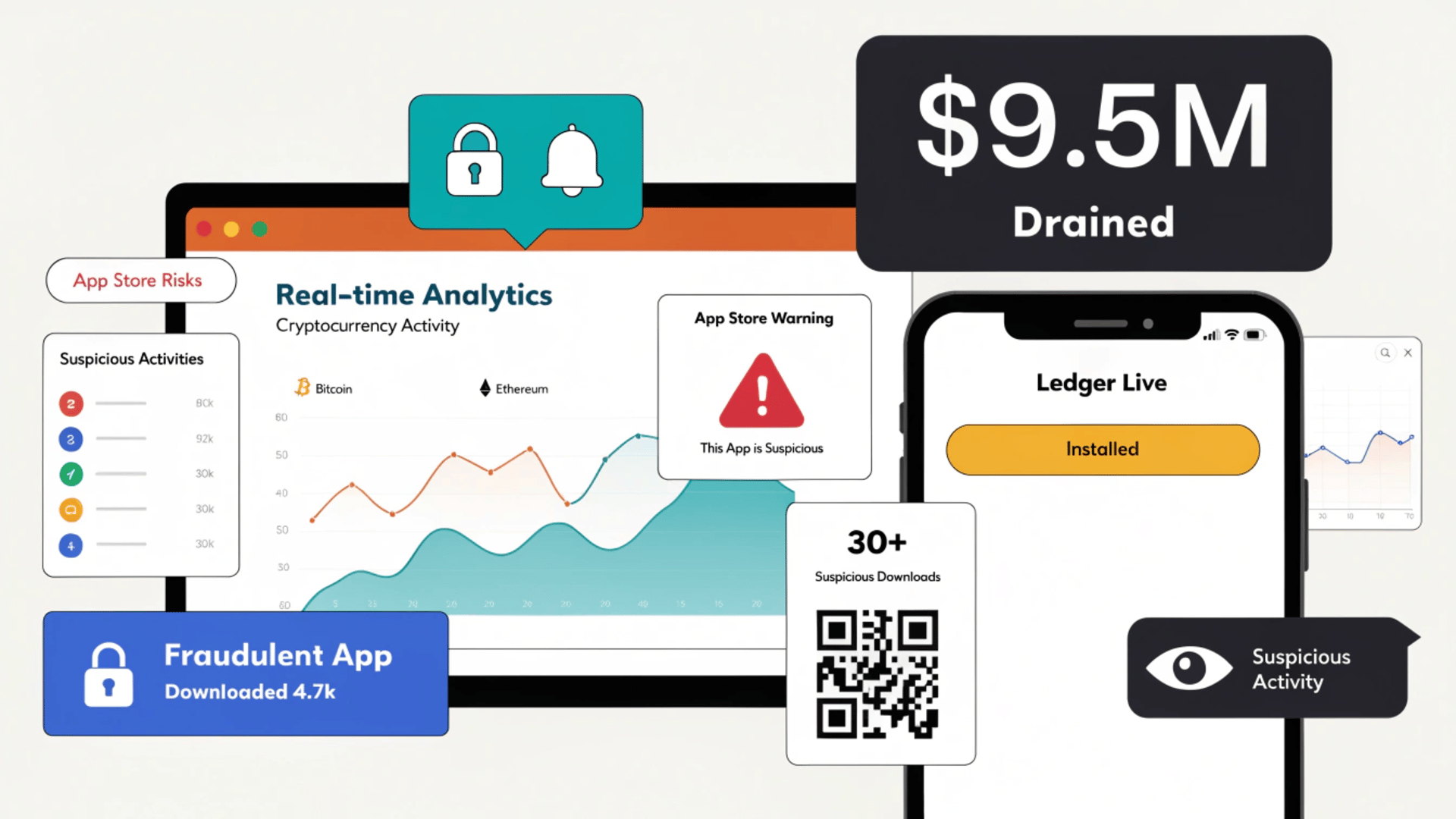
A fake Ledger Live app on Apple’s App Store stole over $9.5 million from more than 50 victims across multiple blockchains.
Stolen funds were routed through KuCoin-linked addresses tied to a laundering service, raising questions about platform oversight.
News - More than $9.5 million in crypto was drained from over 50 users after a fake Ledger Live app appeared on Apple’s App Store, according to findings by on-chain investigator ZachXBT. The phishing campaign ran between April 7 and April 13 before the app was removed.
The attack targeted users across Bitcoin, Ethereum-compatible networks, Solana, Tron, and XRP. Victims entered their recovery phrases into the malicious app, giving attackers full access to their wallets and enabling rapid fund withdrawals.
Among those affected was musician G. Love, who reported losing nearly 6 BTC, valued at over $400,000, after downloading the fraudulent app while setting up a new device. Several others suffered seven-figure losses, including cases involving USDT, USDC, Ether, and staked Ether.
Laundering trail raises red flags - ZachXBT traced the stolen assets through more than 150 KuCoin deposit addresses linked to a service identified as AudiA6, described as a centralized mixing operation used to obscure illicit transactions. KuCoin indicated it had frozen at least one suspicious account tied to the activity, though further action would depend on legal processes.
The incident has intensified scrutiny over how the fake app passed review and was distributed through Apple’s official marketplace. Apple had not publicly confirmed the findings at the time of reporting, while KuCoin said it had frozen at least one suspicious account tied to the incident.
Ledger has reiterated that it never asks users to enter their 24-word recovery phrase into any application, warning that even trusted platforms like app stores cannot be assumed to be secure.
As phishing tactics grow more sophisticated, the breach underscores how quickly users can lose funds when interacting with seemingly legitimate software.
OneCoin victims get $40M relief as DOJ opens compensation claims

Key points:
Victims of the $4 billion OneCoin fraud can now apply for compensation from over $40 million in seized assets.
The claims process marks a step in recovery efforts, even as key figures behind the scheme remain unresolved.
News - Years after OneCoin began defrauding investors, US authorities have opened a compensation process offering victims access to over $40 million in recovered funds.
The US Department of Justice confirmed that individuals who purchased OneCoin between 2014 and 2019 can now file claims through an official remission program, with a deadline set for June 30, 2026. The effort follows years of investigations and asset seizures tied to the scheme’s operators.
OneCoin, promoted as a cryptocurrency through a global multi-level marketing network, ultimately drew over $4 billion from millions of investors. The project never operated on a blockchain, with its founders later found to have misrepresented the asset’s value and structure.
A long road to recovery - The compensation process comes after key legal actions against those behind the scheme. Co-founder Karl Sebastian Greenwood was sentenced to 20 years in prison, while Ruja Ignatova, known as the “Cryptoqueen,” remains at large and on the FBI’s Ten Most Wanted list.
Authorities have indicated that efforts to recover additional assets are ongoing.
The move represents a continued effort to return funds to those affected by one of the largest fraud schemes tied to the crypto sector.
Trade from the subway, golf course, or toilet
Liquid enables users to go long or short on any market from your phone or desktop 24/7.
No matter what time of day it is or where you are, you can monitor the situation with Liquid.
More stories from the crypto ecosystem
Algorand: Can ALGO target $0.1271 after a 10% price breakout?
‘Mainstream access’ for XRP? Inside Rakuten’s 3 trillion point integration
HYPE outflows rise after $2.4 mln buy: Will this reduced supply push price toward $60?
Bitcoin stabilizes after $30B wipeout – BTC’s rally to $80K possible IF…
Michael Saylor adds 13,927 BTC – Strategy’s treasury now has 780,897 Bitcoin
Interesting facts
The first-ever NFT wasn’t on Ethereum; it predates it by years: “Quantum,” minted in 2014 by Kevin McCoy on the Namecoin blockchain, is widely recognized as the earliest NFT, years before Ethereum popularized the concept.
A single hard drive mistake once erased access to billions in Bitcoin: In 2013, James Howells accidentally discarded a hard drive containing 8,000 BTC, which remains lost in a landfill despite multiple recovery attempts over the years.
Bitcoin’s smallest unit wasn’t always called a “satoshi”: The term “satoshi” was adopted by the community in 2010 to represent one hundred-millionth of a Bitcoin, despite not being part of the original Satoshi Nakamoto whitepaper.
Defense Tech Is the New Frontier for Investors

Record defense budgets are flowing into AI, satellite infrastructure, and advanced aerospace platforms. Our free research report names 5 companies at the center of this spending shift, before Wall Street catches up.
Top 3 coins of the day
PancakeSwap (CAKE)
Key points:
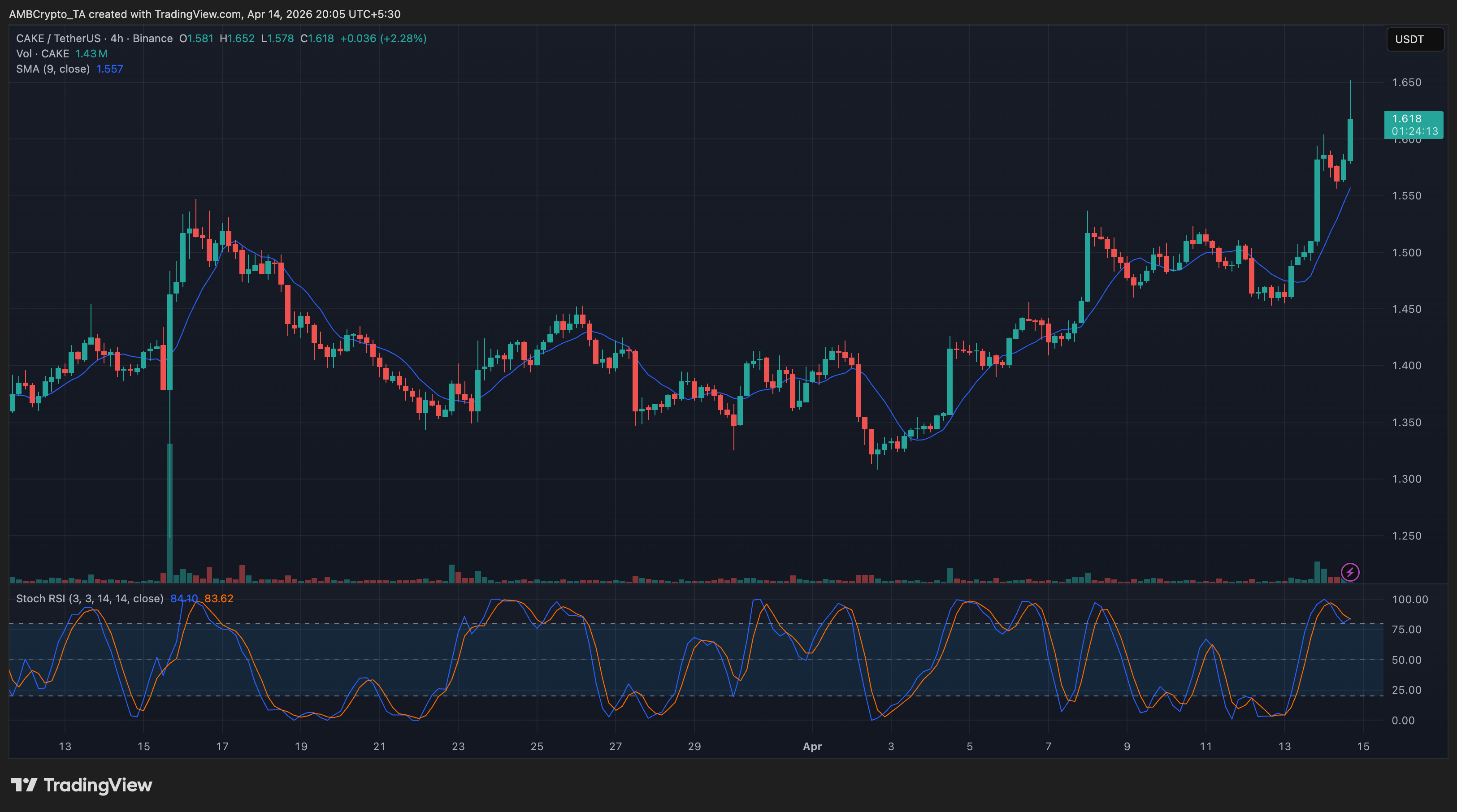
CAKE jumped toward $1.61 after breaking out above $1.50, with price holding firmly above the rising 9 SMA.
Stochastic RSI entered overbought territory while volume showed a moderate uptick, signaling momentum with controlled participation.
What you should know:
CAKE advanced from the $1.48–$1.50 range and extended its move toward $1.61, maintaining a sequence of higher highs and higher lows. The 9 SMA trended upward beneath price, reinforcing short-term bullish control, though the widening gap suggested the move had stretched in the near term. Stochastic RSI climbed above 80 and began flattening, hinting at a potential pause rather than an immediate reversal. The move aligned with a broader market rally, where Bitcoin gained over 5%, alongside a notable increase in CAKE’s trading activity, with volume rising sharply to around $86M. Immediate support stands near $1.55, while resistance is seen around $1.65.
Ethereum (ETH)
Key points:
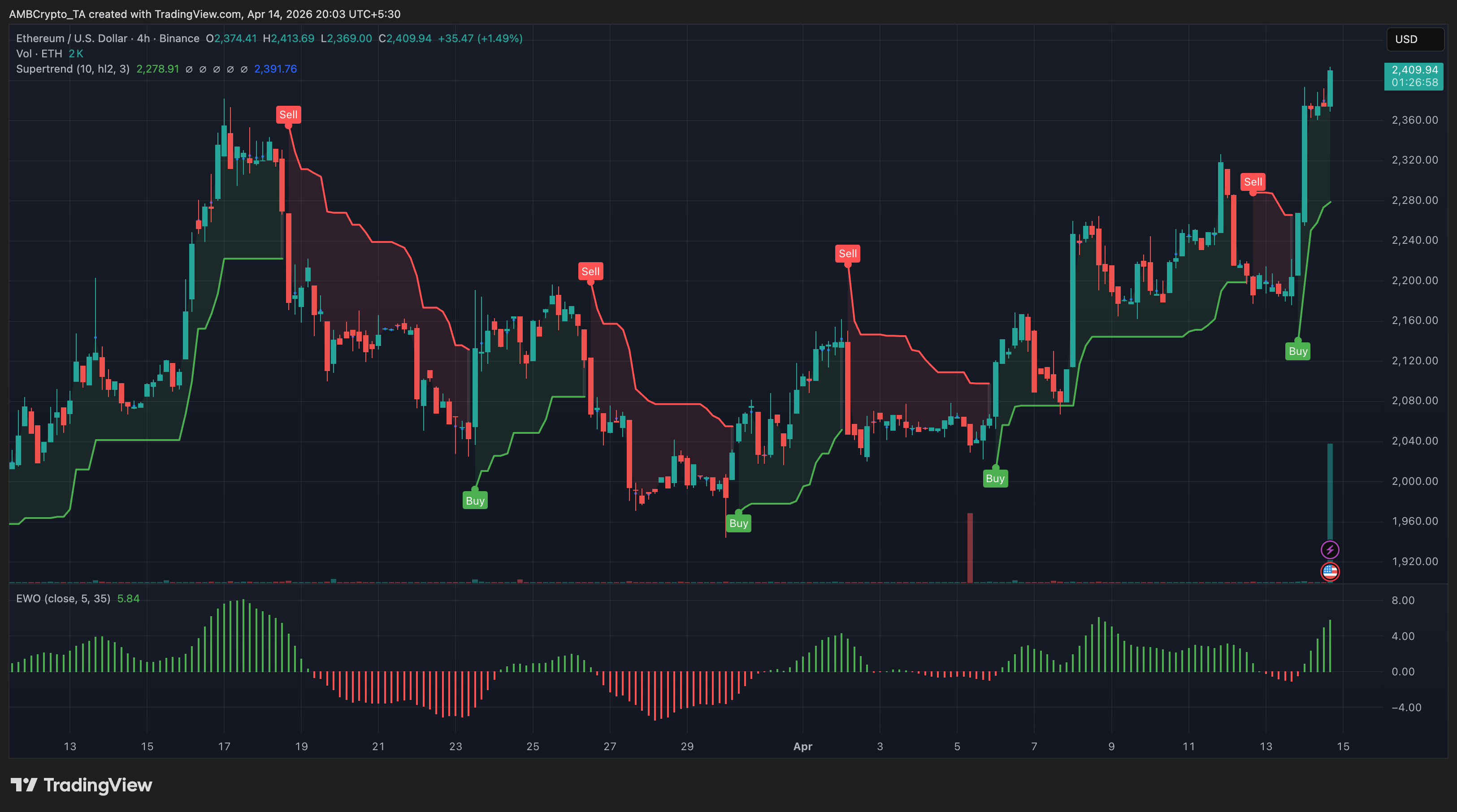
ETH surged toward $2,409, holding above Supertrend support as a strong volume spike reinforced bullish continuation.
EWO expanded further into positive territory, signaling strengthening momentum after the recent consolidation phase.
What you should know:
Ethereum accelerated from the $2,250 region and advanced toward $2,409, extending its uptrend with firm higher highs. The Supertrend remained positioned below price near $2,280, confirming sustained bullish control, while EWO’s rising green bars reflected growing upside momentum. The latest breakout was backed by a notable surge in volume, pointing to strong participation during the move. This rally aligned with $187M in weekly spot ETF inflows and a 41% jump in daily network transactions, alongside roughly $123M in short liquidations that added buying pressure. Immediate support stands near $2,300, while resistance is seen around $2,400.
Siren (SIREN)
Key points:
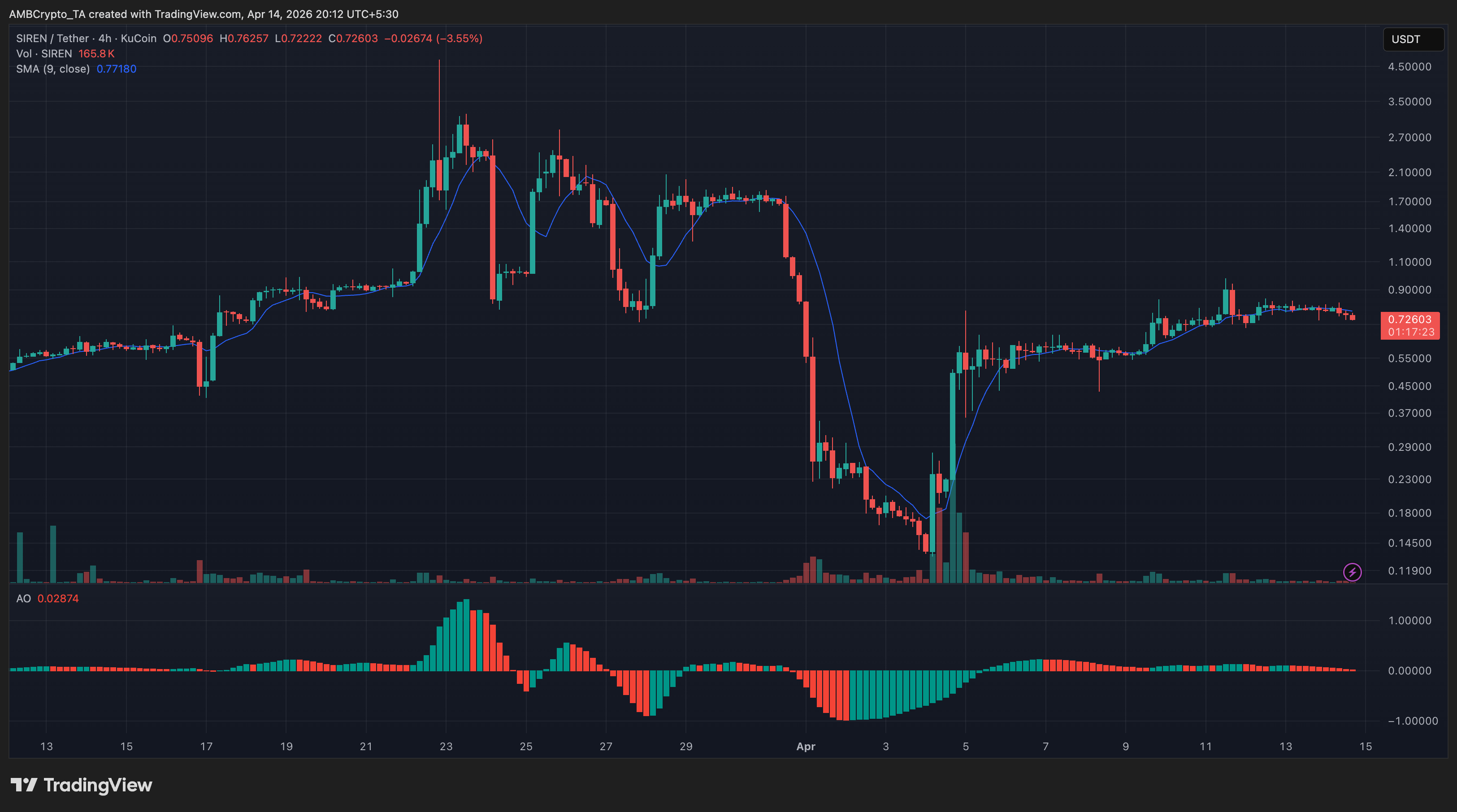
SIREN slipped toward $0.72 after losing traction near $0.80, with price falling below the flattening 9 SMA.
Awesome Oscillator turned red near the zero line as volume cooled, signaling fading momentum after the rebound.
What you should know:
SIREN pulled back from its recent recovery highs and drifted lower toward $0.72, struggling to maintain upside momentum after failing near the $0.80–$0.85 zone. The 9 SMA flattened and began acting as near-term resistance, reflecting weakening bullish control, while the Awesome Oscillator shifted into red, pointing to a slowdown in buying strength. Volume tapered off compared to the earlier rebound phase, suggesting reduced participation during the latest move. This weakness followed a sharp 163% rally that saw price peak near $2.44 before entering a distribution phase, with profit-taking and sentiment-driven selling now shaping the trend. Immediate support sits near $0.70, while resistance is seen around $0.80.
How was today's newsletter? |