- Unhashed Newsletter
- Posts
- U.S. blockade adds pressure to Bitcoin
U.S. blockade adds pressure to Bitcoin

Reading time: 5 minutes
ETH and BTC treasuries expand on institutional demand

Key points:
BitMine deployed $157M into ETH, while Strategy added $1B in Bitcoin, accelerating treasury accumulation.
Institutional demand continues to rise even as retail participation remains subdued.
News - Institutional crypto accumulation remained strong last week, with major treasury firms expanding positions across both Ethereum and Bitcoin.
BitMine Immersion Technologies acquired 71,524 ETH worth roughly $157 million, pushing its holdings to about 4.87 million ETH, or just over 4% of the circulating supply. The firm is now over 80% of the way toward its target of holding 5% of all ETH.
Meanwhile, Michael Saylor’s Strategy added 13,927 BTC for $1 billion, lifting its total to nearly 781,000 BTC. The company now sits within reach of overtaking BlackRock’s spot Bitcoin ETF holdings.
Ethereum builds a yield-driven case - BitMine has staked over 3.3 million ETH, generating around $212 million in annualized revenue. Chairman Tom Lee has positioned ETH as a strategic asset, citing its recent outperformance during geopolitical tensions and its growing role in blockchain-based infrastructure.
Bitcoin demand expands across segments - Strategy’s purchases, funded through preferred share issuances, highlight evolving capital strategies for Bitcoin accumulation. Beyond large U.S. firms, adoption is spreading geographically.
In the UK, Nigel Farage-backed Stack BTC added $2.7 million in Bitcoin to its treasury, adding a UK political dimension to the broader treasury adoption trend.
Institutions lead, retail lags - This wave of accumulation aligns with a broader shift. Market participants note that institutions are accelerating their exposure, while retail activity remains muted, pointing to a cycle where institutional participation is rising even as retail activity remains weak.
Bitcoin slides as U.S. naval blockade, selling pressure build

Key points:
Bitcoin slipped toward $71K as geopolitical tensions and persistent profit-taking capped upside.
Institutional inflows remained strong, even as market sentiment weakened.
News - Crypto markets lost momentum over the weekend as geopolitical tensions resurfaced and selling pressure intensified across major assets.
Bitcoin dropped from above $73K to around $71K after U.S.-Iran negotiations failed, followed by a U.S. naval blockade that pushed oil prices higher. Ether also declined, falling below $2.2K, while overall sentiment turned cautious.
At the same time, on-chain data highlighted persistent resistance to further upside. More than $20 million worth of Bitcoin was being sold per hour above the $70K level, reinforcing the $70K–$80K range as a distribution zone where rallies continue to meet supply.
Macro shocks meet defensive positioning - Oil climbed back above $100 per barrel, adding pressure to risk assets as traders adjusted positioning amid rising geopolitical uncertainty.
Derivatives activity reflected this shift. Demand for downside protection increased, with put options trading at a premium and short positioning rising across several major tokens. Bitcoin also remained below the $74K resistance level, extending a range that has held for months.
Institutional demand holds firm - Despite the volatility, institutional interest showed resilience. Crypto ETPs recorded $1.1 billion in inflows last week, with Bitcoin products alone attracting $871 million.
Elsewhere, a large XRP transfer, nearly $119 million, moved to a Coinbase-linked address, a type of transaction often associated with potential selling or repositioning by major holders.
A split market dynamic - The divergence is becoming clearer. Institutional participation continues to rise, shaping a market increasingly influenced by macro conditions and large players.
Attacker mints 1B bridged DOT, walks away with $237K

Key points:
A Hyperbridge exploit allowed 1 billion bridged DOT tokens to be minted and dumped for about $237K.
The incident exposed bridge vulnerabilities, though Polkadot’s core network remained unaffected.
News - A cross-chain exploit targeting Hyperbridge has reignited concerns around bridge security after an attacker minted 1 billion bridged Polkadot (DOT) tokens on Ethereum, only to extract about $237,000 in value.
The attacker used a forged cross-chain message to gain admin control over the bridged DOT token contract, enabling the minting of 1 billion bridged DOT tokens in a single transaction. The tokens were then dumped into liquidity pools, returning roughly 108.2 ETH.
Despite the scale of the mint, the actual profit remained limited due to shallow liquidity in the Ethereum-based DOT pool. Native DOT tokens and the broader Polkadot ecosystem were not affected, with the exploit confined to assets bridged via Hyperbridge.
Bridge flaw exposes deeper risks - Initial findings point to a vulnerability in Hyperbridge’s message validation process, where a forged proof bypassed verification checks and altered contract permissions. The protocol paused operations following the incident as investigations began.
Security researchers flagged potential issues with proof validation and message handling, though the final root cause has not yet been confirmed. Similar bridge-related vulnerabilities have been highlighted as a recurring weak point in cross-chain infrastructure.
Damage limited, concerns remain - While the attacker’s gains were capped, the exploit underscores how liquidity depth can influence the impact of such attacks. In deeper pools or higher-value assets, similar flaws could result in significantly larger losses.
The incident adds to a series of recent exploits, even as overall losses across decentralized finance protocols have declined year over year.
WLFI mints $25M USD1 as governance clash escalates

Key points:
WLFI minted $25M in USD1 and burned $3M, adding a net $22M to circulation amid lending fallout.
Governance concerns and a public dispute with Justin Sun have intensified scrutiny around the project.
News - World Liberty Financial (WLFI) expanded its stablecoin supply this week, minting $25 million in USD1 while simultaneously burning $3 million, resulting in a net $22 million increase in circulation.
The move comes days after the Trump-linked project said it had repaid $25 million of a roughly $75 million borrowing tied to its governance token. That loan had pushed a USD1 lending pool on Dolomite to near full utilization, limiting withdrawals for other users.
While the mint was executed via BitGo custody infrastructure, the reason behind the $3 million burn and the intended use of newly created tokens remain undisclosed.
Governance concerns come into focus - Scrutiny around WLFI’s structure has grown following criticism from Justin Sun, who questioned the control of key wallets and alleged that certain accounts could freeze token holders. He also pointed to a concentration of voting power among a small group of wallets, raising concerns about centralized decision-making.
WLFI has rejected the claims and signaled potential legal action, escalating what was previously a governance dispute into a public confrontation.
Market signals remain mixed - The broader ecosystem around WLFI-linked assets reflects this uncertainty. The TRUMP memecoin saw whale accumulation ahead of a scheduled Mar-a-Lago event for top holders, even as prices declined.
Large holders have continued to build positions despite price weakness, highlighting continued accumulation by large holders despite price declines.
The 15-Minute Retirement Plan

Retirement savings face two quiet threats: cash flow gaps and inflation eroding purchasing power over time. The 15-Minute Retirement Plan helps investors with $1,000,000 or more account for both and build a portfolio designed to last the distance.
More stories from the crypto ecosystem
Did you know?
The biggest buyer of U.S. debt in crypto is not an ETF giant, but Tether: By the end of 2025, Tether held over $120 billion in U.S. Treasuries, quietly positioning itself among the world’s largest holders of government debt.
South Korea’s stablecoin demand got so intense that USDT rarely traded at $1: In 2025, Tether traded at a premium on Korean exchanges for most of the year, reflecting persistent local demand and capital flow imbalances.
Bitcoin miners are now chasing wasted oilfield gas instead of just grid power: In 2024, MARA Holdings began running mining operations using stranded natural gas at U.S. oil sites, turning otherwise flared energy into Bitcoin production.
Trade from the subway, golf course, or toilet
Liquid enables users to go long or short on any market from your phone or desktop 24/7.
No matter what time of day it is or where you are, you can monitor the situation with Liquid.
Top 3 coins of the day
XDC Network (XDC)
Key points:
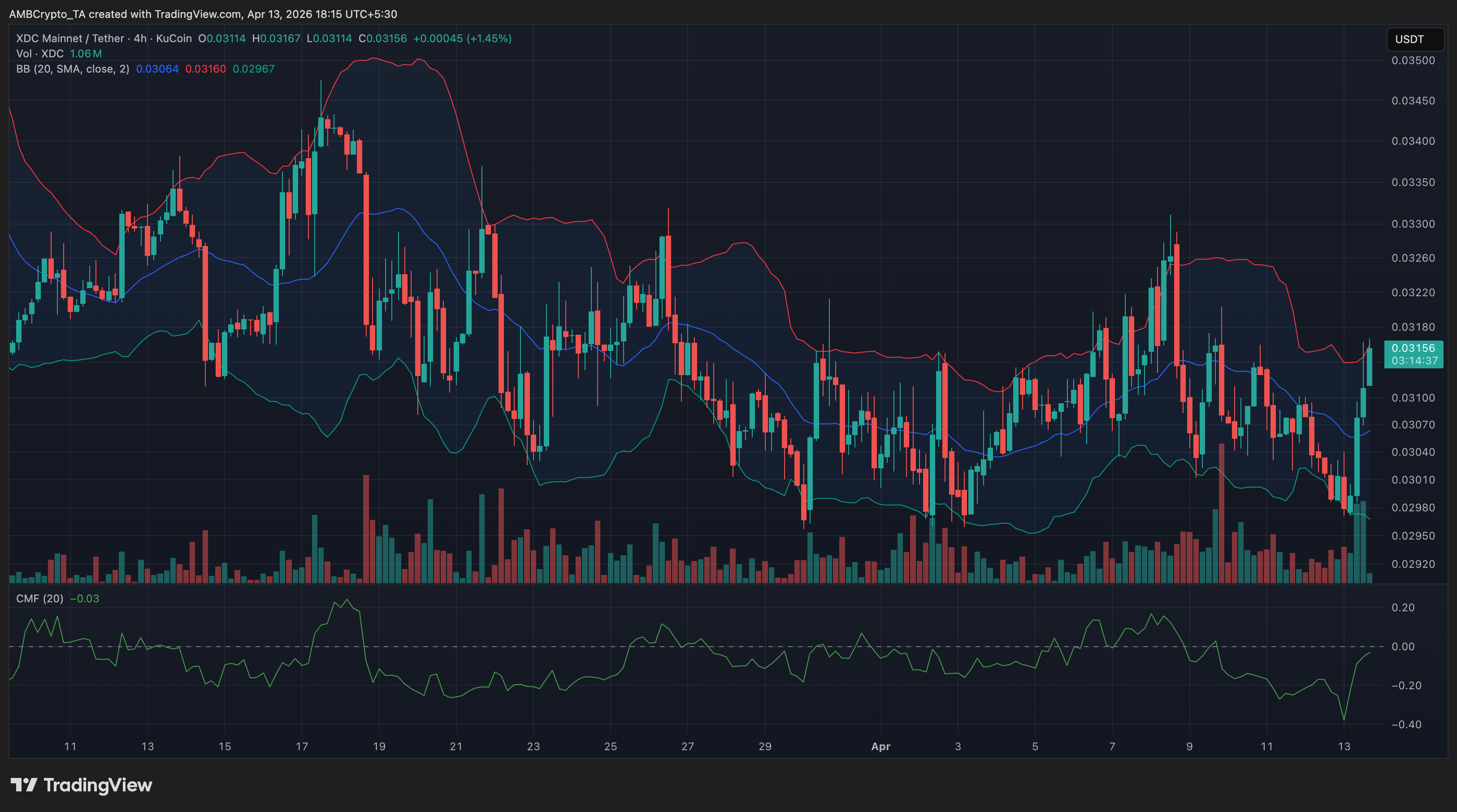
XDC rebounded from the $0.029 zone, briefly piercing the upper Bollinger Band before facing rejection near $0.032.
CMF recovered toward neutral, signaling easing outflows, while volume spikes hinted at early buying interest.
What you should know:
XDC climbed back above its mid-band support near $0.031 after bouncing off the lower Bollinger Band, with the latest candle testing and slightly exceeding the upper band before pulling back. This move suggested a volatility-driven recovery rather than a confirmed breakout, especially as resistance near $0.032–$0.0325 held firm. CMF improved from deeply negative levels to near neutral, indicating selling pressure had weakened, though sustained inflows were still limited. The uptick coincided with renewed attention on XDC’s ecosystem, including its $717M+ real-world asset milestone, the ComTech Gold launch on April 7, and its April 6 AUDDapt partnership targeting SME cross-border payments.
Worldcoin (WLD)
Key points:
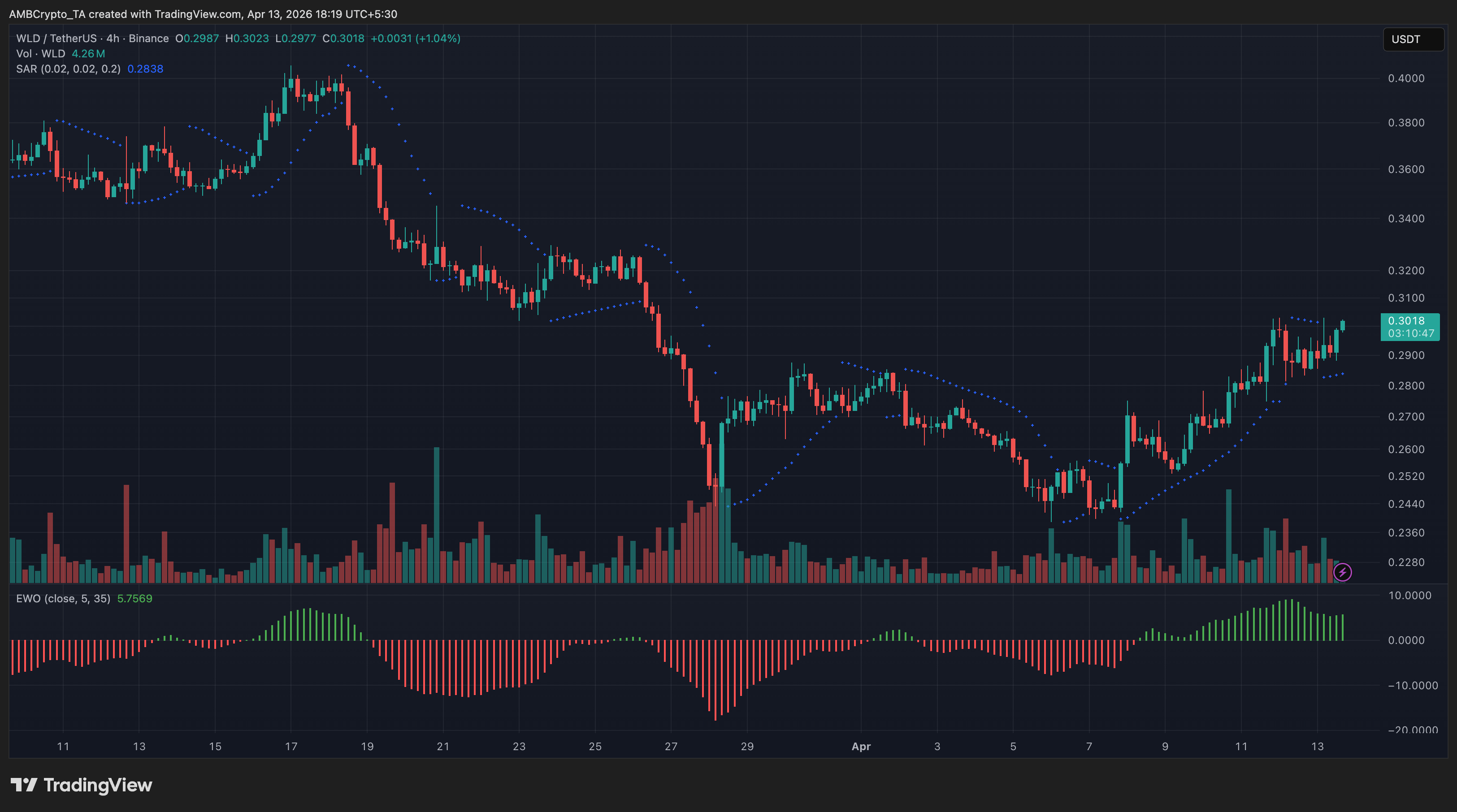
WLD pushed past $0.30 after forming higher lows, with Parabolic SAR confirming a sustained bullish trend shift.
EWO expanded deeper into positive territory as steady volume inflows supported the ongoing recovery.
What you should know:
Worldcoin advanced from its $0.24 base and stabilized above the $0.29 support zone before attempting a move beyond $0.30. The Parabolic SAR flipped below price and continued trailing upward, signaling that the uptrend remained intact, while EWO’s rising green bars reflected strengthening momentum. Volume picked up consistently during the climb, pointing to gradual accumulation rather than a one-off spike. The move coincided with growing investor focus on the upcoming 43% reduction in daily token unlocks set for July 2026, alongside continued whale accumulation in the sub-$0.30 range. Immediate resistance stands near $0.302, while $0.29 remains the key support to watch.
Polkadot (DOT)

Key points:
DOT slid toward $1.17 after a sharp sell-off, with Parabolic SAR maintaining a firm bearish signal above price.
RSI dropped into oversold territory as heavy red volume confirmed strong distribution pressure.
What you should know:
Polkadot fell rapidly from the $1.24 region and broke below its recent consolidation range, with the latest candles reflecting sustained downside momentum. Parabolic SAR remained above price throughout, reinforcing the prevailing bearish trend, while RSI dipped near 30, highlighting intensified selling conditions. The drop was accompanied by one of the largest recent volume spikes, pointing to high-conviction exits. The move aligned with market reaction to the Hyperbridge exploit, where forged messages enabled the minting and dumping of fake DOT tokens on Ethereum, alongside temporary deposit and withdrawal suspensions by major exchanges like Upbit and Bithumb. Immediate support sits near $1.15, while resistance is seen around $1.22.
How was today's newsletter? |