- Unhashed Newsletter
- Posts
- Wall Street slashes crypto price outlook
Wall Street slashes crypto price outlook

Reading time: 5 minutes
Citi cuts Bitcoin, Ethereum targets on policy delays
Key points:
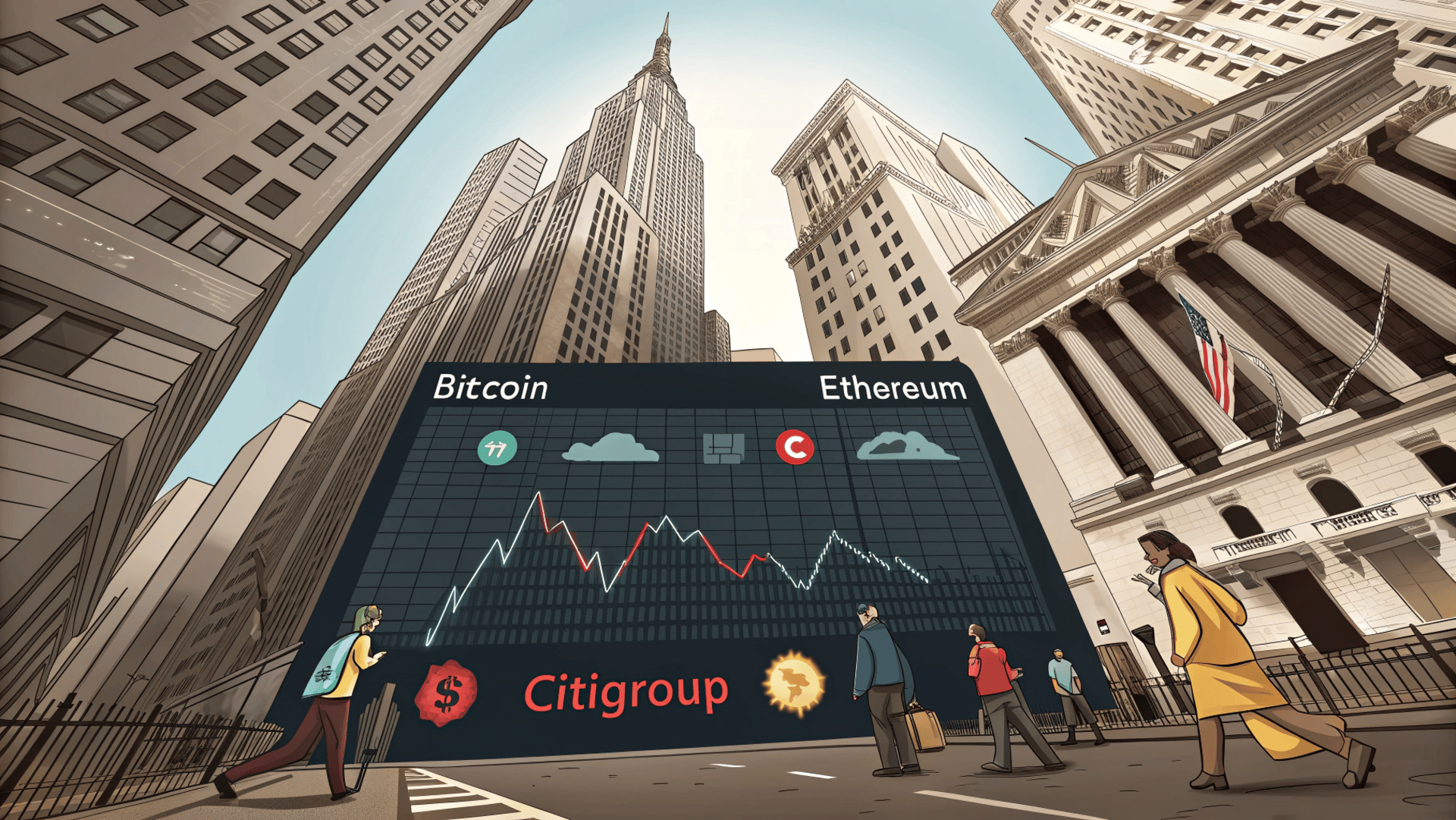
Citigroup cut its 12-month targets for Bitcoin to $112,000 and Ethereum to $3,175, citing weaker ETF flow expectations and stalled U.S. regulation.
The bank indicated that near-term market direction could remain sensitive to legislative progress and network activity trends.
News - Wall Street investment bank Citigroup has turned more cautious on the crypto market, lowering its outlook for Bitcoin and Ethereum as key institutional catalysts lose momentum.
In a recent client note, Citi’s Alex Saunders, Head of Global Quant Macro Strategy, pointed to delays in U.S. digital asset legislation, softer exchange-traded fund (ETF) inflows, and weakening on-chain activity as factors shaping the bank’s updated expectations.
The revised forecast now sees Bitcoin reaching $112,000 within 12 months, down from a previous $143,000 projection. Ethereum’s target was also trimmed to $3,175 from $4,304. At the time of the update, Bitcoin was trading near $74,000 while Ethereum hovered around $2,330, still suggesting upside relative to the new estimates.
ETF demand continues to be viewed as the primary growth driver, though Citi reduced its inflow assumptions to about $10 billion for Bitcoin products and $2.5 billion for Ethereum funds. Analysts noted that macro uncertainty has contributed to more measured inflow momentum in recent months.
Washington delays become market variable - The bank highlighted the stalled progress of the Digital Asset Market Clarity Act as a central risk factor. While the legislation cleared the House, disagreements in the Senate over stablecoin rules, anti-money laundering (AML) measures, and ethics provisions have slowed its path forward. Citi warned that a narrowing window for regulatory action could delay potential catalysts tied to institutional participation.
Range trading likely as market waits - Citigroup identified $70,000 as a key psychological level for Bitcoin, suggesting prices may remain range-bound as investors monitor policy signals. The bank’s scenario analysis outlines a potential rally toward $165,000 for Bitcoin and $4,488 for Ethereum if adoption strengthens. Under recessionary conditions, however, prices could fall toward $58,000 and $1,198 respectively.
Despite the reduced forecasts, Citi maintained that long-term growth drivers such as ETF development and regulatory progress in other regions could still support the broader crypto cycle.
Strategy’s Bitcoin buying frenzy enters new phase

Key points:
Strategy bought over 22,000 BTC in one week after raising about $1.18B through preferred stock, signaling a shift in how it funds accumulation.
STRC trading below par has slowed fresh purchases, a development that has previously coincided with periods of Bitcoin price weakness.
News - Corporate Bitcoin giant Strategy is reshaping how it finances its aggressive accumulation campaign. The firm recently purchased 22,337 BTC in what became one of its largest acquisitions, funded primarily through issuance of its perpetual preferred stock series STRC rather than traditional common equity sales.
This marks a notable evolution in the company’s funding model. Issuance tied to STRC totaled roughly $1.18B in the week, far exceeding capital raised through common stock programs that historically supported its Bitcoin strategy. Strategy now holds more than 761,000 BTC, reinforcing its position as the largest corporate holder of the asset.
The scale of buying has also drawn attention to supply dynamics in the market. In recent weeks, the company acquired amounts of Bitcoin comparable to several weeks of new network issuance, highlighting the growing role of large corporate accumulation alongside traditional halving-driven supply changes.
Funding pressures begin to surface - Momentum in purchases has recently slowed after STRC slipped below its $100 par value. Since the company typically issues new preferred shares only when pricing conditions are favorable, the dip has constrained its ability to raise fresh capital through this channel. Historical instances of similar funding pauses have been followed by short-term Bitcoin pullbacks.
Strategy’s expanding preferred stock base also brings rising dividend obligations, now exceeding $1B annually. While the firm maintains USD reserves to manage these costs, the increased reliance on preferred capital underscores the ongoing funding demands tied to its accumulation strategy.
A different way to measure performance - Executive chairman Michael Saylor has framed the company’s strategy around proprietary metrics such as “BTC Gain,” which tracks changes in Bitcoin exposure per share rather than conventional accounting profit. The approach reflects Strategy’s continued focus on expanding its Bitcoin holdings even as market conditions and financing costs evolve.
Payments giants and banks accelerate stablecoin push

Key points:
Mastercard’s planned $1.8B acquisition of BVNK and PayPal’s global PYUSD rollout signal growing momentum in stablecoin-based payments.
U.S. regional banks are also testing tokenized deposit networks, highlighting rising competition over the future of digital money.
News - Global payments firms and traditional banks are stepping up efforts to modernize how money moves, with new initiatives centered on stablecoins and blockchain infrastructure. Mastercard has agreed to acquire stablecoin payments platform BVNK in a deal worth up to $1.8B, aiming to strengthen its ability to link traditional payment rails with onchain transactions.
BVNK provides technology that allows businesses to send and receive funds across major blockchain networks in more than 130 countries. The acquisition reflects Mastercard’s view that financial institutions will increasingly offer digital currency services, including stablecoins and tokenized deposits.
At the same time, PayPal is expanding access to its PYUSD stablecoin beyond the U.S. and U.K., enabling customers in a total of 70 markets to hold, send, and receive the dollar-pegged asset. The rollout is intended to reduce cross-border transfer costs while introducing rewards for users who maintain balances in PYUSD.
Banks explore regulated digital alternatives - Parallel developments are emerging within the banking sector. A coalition of U.S. regional lenders is building the Cari Network, a blockchain-based platform designed to move tokenized deposits instantly between institutions while keeping funds inside the regulated banking system.
The project, built on infrastructure linked to the ZKsync ecosystem, aims to combine the speed of crypto-native payment systems with regulatory safeguards such as deposit insurance and oversight. Participating banks plan to test issuance, transfers and redemption of tokenized deposits ahead of a broader rollout targeted for 2026.
Taken together, these moves underscore how competition to shape the next generation of global payments is intensifying, with stablecoins, tokenized deposits and traditional payment networks converging into a rapidly evolving financial landscape.
Argentina orders nationwide block on Polymarket

Key points:
A Buenos Aires court has ordered internet providers to block prediction market platform Polymarket across Argentina over unauthorized gambling concerns.
The ruling adds to a broader global regulatory pushback against prediction markets operating without local approval.
News - Argentina has moved to restrict access to crypto-based prediction market Polymarket after a court in Buenos Aires ruled that the platform was operating without proper authorization and exposed users to gambling-related risks. The order instructs telecom authorities and internet service providers to implement nationwide restrictions on the website and related domains.
The decision also directs Apple and Google to remove or limit access to Polymarket’s mobile applications for users in the country. The enforcement process is being carried out through Argentina’s communications regulator ENACOM following an investigation triggered by complaints from local gambling authorities.
Officials argued that Polymarket allowed users to place wagers on real-world events without robust identity or age verification safeguards, raising concerns about potential access by minors. Prosecutors described the service as functioning in practice like an online betting system despite its positioning as a prediction market.
Scrutiny intensifies after inflation market activity - Regulatory attention intensified after prediction contracts tied to Argentina’s February inflation data saw sharp activity ahead of the official release, prompting speculation that some participants may have traded on privileged information. Authorities have stated, however, that the court’s decision was primarily based on licensing and consumer protection considerations.
The latest action reflects growing global resistance to prediction market platforms. Access to Polymarket is already restricted or blocked in several jurisdictions, including parts of Europe and Latin America, as regulators examine whether such services fall under gambling laws.
The ruling underscores the growing regulatory pressure facing prediction market platforms as authorities focus on licensing, consumer safeguards, and legal classification.
More stories from the crypto ecosystem
Ethereum whales cash out $14mln as $136mln shorts burn – Next move for ETH?
Bitcoin near $76K – LTHs hold tight, BTC ETFs add almost $1B: What changed?
Zcash surges 20% after breakout – ZEC traders, watch THIS for next move
PENGU now trading at a make-or-break level – Is a 22% rally incoming?
Cardano leads top 10 with 10% gain – But sentiment says bulls aren’t back
Interesting facts
Bitcoin once started behaving like an NFT chain: In May 2023, Bitcoin’s daily transaction count hit a record 682,000 as Ordinals activity surged, showing how non-payment use cases were suddenly reshaping network traffic.
One mining pool got too close to controlling Bitcoin: In June 2014, mining pool GHash.io briefly crossed the 51% hash-power threshold, forcing a major decentralization scare and later a voluntary pledge to stay below 40%.
When Bitcoin briefly broke its own scarcity rule: In August 2010, a bug in Bitcoin allowed a transaction to create 184,467,440,737 BTC in a single block before the network was patched and the bad transaction was rolled back.
Go from AI overwhelmed to AI savvy professional

AI will eliminate 300 million jobs in the next 5 years.
Yours doesn't have to be one of them.
Here's how to future-proof your career:
Join the Superhuman AI newsletter - read by 1M+ professionals
Learn AI skills in 3 mins a day
Become the AI expert on your team
Top 3 coins of the day
Kaspa (KAS)

Key points:
KAS advanced toward the $0.036 area after breaking out of its recent sideways band, reflecting renewed short-term buying momentum.
The Parabolic SAR flipped below price while RSI climbed into the upper zone, with rising volume reinforcing the latest upside move.
What you should know:
Kaspa strengthened in recent sessions, rising from the $0.032 base to near $0.036 as momentum improved following weeks of consolidation. The move unfolded as buying activity picked up, helping price push away from its recent support cluster. Structurally, the $0.031 to $0.033 region now acts as the nearest support zone, while the next reaction barrier stands around $0.036 to $0.038. Momentum indicators also signaled firm upside pressure, with RSI entering elevated territory after remaining subdued through much of February. Beyond chart signals, sentiment has been supported by a sharp rise in network usage and anticipation surrounding the May hard fork aimed at enabling smart contract functionality. Continued whale accumulation and improvements introduced through the latest node software release have also contributed to renewed speculative interest.
DeXe (DEXE)

Key points:
DEXE climbed to around $5.44 after extending its recent recovery, marking a steady daily gain as buyers continued to build momentum.
Price moved above most layers of the MA ribbon while the Awesome Oscillator expanded further into positive territory, reflecting strengthening bullish pressure.
What you should know:
DEXE advanced after sustaining a strong recovery phase that followed its February bottom near the $2 region. Recent sessions showed a sequence of higher highs and higher lows, with the latest candle pushing firmly above the bulk of the MA ribbon. This shift suggested improving short to medium-term trend strength, even as the uppermost ribbon band still acts as a resistance area to monitor.
Volume picked up notably during the breakout leg, indicating rising market participation as the token retested the $5 zone. The Awesome Oscillator remained in green territory and continued to build positive histogram bars, signaling persistent upward momentum.
Fundamentally, renewed investor interest in DAO governance infrastructure and continued capital rotation into niche altcoin sectors likely supported the move. The $5 level now acts as immediate support, while the zone near $5.60 remains the next resistance region to watch.
Hyperliquid (HYPE)
Key points:
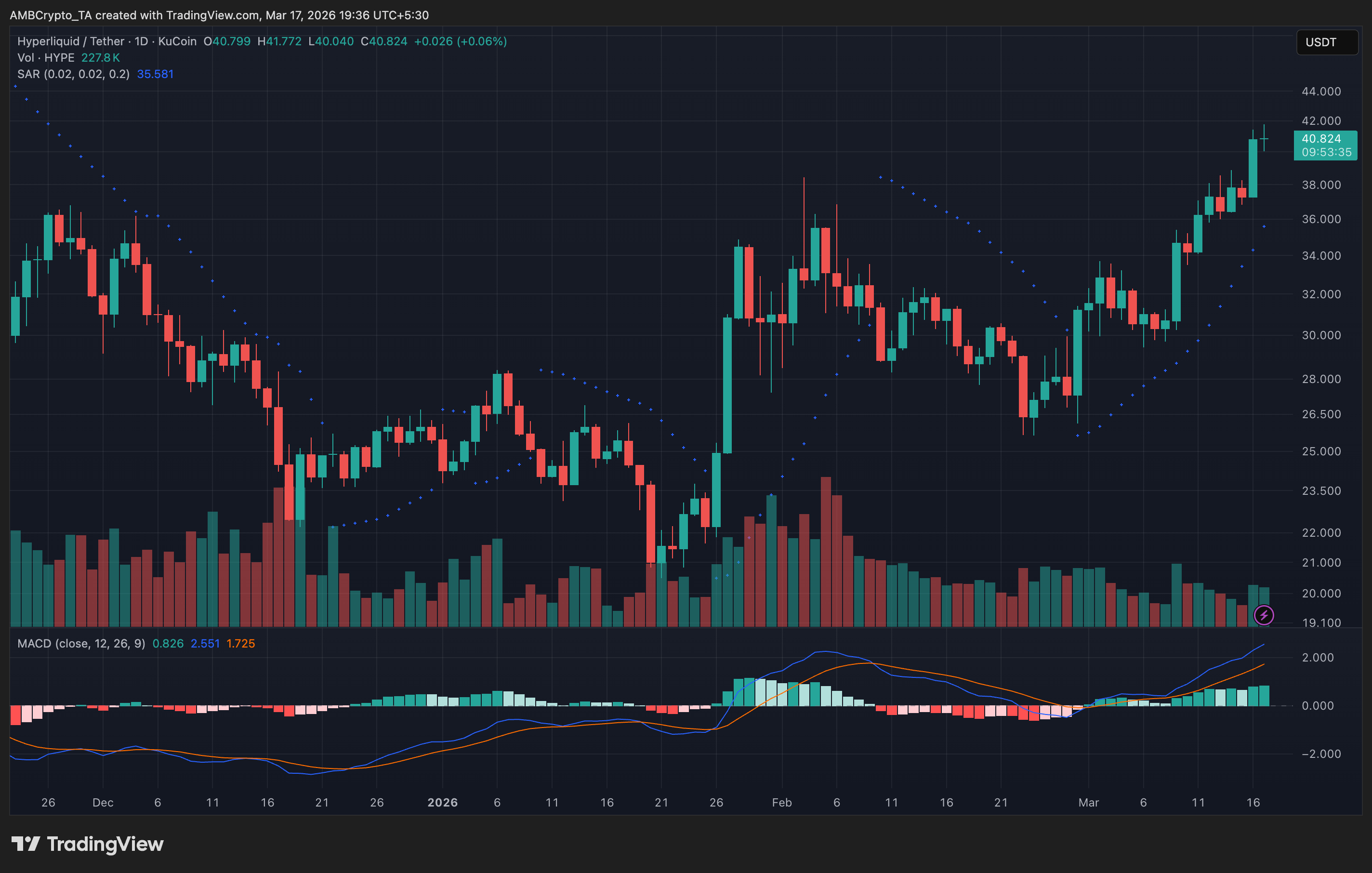
After consolidating earlier in the month, HYPE accelerated toward the $41 zone, extending its rebound with a decisive bullish continuation.
Parabolic SAR dots stayed positioned below the candles while the MACD trend strengthened above the signal line, reflecting improving upside momentum.
What you should know:
Hyperliquid gained traction following a mid-term recovery phase that began after its late-February decline. Price action shifted into a sequence of sustained advances, with the latest candles approaching a key swing-high region near $41–$42. This progression highlighted firm buyer conviction as the token attempted to build on its recent breakout structure.
Trading participation expanded during the initial rally leg and remained relatively stable in subsequent sessions, pointing to consistent interest rather than a brief speculative spike. Momentum indicators also improved, with the MACD histogram widening in positive territory and reinforcing the ongoing upward bias.
External sentiment may have added fuel to the move. Rising derivatives activity on the platform, record open interest levels, and demand supported by its fee-driven buyback model likely strengthened bullish positioning. The $37 zone serves as near-term support, while the next resistance band lies near $42.
How was today's newsletter? |