- Unhashed Newsletter
- Posts
- XRP dominates while U.S. sits out
XRP dominates while U.S. sits out

Reading time: 5 minutes
Binance rolls out trading guardrails after volatility concerns

Key points:
Binance will roll out a new execution rule from April 14 to prevent trades at extreme prices during volatile market conditions.
The update comes alongside higher institutional leverage offerings and uncertainty around its compliance leadership.
News - Binance is rolling out a new trading safeguard designed to limit abnormal price executions during periods of extreme volatility.
The Spot Price Range Execution Rule (PRER), launching gradually from April 14, restricts trades from executing outside a dynamic price band based on recent activity. The mechanism applies to taker orders, canceling any unfilled portion that falls beyond the defined range, while leaving normal trading largely unaffected.
After the October 2025 market dislocation - The move follows the October 2025 market event, when over $19.13B in leveraged positions were liquidated within 24 hours, impacting more than 1.6M traders. On Binance, some assets briefly traded near zero as thin liquidity and stale orders triggered extreme price dislocations.
PRER is designed to address this risk by anchoring executions to a moving reference price, reducing the likelihood of distorted fills during stress.
Institutional expansion and compliance developments - Alongside this, Binance has expanded its institutional loan offering, raising leverage limits to 5x, increasing LTV ratios, and introducing fixed-term loans.
However, the update comes as Chief Compliance Officer Noah Perlman is reportedly in discussions to exit, following a series of senior compliance departures.
These developments combine new execution safeguards with expanded institutional services at the exchange.
XRP leads inflows as Switzerland dominates global demand

Key points:
Crypto investment products recorded $224M in inflows, with XRP contributing over half of the total.
Switzerland accounted for the majority of regional activity, while U.S. ETF participation remained limited.
News - Crypto investment products saw $224M in inflows last week, reversing the prior week’s $414M outflow, though demand remained highly concentrated across regions and assets.
XRP led all inflows with about $119.6M, marking its strongest weekly performance since mid-December 2025 and pushing its year-to-date inflows to $159M.
Switzerland leads regional inflows - Switzerland accounted for roughly $157M of total inflows, nearly 70% of the global figure. Germany, the United States, and Canada contributed far smaller amounts, reflecting the distribution of activity across regions during the week.
Most XRP demand came from European and international products, while U.S. spot XRP ETFs recorded minimal flows. Bitcoin saw $107M in inflows, though only a small share came from U.S. ETFs, which remain negative year-to-date.
Diverging signals across the market - Ethereum continued to lag, posting about $53M in outflows amid ongoing uncertainty tied to the Digital Asset Market Clarity Act. Solana attracted roughly $35M, while short-Bitcoin products saw renewed inflows, indicating continued hedging activity.
Macro conditions also weighed on sentiment, with stronger U.S. retail data and shifting policy expectations reversing part of the week’s gains.
Meanwhile, XRP’s onchain data shows 43% of supply remains in profit, alongside continued realized losses and a setup pointing to potential downside toward $1.10. Also, at its latest Tokyo conference, Ripple projected $33T in onchain stablecoin volume for 2026 as part of its messaging around stablecoin adoption.
Milei’s LIBRA links questioned after new call records surface

Key points:
Investigators found seven calls between Javier Milei and a LIBRA-linked entrepreneur on the token’s launch night.
The evidence adds scrutiny to an ongoing probe into a collapse that erased over $250M in investor funds.
News - Newly surfaced phone records, reported by The New York Times, have raised fresh questions about Argentine President Javier Milei’s connection to the failed LIBRA token, following earlier claims that he had no involvement.
According to logs obtained by federal prosecutors and reviewed by The New York Times, Milei exchanged seven calls with crypto entrepreneur Mauricio Novelli on February 14, 2025, the same night he promoted the token on X. The calls occurred before and after the post, though their contents remain unknown.
From endorsement to collapse - Milei’s post promoted LIBRA as a way to support small businesses, briefly pushing its market capitalization above $4B. The token then lost more than 96% of its value from its peak, with investor losses estimated at around $250M.
The fallout triggered fraud complaints, calls for impeachment, and a federal investigation that remains ongoing, with Milei named as a person of interest.
New evidence adds to ongoing probe - Milei has denied any connection to the project, describing his post as support for a private venture. Argentina’s Anti-Corruption Office previously cleared him of violating public ethics rules, stating the post was made in a personal capacity.
Investigators have also recovered draft documents from Novelli’s phone referencing a potential $5M agreement tied to the token’s promotion. The document did not specify who would receive the funds, and no evidence has confirmed that Milei received any payments.
FBI: Americans lose $11.3B to crypto scams as fraud accelerates

Key points:
Americans reported over $11.3B in crypto-related fraud losses in 2025, up 22% year over year
Investment scams dominated, with older victims accounting for a significant share of total losses
News - Americans lost more than $11.3B to cryptocurrency-related scams in 2025, according to the FBI’s Internet Crime Complaint Center, marking a 22% increase from the previous year. The losses accounted for a large share of the $20.8B in total cybercrime losses reported across more than 1M complaints.
Crypto-related cases continued to rise, with over 181,000 complaints filed during the year. The data highlights how digital assets remain a central payment method in online fraud schemes.
Investment scams remain the core driver - Investment-related fraud generated over $7.2B in losses, making it the largest category by a wide margin. These scams often involve long-term social engineering, where victims are approached through messaging apps, social platforms, or dating sites and directed to fraudulent investment platforms.
Many of these operations are linked to organized criminal groups in Southeast Asia that use forced labor and coordinated scripts to target victims globally. The average reported loss stood at $62,604, with nearly 18,600 victims each losing more than $100,000.
Older victims and evolving tactics - Americans aged 60 and above accounted for roughly $4.4B in losses, the highest among all demographics. Crypto ATM scams and recovery fraud also increased, with the FBI report showing scammers continued targeting easily used payment channels and previous victims.
The FBI also flagged the growing role of artificial intelligence, with over 22,000 AI-related complaints contributing to significant losses. Despite enforcement efforts such as Operation Level Up, reported losses continued rising as scam methods grew more sophisticated.
The 15-Minute Retirement Plan

Retirement savings face two quiet threats: cash flow gaps and inflation eroding purchasing power over time. The 15-Minute Retirement Plan helps investors with $1,000,000 or more account for both and build a portfolio designed to last the distance.
More stories from the crypto ecosystem
Interesting facts
U.S. regulators recently outlined how core crypto activities may be classified: The U.S. Securities and Exchange Commission (SEC) clarified in March 2026 how airdrops, staking, mining, and wrapped assets may be treated under federal securities laws, signaling a shift toward clearer crypto classification frameworks.
Tokenized Treasuries are no longer a niche experiment: On RWA.xyz, tokenized U.S. Treasuries stood at $12.85B in total value with 59,004 holders, showing how onchain fixed-income products have become one of crypto’s most established real-world asset categories.
USDC’s reserve model is now deeply tied to traditional money markets: Circle says USDC is backed 100% by highly liquid cash and cash-equivalent assets, with the majority of reserves held in the Circle Reserve Fund, an SEC-registered 2a-7 government money market fund.
The Best Place to Invest $1,000 Right Now

This AI tech could go down in history as the crown jewel of Elon's career. It could send ChatGPT offline forever and trigger a 70X investment boom. Watch the free presentation.
Top 3 coins of the day
Siren (SIREN)
Key points:
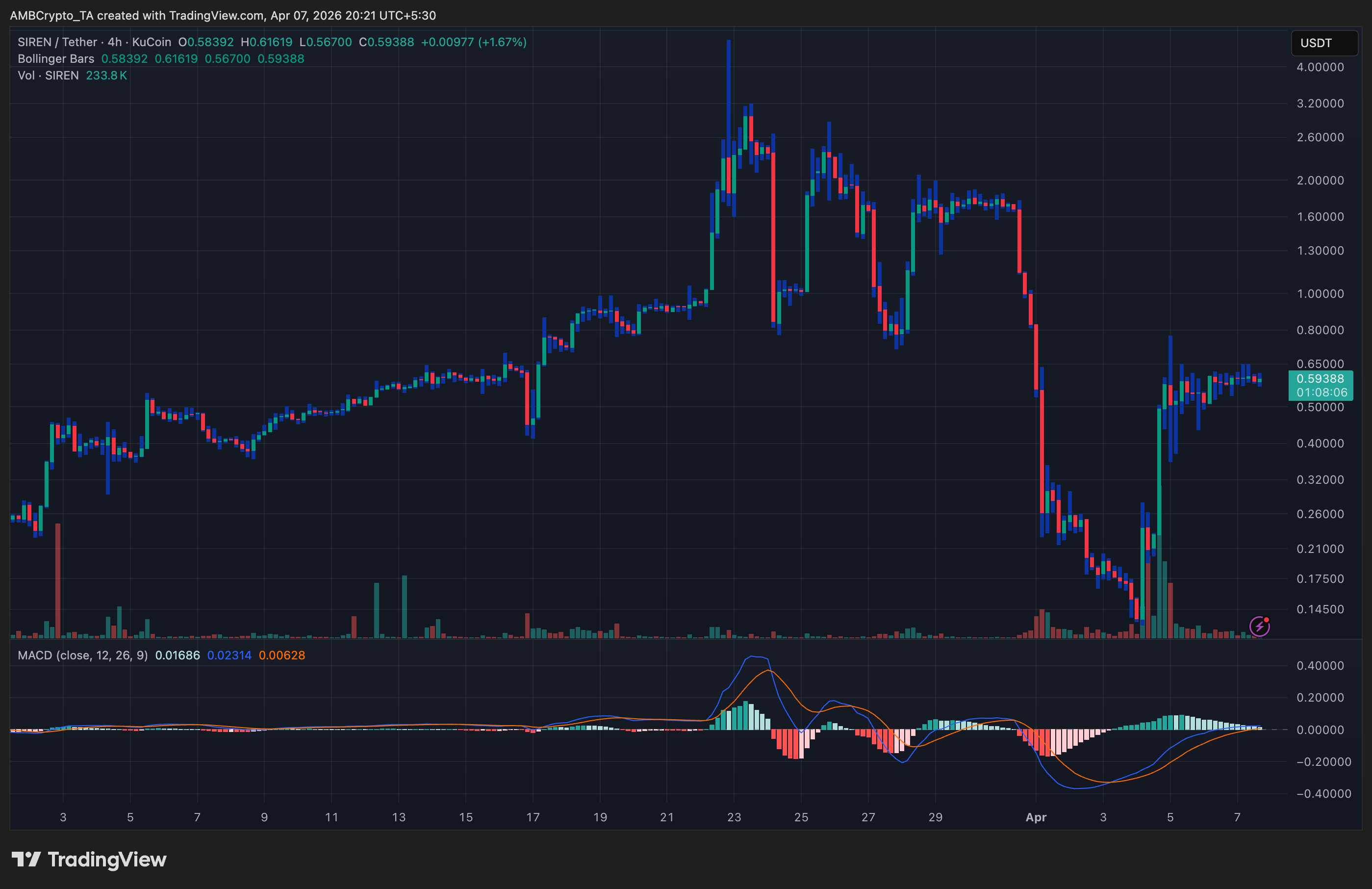
SIREN steadied near $0.59 after rebounding sharply from sub-$0.40 levels, but price continued to stall below the $0.60–$0.65 resistance zone.
Bullish momentum persisted with the MACD histogram remaining faintly green, though the bars have gradually shortened, signaling slowing upside strength.
What you should know:
SIREN’s recent price action reflected a pause rather than continuation, with the token holding near $0.58–$0.60 after a rapid recovery from its earlier collapse. The bounce followed a steep 67–70% weekly decline, drawing in dip buyers as AI-themed tokens gained traction, positioning SIREN among short-term outperformers. On the chart, price hovered near the upper Bollinger zone without a decisive breakout, while the MACD histogram stayed positive but printed smaller yet fading green bars, indicating that bullish momentum was easing after the initial surge. Volume has also cooled compared to the spike seen during the rebound. Holding above $0.55 keeps the structure stable, while a move above $0.65 is needed to extend the recovery.
Zcash (ZEC)
Key points:
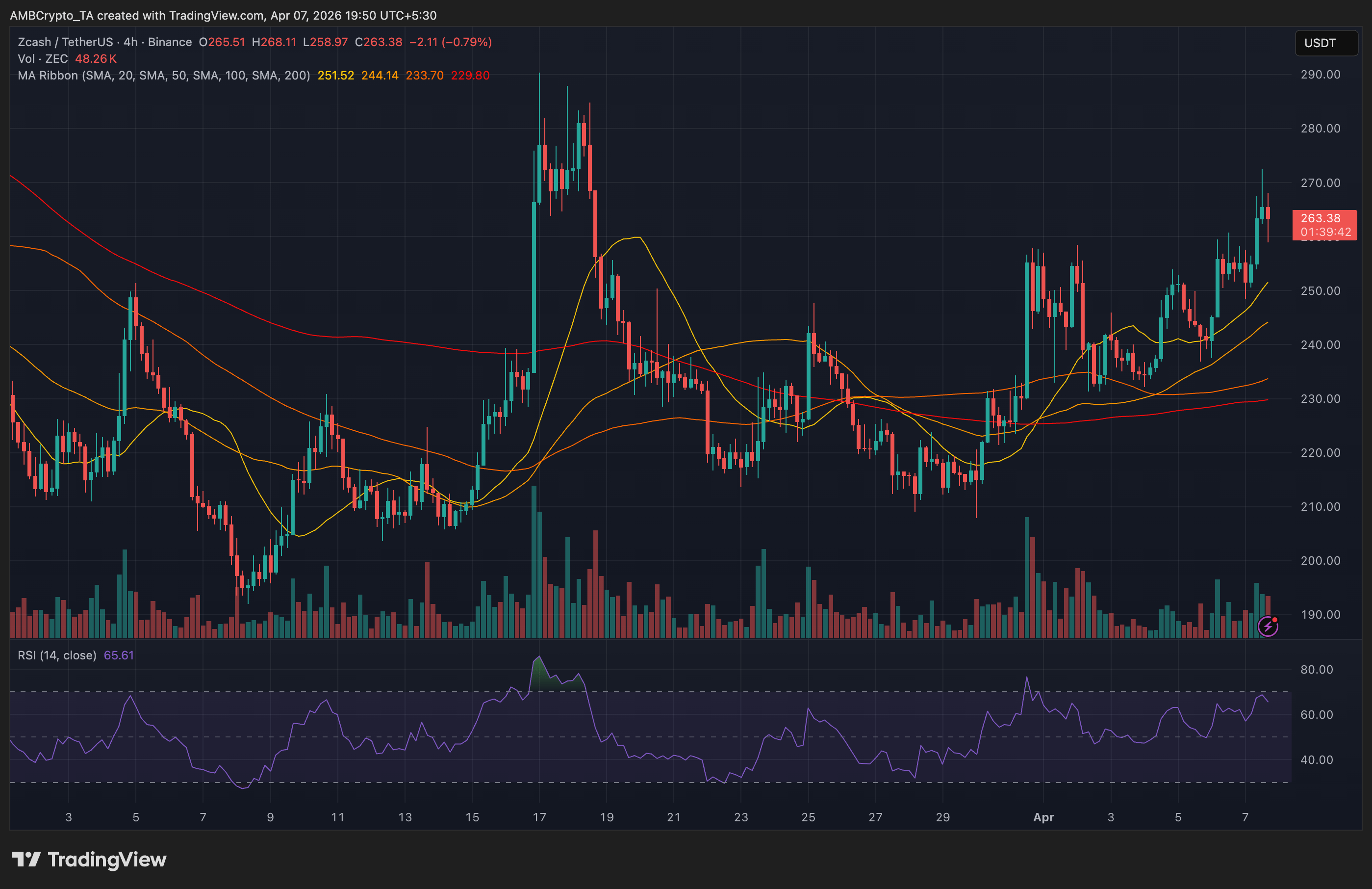
ZEC held near $263 after reclaiming $250, with price staying above the full MA ribbon despite a slight pullback in the latest session.
RSI remained in the mid-60s without entering overbought territory, while volume stayed steady through the advance.
What you should know:
Zcash held onto its recent gains above $250, trading near the $260–$265 zone after a brief pullback from local highs. The move coincided with renewed interest in privacy-focused tokens, supported by a $25 million funding round for the Zcash Open Development Lab and a broader rotation into the sector as Bitcoin strengthened. On the chart, price stayed positioned above all key moving averages, with the ribbon beginning to widen, reflecting a well-supported trend. RSI remained in the mid-60s, indicating sustained momentum without overheating, while volume stayed consistent rather than spiking. As long as ZEC holds above $250, the trend remains intact toward $270, while a drop below $240 could weaken the structure.
Monero (XMR)
Key points:
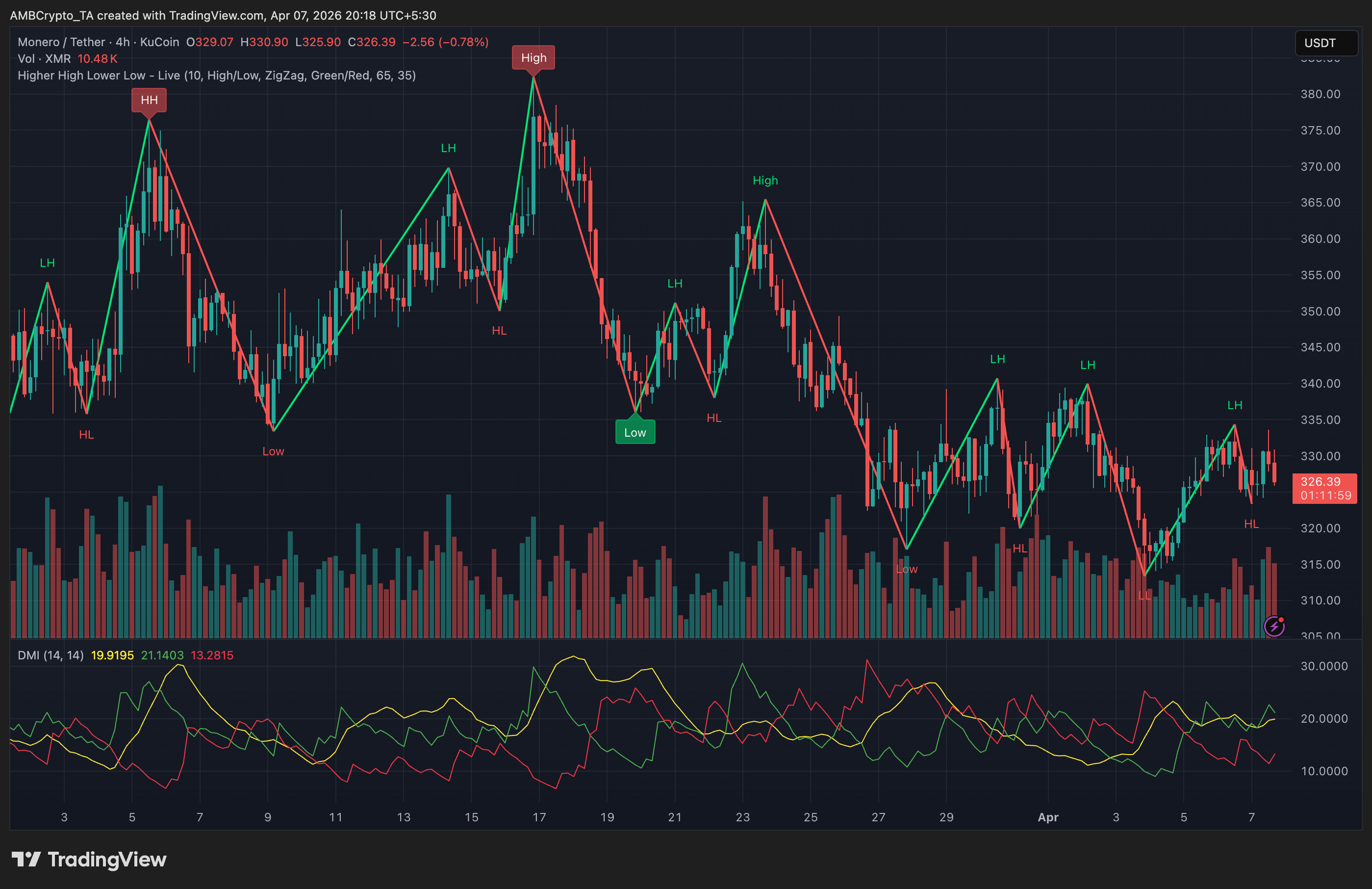
XMR hovered near $326 after failing to hold above the $333–$335 zone, with price pulling back despite forming a recent higher low.
Directional strength favored buyers as +DI stayed above -DI with a firm ADX, while volume showed repeated spikes during recent swings.
What you should know:
Monero’s latest move reflected a tug-of-war rather than a clean trend, with price slipping from the $333 area but still holding above a recently formed higher low near $320. The bounce followed renewed interest tied to THORChain integration expectations and growing chatter around the April 18 “Monero Run,” both of which supported buyer activity during dips. On the chart, the Higher High Lower Low structure showed an early attempt to rebuild, while the DMI indicated buyers retained control with +DI leading and ADX holding firm. Volume also printed multiple spikes during these swings, signaling active participation. Holding above $320 keeps recovery attempts alive toward $335–$340, while a drop below $315 could weaken this setup.
How was today's newsletter? |